Andrew L. Urban.
On the eve of tomorrow’s 60 Minutes (Nine Network) special report on the case of Sue Neill-Fraser, we take you back to her trial in the Supreme Court of Tasmania, for the murder of her partner Bob Chappell, alleged by the Director Public Prosecutions, Tim Ellis, to have taken place on board the couple’s recently purchased yacht, Four Winds. It’s the final day, October 15, 2010.
Of all the possible elements that we could highlight to show how things went wrong from the beginning, we have chosen three telling short passages from the trial transcript – and our short comments by way of cross examination.
JUSTICE BLOW SUMMING UP FOR THE JURY – with commentary by Urban:
TRANSCRIPT: Mr Ellis in cross-examining Ms Neill-Fraser put to her a series of propositions, a scenario about killing Mr Chappell with a wrench, attacking him from behind, and killing him because of a difference of views about the yacht and expenditure and of the future of the yacht.
Urban: Scant evidence for a deadly disagreement along these lines. Justice Blow should have warned the jury that the scenario put to the jury by Mr Ellis was pure speculation. There was no wrench, for a start. (He should not have allowed this speculation in the first place.)
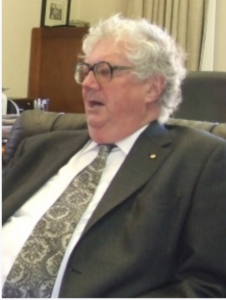
Justice Blow in 2016 (Wikipedia)
TRANSCRIPT: Well it’s not essential that you be satisfied beyond reasonable doubt as to the correctness of any or all of those propositions. You – you – it’s open to you to be satisfied beyond reasonable doubt of guilt without being satisfied of particular contentions or theories as to precisely what happened or why it happened; and the reasoning of the individual jurors might be different. Some of you might regard some pieces of evidence as reliable when others don’t.
Urban: Was he suggesting that the jury could discard those “propositions … contentions or theories” and still be satisfied beyond reasonable doubt about guilt? See comment above.
TRANSCRIPT: The question for each of you is, “Am I satisfied beyond reasonable doubt that guilt has been proven? That on the whole of the evidence that I accept the only – the only reasonable possibility, the only rational conclusion is that Ms Neill-Fraser deliberately murdered Mr Chappell, and that there’s no other sensible explanation for the evidence that I accept – no other reasonable possibility consistent with her innocence.”
Urban: Justice Blow should have warned the jury that there were other “reasonable possibilities consistent with her innocence” including suicide, accident or a third party – the latter later to be manifested by evidence from Meaghan Vass, who was at the crime scene at the relevant time.
JUSTICE BLOW SENTENCING REMARKS – with commentary by Urban:
Blow: I am satisfied beyond reasonable doubt that Ms Neill-Fraser attacked Mr Chappell
Urban: On what evidence? None was produced in court. No weapon. No body. No Witness.
Blow: I cannot rule out the possibility that the attack left him deeply unconscious, and that drowning was the cause of death
Urban: Baseless speculation based on baseless speculation.
Blow: I am satisfied beyond reasonable doubt that Ms Neill-Fraser used the ropes and winches on the yacht to lift Mr Chappell’s body onto the deck; that she manoeuvred his body into the yacht’s tender; that she attached an old-fashioned fire extinguisher weighing about 14 kilograms to his body; that she travelled away from the Four Winds in the tender with the body for some distance; and that she dumped the body in deep water somewhere in the river.
Urban: On what evidence? None was produced in court.
Blow: … the scientific examination of the tender, DNA matching of samples from the blood on the yacht and Luminol positive areas of the tender with Mr Chappell’s DNA
Urban: This is either a confused or a misleading statement, despite the words ‘scientific examination’: a) the presumptive (preliminary) luminol test was positive, but the confirmatory test proved there was no blood in the dinghy – not Chappell’s nor anyone else’s; b) Chappell’s DNA being present on his own dinghy is not proof that Neill-Fraser put his body in it.
Some of Justice Blow’s sentencing remarks (examples above) reveal a cavalier attitude to lack of evidence. In the last example given, Justice Blow makes a catastrophic error of judicial thinking, claiming Luminol testing as proof of blood – despite knowing full well that there was no blood found in the dinghy. Here is an exchange earlier in the trial with jury absent, that makes his error absolutely clear:
CT 1486 HIS HONOUR, COUNSEL, JURY ABSENT – SUBMISSIONS, PRIOR TO SUMMING UP, 13/10/2010
MR ELLIS SC: The next point is, it was attributed to me that I said it was Mr Chappell’s blood in the dinghy. Now I don’t believe I did.
MR GUNSON SC: Yes, you did.
MR ELLIS SC: Okay – I don’t know why I’d say it
HIS HONOUR: – Well –
-
MR ELLIS SC: – because I’ve never believed it.
HIS HONOUR: In opening.
MR GUNSON SC: Yeah.
MR ELLIS SC: Oh in opening –
MR GUNSON SC: Yes, in opening.
MR ELLIS SC: Oh okay, I abandon that, if I said it in opening.
HIS HONOUR: All right. Well I’ll do nothing about that point. What’s the next point?
(His Honour indeed did nothing about this point, not even telling the jury. Did Mr Ellis mislead the jury when he said something about evidence he didn’t believe?)
Alan Blow AO became Chief Justice of Tasmania (2013 – 2024) and in 2025 was appointed as an Acting Judge of the Supreme Court of the Northern Territory.
Andrew and Gary have exposed the cavalier manner or is an ego driven attitude that the bench demonstrated in accepting the flimsy non evidenced arguments of the prosecution.
For that same judge Blow to be heading up The NT Court is a sad reflection on the Australian Justice System
Is it “Oh Blow!” or simply ” J.Blow ” for there is no justice in the conviction of Sue Neil Fraser
Andrew’s October 17 article, Sue Neill-Fraser’s Trial Judge Cross-Examined, raises fundamental questions about the evidentiary and procedural foundations of Sue Neill-Fraser’s conviction. By examining Justice Alan Blow’s handling of the trial, Urban draws attention to the distinction between a prosecution theory that is capable of being advanced and one that is adequately supported by admissible evidence. The hypothetical wrench attack and subsequent drowning illustrate the danger of allowing a jury to bridge evidentiary gaps through speculation rather than reasonable inferences grounded in the evidence.
Of particular concern is the treatment of the prosecution’s opening assertion about blood in the dinghy. According to Urban’s account, the claim was subsequently abandoned in discussions outside the jury’s presence, without an adequate clarification being given to the jury. A prosecutor’s opening address is not evidence; its purpose is to outline the case the Crown intends to prove. Where a material assertion is not subsequently supported by evidence, the jury must not be left to treat it as an established fact. The critical issue is whether the withdrawal was adequately addressed and whether the jury was properly directed to disregard any unsupported assertion. That goes directly to the fairness of the trial and the risk that the verdict was influenced by a claim the Crown did not prove.
These concerns are reinforced by the sustained contributions of Garry Stannus, whose commentary in the Wrongful Convictions Report has documented investigative decisions, disputed timelines and potential procedural deficiencies in the case.
Stannus has drawn particular attention to the chronology surrounding Neill-Fraser’s arrest. After months of investigation, Neill-Fraser lodged a written complaint on July 30, 2009, seeking an independent review of the evidence. The complaint was dismissed, and she was arrested within weeks. The sequence warrants scrutiny, although chronology alone does not establish that the complaint prompted the arrest or that the police acted improperly. Its significance lies in the questions it raises about investigative impartiality, the consideration given to alternative hypotheses and whether potentially exculpatory material received adequate attention.
Stannus has also highlighted Detective Conroy’s reported statement that police had “really only been looking at you all along”. If accurately reported and understood in context, that admission raises a legitimate question about confirmation bias: whether investigators tested their working hypothesis against competing explanations or instead concentrated on evidence that supported their preferred suspect. Such a concern is not, by itself, proof of investigative misconduct or that the resulting conviction was unsafe. Its legal significance depends on how any resulting investigative shortcomings affected the evidence presented at trial and the reliability of the verdict.
The strength of Stannus’s contribution is his detailed cross-referencing of police conduct, chronology and interview transcripts. This provides a basis for examining specific decisions and statements against the available record, rather than relying on general allegations of police failure. It also helps distinguish between an investigative irregularity, a matter relevant to the defence, and a deficiency capable of affecting the safety of a conviction.
Urban’s analysis and Stannus’s research converge on a fundamental principle of criminal justice: a conviction must rest on evidence capable of proving guilt beyond reasonable doubt, not on the apparent coherence of a prosecution narrative. The legal question is not simply whether the Crown’s theory was plausible, but whether the evidence established the essential elements of the alleged offence, whether material weaknesses were properly addressed at trial, and whether the jury’s verdict was reached according to law.
A trial judge is not required to resolve every evidentiary gap in an accused person’s favour, nor does every error or irregularity render a conviction unsafe. But where a prosecution theory depends on inference, the distinction between a reasonable inference and speculation is critical. Where a material prosecution assertion is abandoned, the adequacy of the jury’s directions matters. And where an investigation may have been affected by tunnel vision, the consequences for the evidence and the fairness of the trial require examination.
These are not merely historical criticisms of investigative or judicial decision-making. They go to the central question of whether Neill-Fraser’s conviction can withstand rigorous scrutiny of the evidence, the directions given to the jury and the process by which guilt was determined.
Well done 60 Minutes. Exoneration for Sue Neil Fraser.
Yes, Andrew: as you point out, the remarks made by Justice Blow were made in his sentencing of Sue. To me, what they highlight is the ‘no-mans-land’ of the fact-finding process that judges seems able to fill with their own views – after a jury has delivered a guilty verdict.
Following a verdict, the judge gets to be the one who pronounces what the facts are. As we know, the judge gets to decide the law, the jury gets to decide the facts. Yet when the jury delivers its verdict, it seems as if the judge then trawls through various of the trial evidence and pronounces (in sentencing) what the facts were that the jury must have accepted.
The jury haven’t told the judge anything … they simply have delivered a guilty verdict. The judge is then free to write an account – based on prosecution claims and based on the judge’s own selections from the evidence – of what – in the judge’s opinion – took place. Or, as in the case of Bob Chappell’s disappearance/murder, what might have taken place.
Thank you for posting “Sue Neill-Fraser’s trial judge cross examined“. It is high time that the torch be shone in Justice Blow’s direction. I have recently identified a clear failure by Justice Blow to observe a specific prescription of one of the sections of the Evidence Act 2001. I use the word ‘prescription’ rather than ‘provision’ because in the particular section of the Act, a paragraph in the relevant sub-section prescribes the course of action that a judge must follow in a given situation.
Plainly, the trial transcript shows that Justice Blow failed to observed the prescribed requirement. The matter that I refer to was not just one of incidental interest, but rather it was fundamental to an accused’s right to a fair trial and Justice Blow’s failure to follow the law occasioned an actual miscarriage of justice.
I am not willing here and now, Andrew, to detail the particulars of the MoJ. My discovery is new and I’ve not had time to identify an appropriate course of action. Things relating to SNF’s wrongful conviction are quite busy at the moment (e.g. the lifting of the PBT gag-order and the 60 Minutes program tonight) and I need to obtain advice on the best way to proceed on how to handle the particular MoJ that I have uncovered. It is not new evidence, it is not related to any matter that’s previously received attention. It’s a question of law and a judge’s failure – in black and white – to follow the clear and simple prescription of the sub-section of the Act. Justice Blow failed to follow it.
I can’t wait to read all about it.