Janet Albrechtsen, Stephen Rice (The Australian), with cynical comments by Andrew L. Urban.
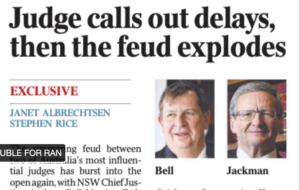
The simmering feud between two of Australia’s most influential judges has burst into the open again, with NSW Chief Justice Andrew Bell blasting Federal Court judge Ian Jackman for “denouncing” fellow judges – one of them dead – over delays in delivering judgments. Clearly unimpressed, Justice Jackman hit back in a judgment delivered on Wednesday in an insurance dispute, observing that “the duties of judges to serve the public in the proper administration of justice should rank ahead of the desirability of cordial internal relations within the judiciary”. [Take that, old boy your Honour!]
Chief Justice Bell renewed the long-running feud at a judicial conference in Kyoto, Japan, last week, condemning Justice Jackman’s “unfortunate” comments on judicial delays as “extremely divisive” and doing unwarranted damage to the reputation of judges. [Judges need no help damaging their collective reputation.] Though not directly naming him, Chief Justice Bell was referring to an extraordinary rebuke by Justice Jackman in June when he named and shamed judges who had failed to deliver decisions in cases up to three years after hearing them. In that speech, Justice Jackman condemned the “egregious” delays as “a threat to the rule of law in Australia”, identifying six judges who had each taken more than 2½ years to arrive at verdicts. [No rush to judgement there!]
The Chief Justice noted that Justice Jackman’s speech had not been delivered in an obscure setting but was “filmed, put up on YouTube by the organisation hosting the speech, and reported on by a national newspaper (The Australian) almost immediately after it had been delivered”. [As if it should have been hidden from view … as it was soon to be, see next par.] “The intervention attracted generalised newspaper headlines such as ‘Our judges are letting us down’, presenting a highly adverse impression and image that was not accurate as a general proposition,” he said.

It was not the first time Chief Justice Bell had condemned the speech, calling it an “iconoclastic outburst” in an email to the 52 judges of his court. Justice Jackman’s speech was later removed from the Federal Court website without explanation. [Can’t hear you la la la! with fingers in ears. Unintentionally symbolic?]
After citing the 2013 case of Chubb Insurance v Robinson, Justice Jackman “noted in passing” that the primary judge in the case, Justice Kenny, had reserved judgment for eight months after a two-day hearing, only to be ‐ followed by the appeal court, comprising Justices Foster, Robertson and Davies, reserving judgment for 21½ months after a one-day hearing.
Justice Lindsay Foster, who died from cancer in 2021, was one of those criticised by Justice Jackman in his earlier speech, for delays in delivering judgments. “None of the judges gave any reason, nor offered any apology, for their delay,” Justice Jackman noted. “I have referred to the lamentable delay in Chubb because the standards one walks past are the standards one accepts.” [Clearly thinking of the old adage that ‘justice delayed is justice denied’.]
Justice Jackman listed five other reasons for exposing judicial delays. “Public exposure and scrutiny are the most effective spurs to judicial exertion, and judges are well placed to keep other judges up to the mark, acknowledging that the media also have an important role to play, and acknowledging also that the legal profession is in an impossible position in criticising the judges before whom they appear,” he said.
“There is no threat to judicial authority by judges making such criticisms, but only a threat to judicial comfort and complacency. [Ouch!] The accountability of the powerful is fundamental to the rule of law, and reflects the reciprocity which exists in a healthy legal system between the rulers and the ruled, rather than a one-way projection of authority.”
The brother of movie and stage star Hugh Jackman, Justice Jackman has repeatedly shown he is not afraid to criticise colleagues since joining the court in 2023 after more than 20 years as a senior counsel. Those targets include Chief Justice Bell, who he sharply criticised in 2024 for creating “legal uncertainty” and flexing a “supervisory power” over judges outside his jurisdiction, in a long-running dispute over the drafting of evidence. [Ah, now we see the context for this scrap!]
In his Kyoto speech, Chief Justice Bell conceded that egregious delays were a problem, but said there was “a time and place for doing so and larger contextual questions arise including by whom and how it should be dealt with”. If anyone was to speak out publicly about matters concerning a court or the judiciary, it should be the Chief Justice or head of the judiciary, Chief Justice Bell said. “A chief justice is best placed to speak for and about the court on an informed basis, being across the business of the court in the broader context,” he said.. “That is not to say that other judges may not answer requests to speak but it is prudent and I would say essential for that judge to consult with his or her chief justice before doing so to ensure that messages are consistent, that what a judge says or is planning to say does not cut across broader issues of which that judge may be unaware, or otherwise undermine initiatives that are underway.”
Care should be taken where the subject matter of the critique could “readily shade into political commentary, or at least run the risk of being perceived to do so”. [Political? Judges? Surely not!**] “A judge who does not do this … runs the risk of doing serious damage to the institution of which he or she is a member,” Chief Justice Bell said. “Such conduct may also disclose either a lack of awareness of the importance of collegiality or an indifference to it which, if played out in public, does little for the public’s perception of the judiciary and its professionalism. It will also be apt to undermine judicial leadership and authority within that judge’s court. Judicial institutions and their judges are not perfect [understatement award!] but publicly voiced criticism by sitting judges either of their colleagues, of judges of other courts or of other public players in the administration of justice does little to engender public confidence in the judges or the wider administration of justice and may in fact undermine it.” Too late, mate…]
Chief Justice Bell said the vast majority of judgments were delivered “expeditiously” given increasing caseloads and the impact of technology that contributed to the size of cases and the time taken for resolution. “Increasing use of Gen AI by unrepresented litigants, while hailed in some quarters as a victory for access to justice, has been seen as contributing to a swamping of some courts with ‘AI slop’,” he said. Australia’s current Chief Justice, Stephen Gageler, had identified the risk of AI use in litigation “in which members of the Australian judicature are acting as human filters and human adjudicators of competing machine generated or machine-enhanced arguments”, Justice Bell said.
*Jackman, no question.
** There are many examples of judges being political. Take one: a doctrine invented by the High Court in 1992, the implied constitutional freedom of political communication, has frustrated attempts by NSW to reclaim public places from those who have intimidated and silenced Jews, such as pro-Palestinian demonstrators.
“The only safe course of action for a sensible judiciary is to stay strictly in its lane. If Bell really wants to maintain trust in our courts, he ought to be thundering about judges being disciplined legalists, not about collegiality as a club rule.” – Janet Albrechtsen, The Australian, October 3, 2026.
They’re all political appointees, beholden to political hacks, so why wouldn’t they be politicized. They’re so up themselves, it ridiculous. Pompous berks, most of whom should be locked up for ignoring our constitutional safeguards.