
Andrew L. Urban.
One Nation features 29 policy outlines on its website; criminal law reform isn’t one of them. Under the heading What we’re working on, Labor’s website features five top policy areas; criminal law reform isn’t one of them. Law reform policies are also absent from the Liberal Party website. The Law Reform Commission has barely dipped its toe into reform. Neither politicians nor the legal profession show any signs of recognising the need for reforms. This article marks the 13th annual International Wrongful Conviction Day, October 2, 2026.
A respected middle aged businessman and philanthropist, without a single other legal blemish, convicted of historical sexual abuse of a young girl in his family, 22 years before, believes he could prove his innocence if the NSW Attorney General advised the Governor to act on his 76 page petition prepared pro bono by a lawyer outraged at the many flaws that led to the conviction. He wants a judicial review – like that of Kathleen Folbigg’s case. But the Attorney-General has refused and has given no reason. No reasonable person would consider that refusal to be in the interests of justice.
In South Australia, Derek Bromley’s 1984 murder conviction was based on Dr Colin Manock’s impermissible (fraudulent) forensic evidence, his 2018 appeal was mangled by the court’s erroneous approach (“…the appeal court in Bromley has fundamentally failed to pay due regard to the rule of law and to the well-established principles governing criminal appeals,” according to Flinders University legal academics Dr Bob Moles and Bibi Sangha) and in 2023 the High Court dismissed his final appeal because the jury was entitled to trust the testimony of a mentally ill witness.
At least four issues are potential grounds that might be framed as a ‘fraud on the court’ in the case of Sue Neill-Fraser.Given the shameful history of the case at the hands of Tasmania’s legal system, nobody should be surprised. One would be enough. For example: Fabricated or Reconstructed “Sequence of Events” Evidence — such as the police’s “reconstruction” of how the body must have been moved, an assumed murder weapon (wrench) though no wrench found, hypotheticals presented as fact. When a reconstruction is speculative but presented as fact, that misleads the jury; if presented despite lack of evidentiary support, it is fraudulent.
There are plenty of other examples that scream for attention in a legal system that is like Victoria: too many potholes that have not been fixed.
As for the Australian Law Reform Commission (ALRC), its interest in law reform is reflected in its one and only inquiry resulting in ALRC Report 96, Essentially Yours: The Protection of Human Genetic Information in Australia, tabled back in 2003. Chapter 45 specifically examined post-conviction use of DNA evidence. The ALRC expressly (uncontroversially) recognised that DNA testing can exonerate persons wrongly convicted and discussed the first Australian post-conviction DNA exoneration, R v Button (Qld CA, 2001).
The ALRC considered the institutional mechanisms for correcting wrongful convictions. It examined:
- criminal appeals;
- reception of fresh evidence;
- Attorney-General referral mechanisms;
- Royal Commissions;
- the NSW Innocence Panel;
- the English Criminal Cases Review Commission (CCRC); and
- whether Australia should establish an independent post-conviction review body.The ALRC ultimately proposed that the Commonwealth establish a body capable of considering applications for post-conviction review based on DNA evidence where there was prima facie evidence of a reasonable possibility of a miscarriage of justice. If that’s all they concluded, many would see this as too timid, too restricted, not seriously reform-oriented … another bottle of Clayton’s. With respect, the ALRC appears naive. We would suggest at the very least broadening the eligibility for post-conviction review beyond DNA evidence. That restriction hobbles the very idea of a post-conviction review. But given nothing has been done in the 23 years since the report, it’s a moot point.
There are other crucial reforms required to improve the administration of justice, which we have previously identified. For example, perhaps the top priority should be the separation of forensic services from the unhealthy embrace of police services, nationwide.
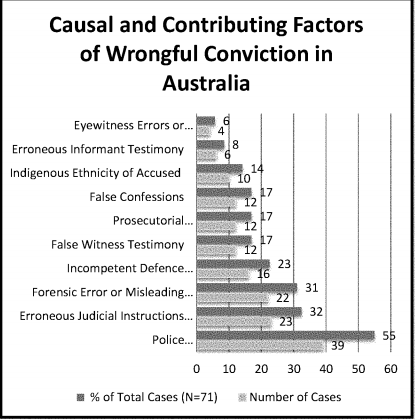
Griffith University research
Using research by Griffith University (the only research on this topic of which I am aware) to prioritise the need for reform, let’s take the top three causal and contributing factors in wrongful convictions in Australia.
No 1 – police misconduct 55% –
“in many instances, several acts took place over the course of an investigation that constituted police misconduct, overzealousness, or tunnel vision where police may not have followed up on potentially important leads during the investigation or they placed undue weight on circumstantial evidence during the investigation that surrounded the suspect.”
reforms we propose:
*repeated training to avoid ‘tunnel vision’ approach
*training to adhere strictly to investigation procedures, notably
*accurate record keeping
*accurate, unaltered witness statements
*evidence collection management culture to emphasise serving the court not the prosecution
No 2 – erroneous judicial instructions 32%
The nature of these errors were raised on appeal and were case specific that related to various aspects of the trial and the way in which the judge addressed the jury. For example, they related to directing the jury as to the definition of the crime, what aspects of evidence should be considered or ignored, what to consider for their final verdict. EG:Tomas Klamo was convicted of manslaughter for killing his infant son by shaking him to death. The Supreme Court of Victoria Court of Appeal found that the trial judge erred by repeatedly directing the jury that its task was to unanimously determine the cause of the infant’s death before finding a verdict of guilt. Rather the jury should have been instructed that they could not convict unless they unanimously agreed upon which act constituted the crime that killed the infant, as the act may not have involved Klamo. This example brings up the infamous ‘shaken baby syndrome’ issue, on which we have reported in several posts.
No 3 – forensic error or misleading forensic evidence 31%
This category was coded to include behaviours such as forensic experts exaggerating forensic evidence in court, if and when results were falsified or misinterpreted during the investigation or at trial, or when an untested or unreliable forensic technique was used in the analysis. The conviction of Farah Jama for the rape of a woman in a nightclub is a key example of a forensic error that led to a wrongful conviction. In this instance, the prosecution’s case rested solely on DNA evidence, since there were no eyewitnesses that could identify Jama, the victim had no memory of the assault or perpetrator, and Jama had an alibi for his whereabouts on the night of the crime. The Victorian Court of Appeal quashed Jama’s conviction due to a “mix up” in the forensic laboratory.
Not part of the Griffith Uni study, but incompetent or fraudulent forensic evidence was perpetrated on the courts hundreds of times by South Australia’s Chief Forensic Pathologist Dr Colin Manock over decades. It was known to the legal and political establishments and they did nothing about it.
reforms we propose:
*develop a system of quality standards, with documented policies and procedures
*training to explain expert forensic evidence in court so that it is understood by lay judges & juries
*requirements for validation of evidence
*emphasis on experts serving the court not the police or prosecution
*training to avoid contextual bias
There has been no agitation from lawyers working in criminal law for serious reform. Actually, any reform. We can’t expect street demos, but a profession so deeply invested (literally!) in the conduct of law would make itself heard if its income were choked. Where are the judges calling on their colleagues to sharpen up…other than Justice Ian Jackman, that is. Where are the prosecutors calling on their colleagues to always remember their duty is not to seek convictions but to seek the truth.
The main reason that some lawyers and interested parties have over recent years supported the establishment of a Criminal Cases Review Commission (CCRC) is the failures of appeal courts, which leave the applicant only one avenue: the impossibly steep, rarely successful and expensive climb to the mountain top: the High Court. I say this after reporting on failed appeals that have demonstrated a range of inherent weak spots, from judicial failings to poor advocacy to bad prosecutorial behaviour.
The Shadow Attorney-General is Michaelia Cash, in 2021 she was THE Attorney-General. I wrote to her urging her to consider the implementation of a Criminal Cases Review Commission-like entity to improve Australia’s managing claims of wrongful convictions. Here is the reply in full:
28 June 2021
Mr Andrew L Urban
andrew.urban@wrongfulconvictionsreport.org
Dear Mr Urban
Thank you for your letter of 17 May 2021 to the Attorney-General and Minister for Industrial Relations, Senator the Hon Michaelia Cash, regarding the establishment of a Criminal Cases Review Commission. The Attorney-General has requested that the Attorney-General’s Department respond to you on her behalf.
Under Australia’s federal system of government, the Commonwealth, states and territories each have different areas of responsibility, with the states and territories primarily responsible for the administration of criminal law. Each jurisdiction manages its own criminal justice system and related programs. Any decision to enact new post-conviction review arrangements is a matter for individual jurisdictions.
The Australian Government is not currently considering establishing a federal Criminal Cases Review Commission. If a person is not satisfied with the decision of a court in their matter, the appropriate avenue of review is through the appeal process. The appeal process is a fundamental part of our legal system in that it affords people the right to challenge decisions which affect their legal rights. This process is also consistent with the independence of the courts from other arms of government. Preserving the independence of the courts is vital to the maintenance of the rule of law and public confidence in the administration of justice, which both underpin our democratic system of government.
At a federal level, a person convicted of a Commonwealth offence continues to have recourse to the Royal Prerogative of Mercy where evidence emerges of a miscarriage of justice after ordinary avenues of appeal have been exhausted.
Thank you again for bringing your concerns to the Attorney-General’s attention.
Yours sincerely
Marion Barraclough
Acting Director
Transparency and Criminal Law Branch
This is typical of all the A-Gs that I have approached on the matter (in tandem with Adelaide University legal academic Bob Moles), from George Brandis in 2013 to Christian Porter in 2019 to Cash in 2021, to Michelle Rowland in 2025. They regurgitate the “appropriate avenue of review is through the appeal process”, ignoring the whole point of a CCRC which is to improve the appeal process after that process fails. Departmental bureaucrats are given the letter and told to reply in intellectually stunted terms.
Even worse, the reply from Michelle Rowland’s Acting Director, Criminal Law Section, misrepresents what I proposed in my letter, namely a nationally structured system, not a federal system. Drawing on the Bob Moles-designed structure, which in short suggests that “A national CCRC can be established by setting up a single CCRC and then each state and territory can legislate to nominate that CCRC as the appropriate agency to review cases on its behalf and exercise powers given to the CCRC by that state to refer matters to the appeal court of that state. This would not involve any constitutional change of any sort.
Australia has a single unified legal jurisdiction which is why we have a common Supreme Court (the High Court). To have a single administrative body which can exercise powers on behalf of each state and territory, being cognisant of the minor variations in the law which may occur between them, would be administratively simple and have strategic and economic benefits.”
The separation of powers is valid and necessary, keeping the unreliable fingers of politicians away from the administration of the law. (Not that such administration is a model of excellence…)
 BUT 1) In fact, this restriction comes crashing into the legal system at a most critical juncture: when a convicted person has exhausted their appeal options and seeks the prerogative of mercy or judicial review from the Governor of their state – through the Attorney-General of that state, a politician.
BUT 2) The separation of powers does not relieve the Attorneys-General from responsibility for ensuring that the administration of the law functions as intended, protecting the innocent and prosecuting the accused – fairly. One of the key roles of an Attorney-General is developing and sponsoring reforms to legislation and the justice system; referring questions to law-reform commissions where applicable. An Australian Attorney-General could initiate a systematic inquiry into wrongful convictions, post-conviction review or an independent conviction-review body. In other words, make the legal system fully accountable and able to correct its own mistakes.
We can’t avoid the conclusion that Attorneys-General – of the left and the right – have run a mile from contemplating this consequential reform primarily because establishing a CCRC would require understanding, determination, solid inter-State diplomacy and commitment to reform. Oh, yeah, right … I see the problem…
Aren’t the best judges in Australia always supposed to agree 5-0 for or against a case verdict. If not , one case tells you that either 3 or 2 judges got it wrong . Was it those who declared innocence or guilt , it matters not. The judges are supposed to be there to examine the evidence or the points they f appeal, and then weigh up the scales of Justice . They are there to interpret law , not to expose their life prejudice or their own lacking in their ability to interpret law. There is no excuse for not having a unanimous verdict more often than not. In criminal matters the bar must be just the same height for all judges. Only one man decided that E =mc. Squared . The others judged he was correct . Pv