
Andrew L. Urban.
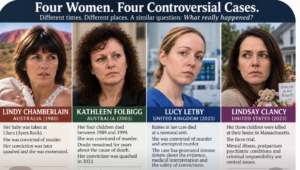
The history of mothers killing their children facing murder charges is turbulent terrain. The cases of Lindy Chamberlain, Kathleen Folbigg in Australia, Lucy Letby (a nurse) in the UK and most recently Lindsay Clancy in the US demonstrate how challenging these cases are for the courts. Public sympathy for the children is an emotional force that can swamp legal guiderails and drive public sentiment. All these killings have challenged the concept of reasonable doubt. (See our previous report on the Clancy case.)
Let’s begin with what reasonable doubt means. The criminal law does not require mathematical certainty. The starting proposition is the presumption of innocence. The prosecution carries the burden of proving the elements of the offence beyond a reasonable doubt. The proper question is whether, after considering the evidence as a whole, the prosecution has proved the necessary propositions to the required level of certainty. If a reasonable doubt remains about a necessary element, the jury cannot properly convict on that element.
The jury should separate established facts from inference, avoid stacking weak inferences upon one another, and ask what proposition the evidence actually establishes. But it is important to remember that there is no actual definition of ‘reasonable doubt’ in law. And then, in many cases including Clancy’s, there is the even curlier question of mental illness v legal insanity, a distinction particularly important in her case.
A person can suffer from a serious psychiatric disorder and nevertheless be legally responsible for criminal conduct.
Conversely, a person need not necessarily have a particular formal psychiatric diagnosis to satisfy the legal concept of a mental disease or defect.
A jury should not use the horror of the outcome as a substitute for proof of criminal responsibility. Nor should the public.
The current Massachusetts homicide instruction states that criminal responsibility is a legal, not merely medical, concept. A defendant is not criminally responsible if, because of a mental disease or defect, she lacked the substantial capacity either:
to appreciate the criminality or wrongfulness of her conduct;
or
to conform her conduct to the requirements of the law.
That is an important distinction from the question:
“Did Lindsay Clancy have postpartum depression, postpartum psychosis, or another psychiatric disorder?”
That medical question may be highly relevant, but it is not itself the ultimate legal question. The jury must decide the legal consequences of the mental condition at the relevant time.
The Massachusetts difference
The unusual but critical Massachusetts burden is probably the most important point for understanding the Clancy defence. Once the evidence raises the issue of lack of criminal responsibility, the defendant does not have to prove insanity. The Massachusetts model instruction expressly says that the Commonwealth bears the burden of proving beyond a reasonable doubt that the defendant was criminally responsible. The defendant has no burden to prove lack of criminal responsibility.
The Massachusetts District Court instruction puts the consequence particularly clearly:
if there is reasonable doubt about an element of the crime → not guilty;
if there is reasonable doubt about criminal responsibility → not guilty by reason of lack of criminal responsibility.
That means the jury should not reason backwards:
“She committed the killings, therefore she must demonstrate that she was insane.”
The proper reasoning is instead:
“Has the Commonwealth proved beyond a reasonable doubt that she was criminally responsible at the time?”
If the Commonwealth has not carried that burden, the law does not permit a guilty verdict merely because the jury is convinced that she physically committed the acts.
Of course, as we know, the jury in Clancy’s case was unable to arrive at a unanimous verdict so the trial miscarried.
The jury is not required simply to choose between:
“The defence psychiatrist is right”
and
“The prosecution psychiatrist is right.”
They can consider all of the evidence bearing upon mental state. The Massachusetts instruction expressly permits consideration of the circumstances of the crime, conduct before and after the crime, and expert opinions, giving expert opinions whatever weight the jury considers appropriate.
That creates a broader evidentiary inquiry. For example, the jury could consider:
- psychiatric history;
- symptoms immediately before the killings;
- contemporaneous observations by family, clinicians or others;
- statements made by the defendant;
- behaviour during the relevant period;
- evidence concerning psychosis or delusions;
- actions immediately before and after the killings;
- expert psychiatric opinions;
- evidence supporting or contradicting those opinions.
But the jury must avoid a simplistic inference such as:
Psychiatric illness → psychosis → therefore legally insane.
Each step requires evidentiary support.
The assertion that “she knew what she was doing” is another potentially important point. The Massachusetts instruction explains that “appreciate” means understand, rather than merely know intellectually. “Criminality” concerns the legal significance of conduct, while “wrongfulness” concerns its moral significance.
Consequently, the question is not necessarily:
“Did she understand that she was physically killing the children?”
Nor is it necessarily answered merely by:
“Did she know that killing was against the law?”
The jury must consider whether, because of the mental disease or defect, she had a meaningful understanding of the criminal or moral significance of what she was doing, and/or whether she retained the substantial capacity to conform her conduct to the law.
That is a substantially more nuanced inquiry and goes to the assertion held by some in the public that because she sent her husband away, for example, she committed premeditated murder.
The defence’s strongest argument is: “You may believe that she committed the acts and may even accept that she suffered from a severe psychiatric disorder, but unless the Commonwealth has eliminated reasonable doubt about the effect of that disorder on her legally relevant capacities, you cannot return a guilty verdict.”
That is not an invitation for the jury to be sympathetic. It is an application of the burden of proof. The defence does not necessarily need to establish an alternative psychiatric explanation with scientific certainty. The question is whether the Commonwealth has discharged its burden after the whole evidentiary record is considered.
A psychiatric expert may provide evidence concerning diagnosis, symptoms, mechanisms, observed behaviour and functional capacity. But expert opinion does not automatically determine the legal conclusion. The evidence must be linked to the individual defendant and the relevant time. The LIA medico-legal framework requires the distinction between:
possibility;
association;
probability; and
causation.
It also cautions that a mechanism or temporal sequence does not itself establish causation.
Applied here:
Evidence that postpartum psychosis can produce severe delusions or impaired reality testing supports the general proposition that such symptoms are possible. It does not by itself establish that Clancy actually experienced those symptoms at the relevant time, or that those symptoms produced the particular legally relevant impairment required by Massachusetts law.
That requires case-specific evidence.
The correct question is:
After considering all the evidence, has the Commonwealth proved beyond a reasonable doubt that the defendant was criminally responsible under the Massachusetts legal test at the time of the killings?
If yes, a guilty verdict may follow, subject to proof of the other elements.
If no, the jury must entertain reasonable doubt rather than effectively placing the burden of proving insanity on the defendant.
That is the central significance of reasonable doubt in this case, which would be put to the test in any retrial. But for now, 11 of the 12 jurors in her trial do appear to have entertained reasonable doubt about the guilt of the accused. Indeed, there are reports that even the one dissenter expressed doubt…
Without the complete trial record and expert reports, it would be inappropriate for us to assign a definitive weight to the competing psychiatric opinions. The key issue is case linkage: what evidence demonstrates her mental state at the precise time of the killings?
NOTE: We are not competent in Massachusetts law; this report has been compiled with the assistance of LIA (Legal Intel AI)
What do you think?
Andrew, I greatly enjoy reading your articles. I saw a short YouTube video about this case that I highly recommend, looking at the effect on Lindsay Clancy of the dozen or so mind-altering medications prescribed to her shortly before all of this happened. (I should say I’m not anti-psychiatry etc – but this seems excessive and points to gross negligence by the American psychiatric system – and adds another element to the points you’re making). You can tell by the title it’s a little dated now – “Hung Jury for Lindsay Clancy? He Resigned Hours Later” by Neal K Shah – https://www.youtube.com/watch?v=8ZWkVKDgiBU
Many thanks Emily, this is a powerful and relevant contribution from Shah. I’ve posted a link to it along with the full transcript in today’s post.
See https://wrongfulconvictionsreport.org/2026/09/13/lindsay-clancy-tragedy-who-are-really-responsible-a-damning-expose/