Andrew L. Urban.
Sixteen years ago on August 20 Sue Neill-Fraser was arrested at her home in Hobart for the murder of her partner, Bob Chappell, supposedly on their yacht Four Winds. A year later in 2010 Sue was tried, convicted and sentenced to 23 years in prison, of which she served 13 before being released on parole. But as we all know, she is not guilty. It’s an open sore on Tasmania’s legal system.
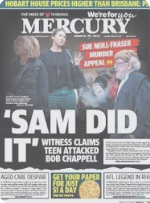
The Mercury, March 2, 2021
The Hobart Mercury splashed it on its front page after the appeal court was told who did it: “Sam did it” according to the homeless young woman Meaghan Vass, who witnessed the fight between Chappell and the intruders on his yacht. Still the Tasmanian constabulary could not or would not pursue this extraordinary tip-off. That was either incomprehensible incompetence or unforgivable malicious intent.
The case was (and still is) altogether so embarrassing that the entire police and legal establishment circled the wagons and maintained a huddle in effect to this day, with its fingers in its ears, chanting nah nah nah naana.”
Our many dozens of reports on the case going back to July 2013 (see menu at right of page) have revealed the many reasons we believe Sue’s conviction to be wrongful. By a long shot. Lack of inculpatory evidence being a start … plus a trainwreck of a trial. Not least was the unsupported speculation by the prosecutor, former DPP Tim Ellis SC, as to how Neill-Fraser committed the murder, which was allowed by the trial judge, Alan Blow.
Sue Neill-Fraser herself provided the first and most pertinent clues for police to pursue in her statement a couple of days after Chappell’s disappearance. These clues are imbedded in her stat dec, which we published HERE back in January 2020.
Several issues that remain appealable were identified by Tony Jacobs, a respected former Hobart prosecutor, others by Flinders University legal academic Dr Bob Moles, and yet others by lawyer Barbara Etter APM & barrister Hugh Selby – not to mention various lawyers & barristers working on Neill-Fraser’s case, and reported on film, TV, podcasts, blogs and in print media.
Some of the issues that remain disputing the conviction
Tony Jacobs, former Tasmanian prosecutor:
# flagrant incompetence by defence counsel, the late David Gunson,
# the failure of the solicitors lodging her 2011 appeal to raise these issues,
# the failure of the solicitor lodging her 2012 High Court appeal
# the failure of the Tasmanian Appeal Court in 2012 to, of its own motion, raise these issues.
Other issues raised by Jacobs:
# Evidence not disclosed re electropherogram of Vass DNA, destroying prosecutor’s claim of transferred deposit;
# Evidence not disclosed about the false Mt Nelson address (given by Vass);
# Failure to object to inadmissible hearsay evidence from Detective Sinnitt re Vass possibly hanging around Goodwood;
# Evidence not disclosed that Mr Gosser in conversation with Detective Sinnitt re DNA unlikely to have been walked on;
Six steps to the wrongful conviction of Sue Neill-Fraser, by Dr Bob Moles, legal academic:
Step 01 – Luminol test results are not admissible
Step 02 – Luminol test results are seriously prejudicial
Photograph of ‘Luminol’ in the dinghy
Step 03 – Inadmissible pathology evidence
Step 04 – Inadmissible submissions by prosecutor and judge
Step 05 – Jury misinformed concerning drug-smuggling operations
Step 06 – The Judge – circumstantial case wrongful summing up to jury

The Etter Selby papers & the police investigation
In August 2021 the findings of a review of the police investigation by former Sue Neill-Fraser lawyer Barbara Etter APM and barrister Hugh Selby was delivered to the Attorney-General. It was later tabled in the Legislative Council by Independent member Michael Gaffney, who also tabled the Tony Jacobs papers.
The Etter Selby investigation report states that: “This paper explores significant police shortcomings in the investigation, along with their failure to disclose key evidence to the Crown in the Sue Neill-Fraser case. It brings to light information that has not been presented to the court at any stage of the initial trial, subsequent appeals nor the latest appeal [then] before the Supreme Court of Tasmania.
“TASPOL investigators in Operation Ransack (the operational name for the Sue Neill- Fraser murder investigation) failed to follow up basic and obvious lines of inquiry about Meaghan Vass [MV] and her known associate Sam Devine [SD] both prior to the Sue Neill- Fraser trial in 2010 and thereafter.”
For example, “important emails from the Manager of Mara House and emails from Grosser at FSST, were not provided to the ODPP for disclosure to the defence as outlined in Sinnitt’s 2019 affidavit.”
FOOTNOTE:
Tasmanian Supreme Court on August 31, 2026 will finally hear the challenge to the latest parole restrictions imposed on Sue Neill-Fraser, prohibiting her from claiming her innocence of the 2009 murder. The legal team representing her will comprise two from the Human Rights Law Centre (Melbourne) and three from the Sue Neill-Fraser Support Group (also from interstate). The Tasmanian Parole Board last year acted contrary to the High Court’s rulings when it tightened the parole condition on Sue Neill-Fraser, as we outline HERE
Thanks for this article, Andrew. Yes, Tony Jacobs certainly added fresh insights to the Tas Justice débâcle (with his ‘J’accuse’ letter). To those four points of his which you have listed (one of incompetence and three of failure) could I add a fifth: That the High Court itself could have (should have?) ‘on its own motion’ accepted the 2012 appeal application by itself citing as a ground for retrial/quashing of conviction: the incompetence (for wont of a better word) of Sue’s Defence Counsel at trial.
Thank you for including the useful live-links to Bob Moles’ 6 Steps to the Wrongful Conviction of SNF. Also thanks for the inclusion of the background on the 2nd Etter-Selby initiative and the work of MLC Michael Gaffney. Might I remind readers that Gaffney’s call for an Inquiry into the whole matter of the conviction is presently in abeyance. It is hoped that following the hearing (Civil Court) on 31 Aug 2026, ‘Neill-Fraser v Parole Board of Tasmania‘, the Gaffney motion in the Legislative Council will be resumed.
Readers may be aware that some time ago, the Parole Board of Tas added an extra condition to the terms of Sue’s parole: she may not directly or indirectly communicate to the outside world claims of innocence. If she does, her parole can/will be revoked and back into prison for another 10 years. Sorry that I haven’t quoted the exact terms of the Parole Board’s new, onerous condition … but I think I’ve adequately summarised it.
I see it as a gross denial of a basic human right – the right to freedom of speech and I have tried to find an acceptable reason for the Board to have imposed it. The only reason I’ve come up with is what I believe may have been already cited by the Board – the pain/added distress to the deceased’s family by Sue’s continuing claims of innocence. Personally, ‘I don’t buy it’ (I don’t find that explanation of the Board’s to be compelling. In the context of the whole saga, the matter more readily fits into one of the Parole Board acting in concert along with Team Tasmania … the Prison System illegally taping lawyers’ meetings with inmates, the Courts, the ODPP and TasPol. Left the Govt out, didn’t I? Sorry … I recall Richter, McLaren and Ash presenting the ‘White Paper’ dossier … and how it was leaked to the cops by one of the three senior govt members present at the meeting.
We have before us on 31Aug, a moment in which, in deciding on whether or not Sue Neill-Fraser should be allowed to directly or indirectly maintain her innocence to the outside world, we shall see whether Tasmania affords its citizens that most basic of human rights – the right to free speech.
I thank the Human Rights lawyers (e.g. through Sarah Schwartz, from the mainland) who will address the Supreme Court of Tasmania (Civil) on this matter. It will be fascinating to see what the Parole Board, for ‘Team Tasmania’ comes up with.