Andrew L. Urban.
On the eve of tomorrow’s 60 Minutes (Nine Network) special report on the case of Sue Neill-Fraser, we take you back to her trial in the Supreme Court of Tasmania, for the murder of her partner Bob Chappell, alleged by the Director Public Prosecutions, Tim Ellis, to have taken place on board the couple’s recently purchased yacht, Four Winds. It’s the final day, October 15, 2010.
Of all the possible elements that we could highlight to show how things went wrong from the beginning, we have chosen three telling short passages from the trial transcript – and our short comments by way of cross examination.
JUSTICE BLOW SUMMING UP FOR THE JURY – with commentary by Urban:
TRANSCRIPT: Mr Ellis in cross-examining Ms Neill-Fraser put to her a series of propositions, a scenario about killing Mr Chappell with a wrench, attacking him from behind, and killing him because of a difference of views about the yacht and expenditure and of the future of the yacht.
Urban: Scant evidence for a deadly disagreement along these lines. Justice Blow should have warned the jury that the scenario put to the jury by Mr Ellis was pure speculation. There was no wrench, for a start. (He should not have allowed this speculation in the first place.)
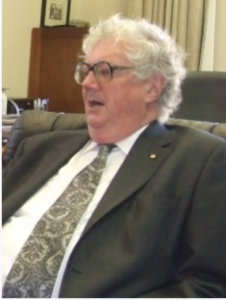
Justice Blow in 2016 (Wikipedia)
TRANSCRIPT: Well it’s not essential that you be satisfied beyond reasonable doubt as to the correctness of any or all of those propositions. You – you – it’s open to you to be satisfied beyond reasonable doubt of guilt without being satisfied of particular contentions or theories as to precisely what happened or why it happened; and the reasoning of the individual jurors might be different. Some of you might regard some pieces of evidence as reliable when others don’t.
Urban: Was he suggesting that the jury could discard those “propositions … contentions or theories” and still be satisfied beyond reasonable doubt about guilt? See comment above.
TRANSCRIPT: The question for each of you is, “Am I satisfied beyond reasonable doubt that guilt has been proven? That on the whole of the evidence that I accept the only – the only reasonable possibility, the only rational conclusion is that Ms Neill-Fraser deliberately murdered Mr Chappell, and that there’s no other sensible explanation for the evidence that I accept – no other reasonable possibility consistent with her innocence.”
Urban: Justice Blow should have warned the jury that there were other “reasonable possibilities consistent with her innocence” including suicide, accident or a third party – the latter later to be manifested by evidence from Meaghan Vass, who was at the crime scene at the relevant time.
JUSTICE BLOW SENTENCING REMARKS – with commentary by Urban:
Blow: I am satisfied beyond reasonable doubt that Ms Neill-Fraser attacked Mr Chappell
Urban: On what evidence? None was produced in court. No weapon. No body. No Witness.
Blow: I cannot rule out the possibility that the attack left him deeply unconscious, and that drowning was the cause of death
Urban: Baseless speculation based on baseless speculation.
Blow: I am satisfied beyond reasonable doubt that Ms Neill-Fraser used the ropes and winches on the yacht to lift Mr Chappell’s body onto the deck; that she manoeuvred his body into the yacht’s tender; that she attached an old-fashioned fire extinguisher weighing about 14 kilograms to his body; that she travelled away from the Four Winds in the tender with the body for some distance; and that she dumped the body in deep water somewhere in the river.
Urban: On what evidence? None was produced in court.
Blow: … the scientific examination of the tender, DNA matching of samples from the blood on the yacht and Luminol positive areas of the tender with Mr Chappell’s DNA
Urban: This is either a confused or a misleading statement, despite the words ‘scientific examination’: a) the presumptive (preliminary) luminol test was positive, but the confirmatory test proved there was no blood in the dinghy – not Chappell’s nor anyone else’s; b) Chappell’s DNA being present on his own dinghy is not proof that Neill-Fraser put his body in it.
Some of Justice Blow’s sentencing remarks (examples above) reveal a cavalier attitude to lack of evidence. In the last example given, Justice Blow makes a catastrophic error of judicial thinking, claiming Luminol testing as proof of blood – despite knowing full well that there was no blood found in the dinghy. Here is an exchange earlier in the trial with jury absent, that makes his error absolutely clear:
CT 1486 HIS HONOUR, COUNSEL, JURY ABSENT – SUBMISSIONS, PRIOR TO SUMMING UP, 13/10/2010
MR ELLIS SC: The next point is, it was attributed to me that I said it was Mr Chappell’s blood in the dinghy. Now I don’t believe I did.
MR GUNSON SC: Yes, you did.
MR ELLIS SC: Okay – I don’t know why I’d say it
HIS HONOUR: – Well –
-
MR ELLIS SC: – because I’ve never believed it.
HIS HONOUR: In opening.
MR GUNSON SC: Yeah.
MR ELLIS SC: Oh in opening –
MR GUNSON SC: Yes, in opening.
MR ELLIS SC: Oh okay, I abandon that, if I said it in opening.
HIS HONOUR: All right. Well I’ll do nothing about that point. What’s the next point?
(His Honour indeed did nothing about this point, not even telling the jury. Did Mr Ellis mislead the jury when he said something about evidence he didn’t believe?)
Alan Blow AO became Chief Justice of Tasmania (2013 – 2024) and in 2025 was appointed as an Acting Judge of the Supreme Court of the Northern Territory.