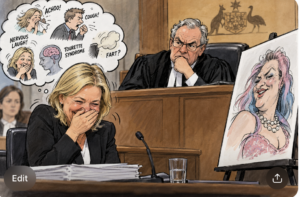
Prompted by our story about Giggle for Girls founder Sall Grover being judged to have giggled hurtfully at a cartoon depicting her legal opponent Roxanne Tickle (yeah, real names), STEVEN FENNELL discusses the issues when involuntary responses conflict with courtroom demands.
The law expects decorum in the courtroom. Quite reasonably. But does that mean the human body must obey the rules of evidence, suppress every inconvenient reflex and confine its biological functions to the lunch break?
The intersection of legal proceedings and human biology has always required a delicate balance between maintaining courtroom decorum and recognising the realities of human behaviour. Recent controversy surrounding the legal consequences of laughter in court has brought an important question into focus: where does legitimate judicial authority end and the policing of involuntary human responses begin?
A courtroom is not a theatre, and a judge is not obliged to tolerate deliberate disruption. Nor is every laugh innocent, every cough unavoidable or every interruption beyond a person’s control. Context matters.
But so does the distinction between what a person chooses to do and what happens before conscious control has had an opportunity to intervene.
When a person’s spontaneous reaction becomes a factor in a legal penalty, the questions are not merely about manners. They concern fairness, evidence, intent and the extent to which the law should account for the realities of human physiology.
After all, the human body does not invariably wait for the judge to finish speaking before doing something inconvenient.
Policing Involuntary Human Responses
Human beings are biological entities, not programmable courtroom furniture. We cough, sneeze, choke, tremble and occasionally laugh at precisely the wrong moment. Nervous tension can produce laughter; shock can leave a person speechless; and certain neurological conditions can produce movements or vocalisations that the individual cannot reliably suppress.
None of this means that every disruptive act should be excused. It means that the nature of the act, the circumstances in which it occurred and the person’s capacity to control it should matter.
There is a difference between deliberately laughing at another person’s distress and experiencing a nervous or involuntary laugh. There is also a difference between an act that causes genuine additional harm and one that is merely interpreted as offensive because of the circumstances in which it occurs.
The distinction may not always be easy to establish. That is precisely why it deserves careful consideration.
The law routinely examines intention, conduct, causation and evidence. It should be equally cautious when drawing conclusions about a person’s internal state from an outward reaction.
A laugh is an observable event. Contempt, malice and deliberate ridicule are conclusions that may or may not follow from it. (Ed: So is a fart; should the court regard it as a comment on proceedings and consider it contempt?)
A courtroom may be entitled to demand decorum. It is not thereby entitled to assume that every human response is a considered submission to the court’s authority.
Tourette Syndrome and the Limits of Voluntary Control
The importance of this distinction becomes particularly apparent when considering Tourette syndrome and other neurological conditions.
Tourette syndrome is a neurological condition characterised by tics: sudden, repetitive movements or vocalisations that are not simply deliberate acts of behaviour. Tics can range from eye blinking and shoulder movements to sounds and, in some cases, involuntary words. Their presentation and severity vary between individuals.
Some people can suppress certain tics temporarily, sometimes at considerable effort, but that does not mean the underlying condition is voluntary or that suppression is always possible.
Legal professionals and people who attend court while living with Tourette syndrome understand the practical implications. An involuntary sound during a solemn proceeding may attract attention, but attention is not proof of intention.
Nor is Tourette syndrome the only relevant consideration. Other neurological conditions, disabilities, respiratory illnesses and acute physical episodes may affect a person’s ability to remain outwardly still or silent. (Ed: see re fart above…)
A person experiencing a severe coughing episode, for example, may be doing everything reasonably possible to avoid disrupting proceedings. Expecting them simply to stop coughing is not a legal principle; it is a triumph of aspiration over physiology.
The appropriate response is not to abandon courtroom order. It is to recognise that order must be maintained with an understanding of the people expected to observe it.
If a court cannot distinguish a symptom from an act of defiance, the problem may not lie entirely with the person who made the noise.
Laughter, Intent and the Judicial Interpretation of Behaviour
 Laughter presents a particularly interesting problem because, unlike a sneeze, it can carry a wide range of meanings.
It may express amusement, embarrassment, nervousness, disbelief, discomfort or deliberate ridicule. Sometimes it is spontaneous; sometimes it is calculated. And sometimes the person laughing may struggle to explain the reaction even to themselves.
The difficulty arises when an observer treats the reaction as conclusive evidence of the intention behind it.
The recent controversy involving Sall Grover illustrates why precision matters. The original Federal Court proceedings did not result in a separate fine for laughing at a caricature. Rather, the trial judge treated the laughter as a limited aggravating factor when assessing damages. The Full Court subsequently dismissed Grover’s and Giggle’s appeal, allowed Tickle’s cross-appeal on direct discrimination and increased the compensation award.
Those distinctions are important. A damages award is not the same thing as a fine, and a court’s assessment of conduct in determining compensation is not automatically equivalent to punishing an involuntary reflex.
Nevertheless, the broader question remains legitimate: how confidently can intention be inferred from a reaction whose meaning may be ambiguous?
The judge in a particular case may conclude that laughter was deliberate or that a person’s explanation is unconvincing. Courts are entitled to evaluate evidence and make findings of fact. But the general principle remains that the meaning of a reaction should be assessed in context, rather than assumed from its appearance alone.
A laugh may be evidence of amusement. It is not, by itself, a signed confession to malice.
And while judicial authority deserves respect, respect is not a biological function that can be switched on and off by judicial direction.
Judicial Decorum Is Not the Same as Human Uniformity
Courtrooms must be orderly. Witnesses must be able to give evidence, parties must be heard and proceedings must be conducted without deliberate intimidation or disruption. Judicial officers need the authority to intervene when those requirements are threatened.
But there is a difference between maintaining order and demanding uniformity of human behaviour.
A person with a neurological condition should not automatically be treated as deliberately disruptive because their symptoms attract attention. Equally, a person should not receive blanket immunity for conduct merely because they describe it as spontaneous. Evidence and context remain essential.
The proper approach is neither automatic condemnation nor automatic exemption. It is an informed assessment of what occurred, the circumstances in which it occurred, the person’s capacity for control and the consequences of the behaviour.
Where disability is relevant, reasonable accommodation may also be necessary to ensure meaningful access to justice. That does not remove the court’s authority; it helps ensure that the authority is exercised fairly.
There is something deeply ironic about a justice system that prides itself on examining evidence carefully while potentially overlooking the distinction between an involuntary reaction and a deliberate act.
The law should not confuse the appearance of disrespect with proof of an intention to show disrespect.
Otherwise, the standard becomes less about what a person actually did and more about whether their body performed the correct social choreography at the correct moment.
Moving Towards a More Reasonable Judiciary
A mature legal system should be capable of holding two propositions at once: courtroom decorum matters, and human beings cannot always control their physiological or neurological responses.
Judicial training, appropriate disability awareness, reasonable accommodation and careful consideration of context can help maintain that balance. So can a willingness to distinguish between deliberate disruption, involuntary behaviour and conduct that demonstrably aggravates another person’s injury.
None of this requires judges to abandon authority or courts to become places where anything goes. It requires the exercise of authority to remain proportionate, evidence-based and attentive to the circumstances of the individual.
The principle is straightforward: punish conduct where the law justifies it, not merely the appearance of a reaction that offends the sensibilities of the room.
The courtroom is a place where human conduct is scrutinised. It should also be a place where the realities of being human are understood.
After all, justice is supposed to be blind. It need not be deaf to a cough, suspicious of every laugh or astonished that the human nervous system occasionally fails to observe standing orders.
And if the law expects people to control themselves, it should at least be prepared to consider whether they reasonably could.
Once convicted but years later exonerated of murder, Steven Fennell knows courtrooms.