Andrew L. Urban.
On October 7, 2023, Hamas terrorists killed, raped and tortured young Israelis in a massacre of some 1200 and took some 240 hostages into their tunnels in Gaza. On October 15, 1894, French Army Captain Alfred Dreyfus, the youngest son of a Jewish family from Alsace-Lorraine, was arrested for treason – without any credible evidence. Dreyfus was convicted in a secret court martial and sentenced to life imprisonment on Devil’s Island, the penal colony in French Guiana (which boasted a 75% death rate). Before his deportation, he was subjected to the public humiliation of being stripped of his rank – with a crowd of 20,000 watching and roaring as his sword was ceremonially broken and his uniform torn.
He spent four years in that cruel prison before being released after the new Chief of Military Intelligence, Lieutenant Colonel Georges Picquart, reported to his superiors that he had found evidence to the effect that the real traitor was Major Ferdinand Walsin Esterhazy. Picquart was sent off to French Tunisia to get him out of the way and avoid embarrassment. But the news was leaked to the papers, and there ensued much heated debate about anti-Semitism – and justice.
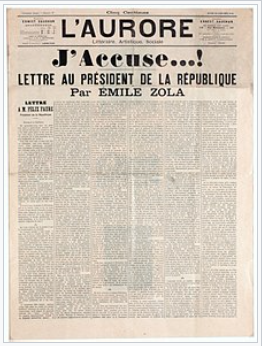 Esterhazy was found not guilty by another secret court martial – before fleeing to England. (see our Dreyfus Affair story for details) There was a massive outpouring of support for Dreyfus, notably from artists and intellectuals – and famously, novelist and journalist Emile Zola, whose impassioned plea to President Felix Foure for a pardon was published on the front page of the January 13, 1898, edition of the Paris daily, L’Aurore under the title, J’Accuse. Zola accused the highest levels of the French Army of obstruction of justice and anti-Semitism, a sentiment which had fuelled sections of the press, the public and the establishment. (Sound familiar?) It was left to Emile Loubet as President, to pardon Dreyfus, 10 days after the sudden death of Faure in scandalous circumstances.
We are rather short of Emile Zolas. ‘Artists and intellectuals’ these days are more likely to screech ‘from the river to the sea’, wearing a keffiyeh, the current equivalent of the swastika, proudly parading the wearer’s hatred of Jews.
The October 7 massacre ignited a pro-Hamas insurgency in Australia (and elsewhere), notably the belligerent demonstration at the Sydney Opera House, on October 8, where the crowd bayed for Jewish blood. Australian leaders became mumbling commentators and the police became silent spectators. Consequently, the demonstrators returned regularly to the streets of Sydney and Melbourne, feeling safe to spew hate.
We often hear that antisemitism is an ancient hatred; one well documented event was the October 11, 1285, attack in Munich that killed approximately180 Jews. On October 10, 1864, massacres of Jews occurred in Tunis and Tripoli. In October 1905, following Tsar Nicholas II’s October Manifesto, a wave of hundreds of anti-Jewish pogroms erupted across the Russian Empire, especially in the south. Estimates indicate roughly 4,000 Jews killed and about 10,000 injured. In Odessa alone, more than 400 Jews were murdered. Violence included mass killings, torture, and attacks on Jewish neighbourhoods.
But of course the worst was to come with the Nazis, whose genocidal practice included the following October events:
- October 27–29, 1938 – Polenaktion (Nazi Germany)
German authorities rounded up and forcibly deported more than 17,000 Jews of Polish Jews (many of whom had lived in Germany for years) to the Polish border. This mass expulsion, carried out under harsh conditions, was a direct precursor to Kristallnacht. - October 8, 1939 – Nazi pogrom in Łódź
Shortly after the German invasion of Poland, a pogrom targeted the Jewish population of Łódź. - October 1941 – Multiple mass killings during the Holocaust
- October 12: Approximately 3,400 Jews from Galicia were executed by Nazi forces.
- Around mid-to-late October: Mass executions of Jews from the Vilna (Vilnius) ghetto (estimated thousands).
- October 25: Romanian forces, in coordination with German units, massacred an estimated 26,000 Jews in Odessa.
Obviously, October is not the only month in which antisemitism manifests and wrongful convictions of Jews for serious crimes have occurred in various periods (including under antisemitic influence in jury selection, media coverage, or investigation). But the confluence of the October anniversary of the infamous Dreyfus case and the October antisemitic violence of recent times is especially notable.
October is also the anniversary of several consequential revolutions, notably the most famous – the Russian October Revolution of 2017. On 25–26 October 1917, the Bolsheviks led by Vladimir Lenin seized power in Petrograd (now St. Petersburg). They overthrew the Provisional Government that had ruled Russia since the February Revolution earlier that year. The event marked the beginning of Soviet rule, led to the Russian Civil War, and ultimately the creation of the Soviet Union. It had enormous global influence on 20th-century politics and inspired communist movements worldwide. It is ironic that the October 1956 Hungarian Revolution was a reaction to oppressive post-World War II communist rule. It wasn’t successful in freeing Hungary of Soviet control (which occurred some 30 years later), but demonstrated how hated the Soviets were.
(We will commemorate the 1956 Hungarian Revolution in our upcoming post, How Suez crisis crashed the Hungarian Revolution: a 70th anniversary card, in our sister blog, pursuedemocracy.com)
Perjury , Serious ! particularly d when used to commit an innocent man.
When police and DPP commit perjury in evidence or by omission, it’s called perverting the course of Justice. Far more serious when the police , prosecution , or judiciary ignore forensic evidence which clears the accused. What sort of country do we live in , if that is allowed to go unpunished. I spent 1 and a half years in jail , one year on parole , and almost 15 years on an offenders list , in spite of evidence which cleared me, not shown to the jury ,2 appeals ignored due to appeal laws and a system which would rather ruin me , with no recourse that seek the truth. In the police brief which was used by DPP
To charge me and convict me there is irrefutable evidence that the alleged crime happened in a room which did not exist and witnesses offered hearsay evidence which put them together with my accuser , 2 years before , records show , that the people involved had ever met. Supported again by police evidence which cleared me of any wrongdoing. Peter V
I know your case and I reckon the litany of sins committed against you by the legal system is as bad as it can get. That is reflected in the 76 page petition your lawyer friend prepared pro bono in outrage. Then came the ultimate sin of refusing to act on that petition by the cowardly NSW Attorney-General of the time, without reason. It’s as if the legal system was doing its best to be worst.