Andrew L. Urban.
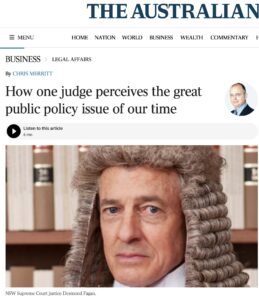
What an exposé! Chris Merritt shows how a judge’s own words provide a rare and distressing insight into how this judge perceives the great public policy issue of our time: antisemitism and hatred of Israel. The judge’s ruling determined that Mohammed Farhat should not be subject to an extended supervision order when he completes his prison sentence for offences committed in a Jewish suburb of Sydney.
Farhat, who has a Hezbollah tattoo on his neck, burned a car and vandalised property with anti-Israel slogans.
My first thought on reading Merritt’s column today (August 21, 2026) was that this NSW Supreme Court judge, Justice Desmond Fagan, isn’t aware never mind ashamed of his bigotry and considers his Jew-hating attitude normal enough to reference it in a judgement, falsities and all. Will he recuse himself from trials involving Jews?
For example:
Par 161 of the judge’s reasons: “Whatever the judgment others might make of right and wrong in the conflict between Israel and Hezbollah, it is understandable that people of Lebanese Shia Muslim heritage would follow closely the military conflict that commenced in late September 2024 and that they would have sympathy for Hezbollah.”
“Yes, you read that correctly,” adds Merritt. “This judge believes it is understandable that people will sympathise with Hezbollah if they are Shia Muslims with a Lebanese heritage.”
Par 116: “It may be reasonably inferred that the results of polling Australian respondents reflect humanitarian reaction to Israel’s genocide of the Gazans since 7 October 2023.”
To be clear, South Africa’s accusation of genocide is still before the ICJ, the only tribunal empowered to decide this question under the Genocide Convention. There has been no finding on the merits of South Africa’s assertion – a point that has been made clear by the ICJ itself.
There’s another point about Fagan’s judgment that deserves scrutiny, writes Merritt: “At paragraph 106, he reproduces part of the definition of antisemitism that has been drawn up by the International Holocaust Remembrance Alliance and proceeds to denounce it.
“He writes that the drafting is “inept” and “the core text is verbose and imprecise”. It is, he writes at paragraph 113, “a parasitic rejection of protest against Israel”.
“At paragraph 114 he says many submissions to a Senate committee “criticised the IHRA definition on the ground that it conflates political criticism of Israel with antisemitism”.
It is worth pointing out, says Merritt, that the IHRA definition received only a passing mention by an expert witness and the judge recognised, at paragraph 117, that the crown’s case did not tender that definition.
My second thought was “how many other judges….?”
The day after I posted this piece, The Australian’s erudite
columnist Henry Ergas also called out the judge’s reasons:
“Respect for the courts is crucial to the rule of law. But, like all respect, it must be earned. By and large, our courts more than earn it every day. And it is precisely so as to defend their standing that decisions that gravely tarnish the courts’ reputation should be called out.
“State of New South Wales v Farhat, handed down this week, is precisely such a decision.
“The court found Mohommed Farhat to be a drug-addicted vandal paid $4000 to paint slogans he did not choose and dismissed the application. Whether that finding is correct is open to debate. What is absolutely indefensible is the court’s decision to stray into extraneous matters on which it proved inconsistent, ill-informed and, ultimately, incoherent.
The errors are typified by what the court felt entitled to declare about Israel, in a case where no party led evidence on the subject. It held, for example, that Israel “achieved demographic Jewish dominance … by forcible expulsion of 750,000 indigenous Palestinians”. Those events, it added, “are uncontroversially established in extensive historical literature”.
In the same paper, columnist Janet Albrechtsen (a qualified lawyer) questions the courts – meaning the judges – over “slippery legal inventions”:
She writes, in part: “… legal niceties are, of course, important. However, the core problem is that our senior courts have made a dog’s breakfast of free speech in this country over many years. Scrap that. I know what’s in my dog’s breakfast. But I cannot for the life of me understand the slippery legal inventions made by judges to empower judges to decide what can and cannot be said in this country.
“Plenty of lawyers more learned than me, and even a few judges, agree the High Court has made a mash of free speech. Some of them will be at the annual Samuel Griffith Society conference in Sydney this weekend, where judicial meddling will be front and centre of a robust debate about free speech.
“The High Court’s invention of an implied freedom of political communication and further inventions of entirely subjective tests that apparently determine when the implied freedom applies, make the whole area harder to decipher than the Voynich Manuscript. At least the Voynich Manuscript has some pictures. This uncertainty means we, the people, have no real clue as to what we can and cannot say – until a High Court cryptographer tells us so.”
She concludes: ‘It would be a travesty and a sign of cowardice, or perhaps hubris, if the High Court refuses to hear Hanson’s appeal.
“It is high time the nation’s most senior court took a long and considered look at the mess they have created and the uncertainly they have foisted on Australians.”
I posted this comment on Albrechtsen’s column”
Janet Albrechtsen’s column today highlights the troubling standards of the judiciary across the board, from the High Court to NSW Supreme Court judge, Justice Desmond Fagan who is reported in this newspaper last Friday to have written in a judgement recently that “it is understandable that people of Lebanese Shia Muslim heritage would follow closely the military conflict that commenced in late September 2024 and that they would have sympathy for Hezbollah.”
The judge’s ruling determined that Mohammed Farhat (with a Hezbollah tattoo on his neck) should not be subject to an extended supervision order when he completes his prison sentence for offences committed in a Jewish suburb of Sydney.
One trial judge failed to stop a prosecutor in a circumstantial case from speculating without evidence as to how a murder was committed. Another judge refused to advise the jury that if they thought a key defence witness could well be telling the truth, they should entertain reasonable doubt about the guilt of the accused.”I wouldn’t go that far,” she told the defence. Plenty more examples …
Appeal court judges regularly demonstrate failings of reason and common sense, also contributing to wrongful convictions.”
My comment was rejected (possibly by the AI moderator).