
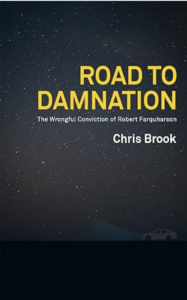
In his important book, Road to Damnation, Chris Brook takes the reader on a gripping journey to the darkest reaches of human experience – the drowning of three children – when it intersects with the law. Brook places the case of Robert Farquharson – their father – at the interface between law, science, society and psychology, as we first reported on October 15, 2020. Farquharson was found guilty and is still in prison, serving a 33 year sentence, but efforts to overturn his conviction continue.
We have published a total of six articles on the case of Robert Farquharson, including three excerpts from Brook’s book. (Access the articles via the menu on the right of this page.) Note our headline: Road to Damnation follows the science to a wrongful conviction – it is literal and also a reference to Brook’s scientific qualifications as an astrophysicist; Chris also has law and commerce degrees. In other words, he is a professional scientist who knows the scientific method. He digs for real evidence, dismisses false narratives and mischaracterisations.
The bare bones:
Police allege Farquharson drove his car with his three young sons into a roadside dam on purpose to drown them. (They didn’t consider whether he was suicidal, since he escaped but couldn’t save the boys.)
Farquharson claims he blacked out in a fit of coughing, the car then out of control careened down the roadside slope into the dam.
After two years investigating the case, Brook had concluded that the evidence indicates that he is innocent.
Victoria’s 2019 appeal laws and the Australian Academy of Science (AAS) have fundamentally altered Robert Farquharson’s legal challenge. By shifting the focus from subjective human intent to strict scientific proof, this pairing targets the core of his conviction.
1. The Statutory Framework: Victoria’s 2019 Laws The Justice Legislation Amendment (Criminal Appeals) Act 2019 introduced a subsequent right of appeal. This law bypassed the previous legal dead-end after a High Court rejection, establishing a strict two-pronged statutory test for a retrial or acquittal: Fresh Evidence that was not and could not reasonably have been produced during the 2007 or 2010 trials.
Compelling: Reliable, high-probative data strong enough to make a jury acquittal highly likely. This framework shifts the legal burden. Farquharson’s team cannot simply argue that the initial trials were unfair; they must introduce structurally new, objective facts.
2. The AAS: Vetting Forensic Integrity The Australian Academy of Science (AAS) acts as the scientific gatekeeper for this fresh evidence. Led by Chief Executive Anna-Maria Arabia, the AAS addresses a systemic vulnerability: Australian courts lack a mandatory reliability standard for expert testimony, allowing unchecked “junk science” into evidence. A working example:
1. Formal Validation Testing ────────> Does it pass peer review?
2. Error Rate Quantification ────────> Is accuracy transparency clear?
3. Institutional Independence ───────> Is it free from police bias?
The AAS applies rigorous scientific scrutiny to legal evidence through three main mechanisms:Enforcing Validation Testing. The AAS demands that forensic techniques undergo formal validation before their conclusions are admitted in court.
In Farquharson’s case, the AAS noted that the prosecution’s traffic reconstruction and vehicle-sinking models failed to pass standard scientific reliability tests.
Exposing Error Rates: Unlike the legal system which historically accepted expert opinions as infallible, the AAS insists on declaring clear scientific error rates. This isolates speculative opinion from peer-reviewed fact.
Lobbying for Structural Reform: Following the wrongful conviction of Kathleen Folbigg, the AAS has used its institutional weight to campaign for a permanent, independent Criminal Cases Review Commission. This would establish dedicated, independent scientific panels to evaluate contested forensic evidence outside the adversarial court structure.
By applying this rigorous standard, the AAS transforms Farquharson’s original defense arguments into fresh, compelling data. This framework helps demonstrate that his conviction relied on unvalidated methodologies that do not meet modern scientific standards.
I would add that, as I’ve always noted; the notion that he drove into the dam on purpose to drown the youngsters lacks credibility. First, there was no evidence he wanted them dead. Second, there was no evidence he was ready to die himself. He barely escaped. It’s a typical grasping for a motive, when police want a reason to prosecute but can’t present a credible rationale. Other examples include Sue Neill-Fraser, Robert Xie and Steven’s own case.