
Andrew L. Urban
Even some judges have called for reforms to laws shielding sex abuse claimants (see below) – why has the legal system done nothing about it?
Bettina Arndt’s report on the case of Anthony Listershows that a coordinated campaign by young women determined to take a man down with fake charges ranging from touching a breast, to throwing a woman across the room and violently raping her got to court. All of these accusations were ultimately discredited in court and dismissed by two juries. Shouldn’t the false claims lead to consequences?
Policy guidance across Australia discourages charging complainants for perjury in sexual cases to avoid deterring genuine victims from reporting. The trouble with this guidance is that it encourages complainants to make false claims, as Arndt reported on April 7, 2022:
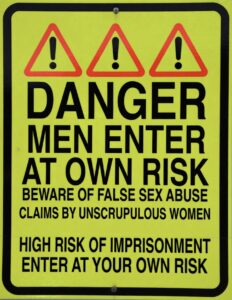
“Police officers across the country all reported last week that they are told never to take action against a woman caught out making false violence or rape allegations, lest punishment of false accusers deters genuine victims from coming forward,” as she recounts a case where police and the DPP ignored clear video evidence revealing a man’s former wife’s rape and assault allegations to be “demonstrably false” said the judge. Yet she suffered no adverse consequences.
Last year, on February 11, 2024, we carried a report from The Sunday Telegraph revealing that the day before the accused man’s rape trial began, the complainant’s deception came to light: she had rehearsed a script for a phone call to manipulate AA* into making admissions to a rape that didn’t happen.
Under the Crimes Act 1900 (NSW), s 319, perverting the course of justice, which seems to apply here, is a serious indictable offence carrying a maximum penalty of 14 years’ imprisonment, with substantial custodial sentences routinely imposed for grave conduct.
During a recent rape trial, the complainant’s history of accusing men of rape in four similar circumstances to the man on trial was largely not allowed into evidence due to section 294CB of the Evidence Act in NSW, which forbids tendency evidence that goes to a complainant’s sexual history from being placed before a jury. (The accused has no such protection from tendency evidence.)
Unlike in other states, the NSW legislation has no exception provision. NSW District Court Judge Robert Newlinds SC has echoed other judges in saying there was “a serious need for law reform in this regard”. He was quoted in The Australian (December 16/17, 2023) “I do think that the trial was unfair because the applicant was not able to put before the jury the true history of the complainant’s complaints thus putting into context all of her evidence and the circumstances of her conduct before the jury,” the judge said.
The accused man spent eight months in prison before eventually being granted bail and then acquitted by a jury on December 4, 2023. But he had already been punished, notwithstanding he was innocent. And his accuser?
*Name withheld under court suppression order
Shocking 😡 False accusations can ruin lives, yet some laws protect liars more than the innocent 😔⚖️. We need fair justice for everyone, both victims and the wrongly accused 🙏🕊️. #JusticeMatters #FairTrial #StopFalseClaims
This is very close to my heart, and false allegations must be punished as per the law. Anthony Lister has been through hell! As have many others.
Not only females make false claims of sexual assault. What about young men, who claim abuse to gain financial compensation? The case of foster parent Tom Easling comes to mind, accused to 20 charges of abuse by a foster child. Tom was found not guilty on all charges. The young man had made it all up – and didn’t even get a slap on the wrist. Figure that!
See our new report:
https://wrongfulconvictionsreport.org/2026/01/29/men-make-false-sex-assault-claims-too/
Everyone is terrified of the radical feminists and this is the result. The wholesale corruption of the legal process. Feminism is about nothing if not the denial of due process. It is time to start jailing any legislator who proposes laws which are blatantly in breach of constitutional safeguards. It is also time to start jailing any police officer who follows up on blatantly false – accusations ie those without any corroborating evidence.