
Arguably the most controversial recent murder (mis)trial in the world will have an encore, but expect the verdict (whatever it is) to be controversial – and without an acknowledgement of the chemical fingerprints left by a modern psychiatric care system that has lost its way. Let’s also consider good ole’ common sense …
A second trial for Lindsay Clancy has been set for March 29, 2027. Common sense will again be an absent, unacknowledged participant. (Not a unique circumstance in murder trials, we have found.) We would put it to the new jury (and those furious with Clancy as a murderous mother) that when a demonstrably loving mother on a cocktail of conflicting medications suddenly turns into a murderous monster, investigators and prosecutors should not have dismissed the role those medications played in her state of mind. Common sense, right? This is the central issue in this case: was Lindsay Clancy so buffeted by multiple medications that she was literally off mental balance to a deadly degree?
Between late summer 2022 and January 2023, Lindsay was prescribed over a dozen very powerful mind-altering psychiatric drugs. Zoloft, Prozac, Lexapro, Klonopin, Ativan, Valium, Ambien, Trazodone, Hydroxyzine, Amitriptyline, Seroquel, Buspar, Lamictal.
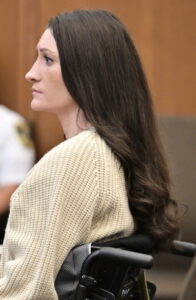
Wheelchair-bound Lindsay Clancy in court
Commentators (even the most level headed) and the tik-toking public fell over themselves with condemnations of Clancy, jumping past common sense considerations, their raw emotional response to the death of the three children understandably fuelling their venomous outrage. How could she? What a monster!
Jury verdict: 11 – not guilty, 1 – guilty
The jury in her trial certainly had an inkling that the medications played a role: during their deliberations, they didn’t just ask the judge if they could review legal transcripts, but they demanded to see the physical bags of prescription pill bottles. And 11 of the 12 went on to declare Clancy not guilty. Consider that! After the mistrial, we published the 20 minute video by caregiving researcher Neal K. Shaw, which is essential viewing (and/or reading the transcript). In it he says: “I’m Neal K. Shaw. As a Johns Hopkins and NIH funded caregiving researcher and a family caregiver myself and the CEO of CareYaya, I spend every single day working with families, older adults, and caregivers who are trying their best to navigate the deep cracks of our broken healthcare system. I see firsthand how modern healthcare routinely ignores human suffering, dismisses family instincts, and often replaces real care with a barrage of toxic prescriptions.
“By asking to see those pill bottles and deliberations and by the abrupt resignation of the star witness from his hospital job for the prosecution, I think most people across America are looking directly at the chemical fingerprints left by our modern psychiatric care system that has completely lost its way.”
Then there was this: “Defence attorney Kevin Reddington began pressing Mack on the biological realities of perinatal mental health. And under oath, the state’s foremost psychiatric witness dropped a statement so astonishing that it left healthcare experts across the country just gasping. Mack testified that he didn’t even factor postpartum conditions into his evaluation and he then went on to claim that the postpartum period only lasts four weeks after birth. Four weeks. Now I’m not a postpartum expert, but any perinatal specialist, any midwife, even any mother who has given birth knows that hormonal fluctuations, neurological adaptations and postpartum mood disorders can sometimes reach for months or even an entire year or more after delivery.
“Yet here was the prosecution’s star witness and supposedly an expert in psychiatry brought in to send a woman to prison for life without parole, operating on an archaic dismissive definition that just totally ignores the biological context of the crisis.”

Patrick Clancy
In the heart-wrenching US 60 Minutes interview (Sunday, Sept. 20, 2026, by Ross Douthat, Michael Karzis) her husband Patrick Clancy says “it was her mental illness … (which) has this ability to be tragically deceptive”.
We rest our case.
Prosecutors in the case had argued in a status hearing on Monday US time that they needed more time and hoped to push the date back to May, or at least the end of April. Assistant District Attorney Jennifer Sprague told the court that prosecutors will be dealing with other trials in March, and would need time to prepare for Clancy’s trial after those are finished.
She said defendants in those cases have been waiting in jail for their day in court, and that the District Attorney’s office didn’t want to postpone them further to make room for the Clancy case.
Some defendants had already filed motions saying the Clancy trial was being given undue priority, she said.
“So I don’t understand why this defendant would be entitled to a second trial before some of these older other cases where people are waiting in custody in jail get their first trial date,” she said. Judge William Sullivan resisted those arguments. He told the prosecutors, and Clancy attorney Kevin Reddington, to pick a date, and adjustments could be made later.
“Generally, the sooner the case is retried, the better it is for all of the parties, including the attorneys, rather than waiting a year to get something done,” he said. “This gives everybody four months to prepare, four months to make adjustments in regards to their schedules. That’s a pretty significant amount of time.” A status hearing in the case is set for Dec. 30, and a pretrial conference is set for Feb. 18, 2027.
Clancy’s lawyers acknowledged that she strangled her three children in January 2023 but argued she was suffering from postpartum psychosis and was “not guilty by reason of insanity.” Sullivan declared a mistrial after the jury could not reach a unanimous verdict. The vote was 11–1.
Her defence team has recently switched tactics and now argues that her previous admissions cannot be corroborated and that she may have been operating under false memories of having committed the crime.
The new trial comes after Sullivan rejected multiple motions to have the case dismissed. Her attorneys had argued that the state had not done enough to prove its case.
They also said the case should have been thrown out for reasons of double jeopardy, arguing the judge should have dismissed the holdout juror after allegations were made that he refused to properly apply the legal concept of “reasonable doubt.”
But the holdout, one of only three men on the jury, later said he had no doubts.
“As I tried to explain different possible theories during deliberation, I kept getting cut off as if I had doubts based on the evidence presented,” he said in a statement after his identity was publicly revealed.
“Based on all the physical evidence, key witnesses, and what the prosecution presented, I thought it was enough proof that [Clancy] knew exactly what she was doing and planned.”
https://wrongfulconvictionsreport.org/category/case-32-lindsay-clancy/