
Andrew L. Urban.
Noel Greenaway and Frank Valentine were both, at different times, child welfare officers at the Parramatta Training School for Girls (GTS), back in the 60s and 70s, a place for troubled and troublesome young teenage girls, generally around 14-15. Decades later, some of the former inmates responded to the promptings of lawyers, media and politicians, to come forward and make allegations of sexual and physical abuse against these two men, the only surviving male staff from those years. The Royal Commission into Institutional Responses to Child Sexual Abuse (2013-2017) was all ears. As were the police and later the courts. All they had to do was make their claims, which until then they had never mentioned to anyone. Corroboration was not required. Both men were found guilty of a number of the charges – no surprise.
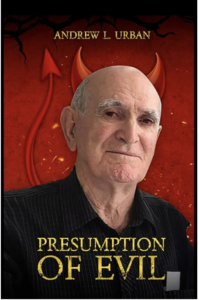
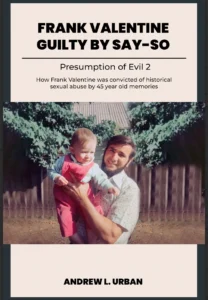
We reported extensively on both cases and I published a book on each: Presumption of Evil (Greenaway) and Guilty by Say-So (Valentine). The reports can be accessed from the menu at the right of this page.
In April 2015, eight months before Frank Valentine would be interviewed by police and four years before his 2019 trial, Maris Valentine BA completed a thorough report exposing flaws in the relevant processes of the Royal Commission. Maris is a former District Officer of the Department of Child Welfare, having been employed on three separate occasions between 1967 and 1989 and with considerable experience dealing with sexually abused girls – and often their abused mothers. She lived in at GTS Parramatta for a week as part of the Residential Care component of the District Officers’ Training Course in 1967 and was a frequent visitor to the Institution during 1971-3 whilst her husband was employed there in the most junior administrative role of Relieving Deputy Superintendent.
 Her report reveals the gross errors that led the 2013 Royal Commission’s processes in Case Study No 7 (the GTS study) into failings against the fair application of the rule of law. As an introduction to her report, Maris Valentine gives a glimpse how serious factual errors of a defamatory nature infected the Commission’s work. It is a disturbing study.
ABSTRACT
The Royal Commission into Institutional Responses to Child Sexual Abuse – Case Study No.7 (Parramatta Girls Training School), examined the testimonies of 16 witnesses who were former inmates at Parramatta GTS. However, this has been done in a one-dimensional way without reference to the experiences of people who were working in the Institution at the time, or of women who had different experiences as girls at Parramatta from those who gave evidence, or of people who had experience with the girls who were inmates at Parramatta and the behaviour many exhibited during the relevant time period. All of this information was available and is necessary.
Too many instances of serious factual errors of a defamatory nature have been uncovered in the records freely available on the Commission’s website. The records have largely been ignored and as a result serious injustices have occurred to some of the alleged perpetrators. A total of five men are involved and perhaps as many as eight men have been defamed. Seven and perhaps eight women are involved.
So many instances of serious factual mistakes of memory have occurred in the testimonies of the witnesses that grave concern exists about the justice of any move to consider totally removing the Statute of Limitations with regard to sexual assault. For the same reason, grave consideration needs to be given to the principle of ‘openness and transparency’ as it applies to the unfettered publication of untested allegations of heinous child sexual assault. Unfortunately, such allegations are too often assumed to be true. Newspapers should not be used as a de facto arm of the law by ‘naming and shaming’.
In order to achieve justice for future victims of child sexual abuse, strategies need to be in place so that early reporting of abuse is encouraged and likely. It is understood that now this is often the case.
The Commission is ethically obliged to restore reputations where possible and to seriously examine its modus operandi for future Public Hearings. The law should not inflict damage on innocent people.
Because the Commission has permitted unnecessary full media publication of alleged perpetrators’ names in the interests of “openness and transparency” the Commission is also ethically obliged to recommend compensation to people whose reputations and health have been damaged by false allegations of child sexual abuse that have occurred as a result of the conduct of this Commission. A false allegation of child sexual abuse is just as serious to the person falsely accused as real child sexual abuse is to the person abused.
***
I visited Noel Greenaway in maximum security in mid-2024. He is still in prison in September 2026, now 89. Frank Valentine died in prison in August 2024, aged 83.
As I detail in my book, the court was provided with dozens of glowing character references for the law-abiding, morally upright Noel Greenaway for the purposes of sentencing (little good did they do him). But the characters of his accusers were never examined. Of course, the jury didn’t get to see Noel’s character references, but my point is how the presumption of innocence is lost in such cases.
The eulogies at Frank Valentine’s funeral also painted a picture of a decent, law abiding man.
But the claim that their convictions were wrongful doesn’t rely on those glowing character references but on the transcripts of their trials and the courts accepting the uncorroborated – and often suspect – claims against them. For example, take the litany of errors by Frank Valentune’s trial judge, Nicole Noman, as outlined in Valentine’s appeal against his convictions. The judges hearing the appeal, Basten AJA, Button J and Wilson J, failed to accept the many errors.
Some of the 500 points in the appeal document by Valentine’s legal team:
-The trial judge erred in making critical findings of fact which were not open in reasoning towards guilt.
-The trial judge erred in failing to have regard to, or acknowledge, what was uncontradicted in the evidence giving rise to a reasonable doubt.
-It is contended the compounding improbabilities caused by the unchallenged or competing evidence at trial required of the judge acting rationally to have entertained a doubt in respect of the allegations of each complainant.
-It is to be noted that in the Reasons the trial judge observed that she was not to be inappropriately influenced by palpable distress, yet the Reasons contain no analysis of why it was appropriate to be influenced by DW’s “palpable distress”.
-The trial judge evidently concluded that “she could tell truth from falsehood accurately on the basis of such appearances” including by the “manner” of a witness’ appearing to do their best. (See below)
-Mrs Valentine’s evidence was entirely rejected on critical issues because it was unpersuasive yet when capable of being set against objective evidence it was wholly persuasive. For example, Mrs Valentine was captured on intercept material referring to a camp at Daruk, at which her car was stolen, which measured against the documentary was clearly correct. That camp, the evidence established, was March 1974. She referred to what must have been (complainant) DW in intercept material as a lovely boy, entirely consistent with her retaining a photo of him, yet her Honour found as much irreconcilable with the defence case and moreover in a way persuasive of guilt.
The “key issues” which underpinned her Honour rejecting the appellant’s evidence in its entirety were not identified..