In response to our report about a war zone that pits soldiers against fake civilians as insurgents, Insurgents 24/7, STEVEN FENNELL teases out why the many tangible and intangible costs of ignoring the operational reality of asymmetric conflict are so high as in the case of Ben Roberts-Smith.
The core difficulty in the Ben Roberts-Smith matter remains a structural mismatch between the legal and public frameworks applied after the fact and the operational environment of asymmetric warfare in Afghanistan. The Wrongful Convictions Report Insurgents 24/7 correctly draws the parallel with Budapest in 1956: un-uniformed [Ed: and maybe armed] civilians, including children, functioned as continuous combatants. Soviet forces could not distinguish threat from non-threat by appearance.
The same condition faced Australian special forces confronting Taliban fighters who deliberately discarded uniforms, embedded in the civilian population, and treated every interaction as potential combat.
In conventional war, uniforms and front lines make the principle of distinction workable. Asymmetric conflict inverts it. The Taliban’s own guidance instructed fighters to adopt local civilian dress precisely to improve mobility and survivability. An individual who appears unarmed at one moment may have been directing fire, emplacing an IED, or acting as a spotter minutes earlier.
Australian rules of engagement recognised that unarmed persons could lawfully be engaged if assessed as directly participating in hostilities; based on observed tactics, techniques and procedures, not mere suspicion. That assessment occurs under time pressure, incomplete information, and the knowledge that hesitation can be fatal.
Reconstructing those decisions years later as if they were deliberative exercises conducted with full discovery and leisure is not analysis; it is anachronism.
This is not an argument that accountability is impossible. It is an argument that accountability must be calibrated to the actual conditions of the conflict.
The civil findings rested on the balance of probabilities and contested recollections of events more than a decade old in a theatre where crime scenes were never preserved under forensic protocols. Criminal liability requires proof beyond reasonable doubt. Memory of high-stress combat is reconstructive, not photographic. Conflicting accounts from participants who operated under the same pressures are predictable. Treating one set of delayed recollections as definitive while discounting the operational context produces a distorted picture.
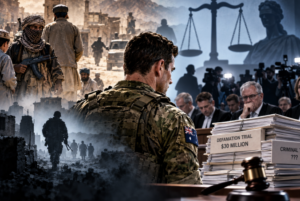
When the evidence base is almost entirely historical “say-so,” the risk of error is not theoretical; it is structural. There is a further, more prosaic problem: cost and institutional value. The defamation proceedings alone consumed resources on a scale most Australians cannot comprehend. Roberts-Smith’s recent interview confirmed that the civil action cost his backer upwards of $30 million — a figure that would bankrupt any ordinary family many times over. That sum purchased senior counsel, extensive discovery, expert evidence, and more than a hundred sitting days. It still produced a loss on the civil standard. The criminal process now underway — with its national security information protocols, closed hearings, remote and protected witnesses, complex disclosure regimes, and multi-year timeline will consume many more millions, drawn from the same finite public purse that funds courts, police, and the defence force itself.
Four individuals who have admitted involvement in executions received immunity in exchange for testimony. Equality before the law is a fine principle, but it is difficult to maintain with a straight face when the system immunises admitted participants in order to concentrate fire on the highest-profile target. The result looks less like even-handed justice and more like selective theatre.
The $30 million civil figure is not merely a curiosity of high-end litigation. It is a distorting mirror. If a war chest of that magnitude, backed by corporate resources, can still leave a defendant financially and reputationally damaged after years of process, the position of the ordinary citizen facing a false allegation or a weak circumstantial brief is self-evident. For most people the choice is not between fighting and winning; it is between fighting and financial ruin, or folding early to limit the bleeding.
The system extracts a heavy price simply for the privilege of contesting the state’s case.
revisionism dressed as principle
The social and emotional content of this particular prosecution is unavoidable and corrosive. Australia’s most decorated living soldier is placed in the dock on charges arising from operations conducted under rules of engagement authorised by the government of the day. Public discourse is already saturated with pre-judgment. A jury drawn from that environment faces an almost impossible task of setting aside years of media narrative. Even if the prosecution ultimately fails to meet the criminal standard a realistic prospect given the passage of time, the absence of contemporary forensic evidence, and the inherent ambiguities of asymmetric combat — the process itself will have exacted a heavy price: years of personal and institutional damage, substantial public expenditure, and a further erosion of confidence among those who serve in high-risk environments. The justice system’s own track record in complex, memory-dependent cases offers little reassurance that a fair and reliable outcome is the most probable result.
None of this denies that unlawful killings can occur in armed conflict, nor that they should be investigated. It insists that the determination of lawfulness cannot be made by abstracting the act from the environment in which it occurred. An engagement that would be criminal in a domestic policing context may be lawful under the law of armed conflict when the individual was assessed, on the information available at the time, as directly participating in hostilities or as performing a continuous combat function.
Hindsight that substitutes perfect information and unlimited time for the actual conditions of the engagement is not justice; it is revisionism dressed as principle.
question of institutional judgment
Objective evaluation therefore requires three disciplined steps. First, reconstruct the tactical picture as it presented itself to the operators , enemy TTPs, prior intelligence, immediate observations, and the compressed decision cycle. Second, apply the relevant rules of engagement and the international humanitarian law concepts of distinction, direct participation, and continuous combat function as they were understood and instructed at the time. Third, weigh the reliability of evidence against the known limitations of delayed recollection, the absence of contemporaneous records, and the incentives created by immunity arrangements.
The Hungarian example and the Afghan operational environment demonstrate the same structural fact: when an adversary elects to fight without uniforms and without temporal limits on belligerency, the burden of ambiguity falls on the uniformed force. That burden cannot be wished away by later insistence on peacetime standards. Continuing to pour millions into a process that is likely to produce neither clear legal resolution nor public catharsis, while concentrating the full weight of the system on Australia’s most decorated living soldier, raises a simple question of institutional judgment.
Resources, time, and the presumption of innocence are finite. Spending them on a case so heavily freighted with social and emotional content, on evidence so heavily dependent on contested memory, risks delivering the worst of both worlds: no conviction, substantial cost, and lasting damage to the relationship between the nation and those it sends to fight on its behalf.