
STEVEN FENNELL explores both sides of the Nicola Gobbo debate, wrongful convictions and the fracture of Australian justice.
This article is designed to provoke robust and honest debate on one of the most contentious episodes in modern Australian legal history, the Lawyer X scandal. At its centre is Nicola Gobbo (Informer 3838), a Victorian criminal defence barrister who secretly acted as a high-level police informant against many of the clients she was professionally obliged to defend. Her actions helped secure convictions during Melbourne’s violent gangland wars but at the cost of fundamentally undermining the solicitor-client relationship.
The scandal raises a sharp question about wrongful convictions: Were individuals such as Tony Mokbel and Faruk Orman rightfully convicted of serious crimes, yet convicted in a wrongful manner because the process was irredeemably tainted by the betrayal of legal professional privilege? Or does the gravity of the gangland violence justify bending the rules in exceptional circumstances? As of April 2026, the legal fallout continues to divide opinions between those demanding criminal accountability and those who view Gobbo as a flawed but effective tool against organised crime.
The Shadow of the Bar: Systemic Crisis in Australian Justice
Nicola Gobbo’s conduct between 2005 and 2009 as a registered police informant while representing criminal clients lies at the heart of the crisis. The High Court of Australia unanimously condemned her actions and those of Victoria Police as a “fundamental and appalling breach” of the lawyer-client relationship that “corrupted the criminal justice system” and “debased fundamental premises” on which it rests.
This breach directly contributed to convictions that were later quashed, raising the uncomfortable distinction between substantive guilt and procedural fairness. If evidence or strategy was compromised by a lawyer secretly assisting the prosecution, can the resulting conviction stand as legitimate justice?
The Argument for Conviction: The “Rule of Law” Perspective
Advocates for criminal prosecution of Gobbo and her Victoria Police handlers rest their case on the absolute sanctity of the solicitor-client relationship, a cornerstone of fair trials protected by long-established common law principles and professional rules.
- Systemic Corruption and Dangerous Precedent: Allowing such a profound breach to go unpunished suggests the state may ignore the law when it suits enforcement purposes. The High Court’s strong language underscores that this was no minor ethical lapse but a corruption of the justice system itself.
- Right to a Fair Trial and Wrongful Convictions: By covertly informing against clients like Tony Mokbel and Faruk Orman, Gobbo helped engineer what critics describe as “show trials.” Convictions obtained through the subversion of legal professional privilege are not victories for justice; they represent miscarriages of justice. In these cases, the accused may well have been guilty of serious offending, yet they suffered wrongful convictions in the procedural sense—the convictions were secured by means that undermined the very fairness of the trial process.
- Failure of Accountability: Despite the Royal Commission into the Management of Police Informants (costing taxpayers well over $120 million) and the subsequent appointment of a Special Investigator, no criminal charges were laid against Gobbo or the police officers involved. The Director of Public Prosecutions declined to prosecute in 2023, and the Office of the Special Investigator was disbanded in February 2024. Many view this outcome as the state protecting its own.
Gobbo is currently represented in her civil matters by lawyer Angela Sdrinis. She was permanently struck off the roll of legal practitioners, reflecting the severity of her professional misconduct.
The Argument for Support: The “Pragmatic” Perspective
While few endorse Gobbo’s methods in principle, her defenders—frequently former senior police figures and sections of the public traumatised by years of gangland violence—emphasise context and outcomes.
- Ending the Gangland Wars: From 1998 to 2010, Melbourne experienced over 30 murders linked to underworld conflicts. Gobbo provided police with unparalleled access to the inner circles of major drug syndicates, acting as a “unique weapon” that helped dismantle networks responsible for widespread violence and trafficking.
- Community Safety Over Procedural Niceties: In this view, the “noble cause” of protecting the public and stopping further bloodshed outweighed strict ethical rules. Without her information, figures like Tony Mokbel might have continued their operations, costing more innocent lives.
- Personal Sacrifice: Gobbo has lived in hiding for years under credible death threats from the criminal networks she helped expose. Supporters see her as a deeply flawed informant who rendered a significant public service at enormous personal cost to her career and safety.
Motives, Costs, Time and the High Stakes
Gobbo’s motivations appear complex: a claimed desire to halt the gangland bloodshed and serve the greater good; the thrill of operating as a double agent close to power; and elements of self-preservation amid her entanglement with serious criminals.
The scandal has already imposed massive financial and temporal burdens on Victoria. The Royal Commission alone exceeded $120 million, with additional tens of millions spent on the Special Investigator’s office, legal defences, appeals, and related litigation. Gobbo reportedly received a $3 million settlement from police in 2010. Her subsequent negligence claim against the State of Victoria was dismissed by the Supreme Court in June 2025, with her ordered to pay the state’s costs.
If arguments broadly justifying her conduct or shielding state actors from accountability were to prevail further, Victoria could face a wave of additional compensation claims, retrials (where possible), and eroded public confidence in the justice system—potentially costing taxpayers tens or hundreds of millions more while weakening deterrence against organised crime.
If, on the other hand, meaningful accountability remains absent, it risks normalising ethical shortcuts by law enforcement in pursuit of results. This could encourage future breaches and leave those who suffered tainted convictions without adequate redress. The Human Source Management Act 2023 (Vic) now imposes a stricter regulatory framework. It generally prohibits the use of lawyers as human sources except in tightly controlled circumstances (including prior Supreme Court authorisation where privileged information is involved), but critics argue the legislation still contains loopholes and arrived too late to prevent the original scandal.
A Question for Debate: Rightfully Convicted, Yet Convicted Wrongfully?
The Lawyer X affair forces a difficult choice: Does uncompromising adherence to the rule of law, including the inviolability of legal professional privilege, best protect society in the long term? Or must it sometimes yield to the immediate demands of public safety during times of exceptional criminal violence?
Were the gangland figures whose convictions were quashed (including Tony Mokbel, who walked free in early 2026 after prosecutors dropped further proceedings) wrongfully convicted, or were they rightfully convicted of grave offences but in a manner so corrupted that the convictions could not be allowed to stand?
There are no simple answers. The convictions may have reflected substantive guilt, yet the betrayal of the lawyer-client relationship rendered the process illegitimate in the eyes of the law. This tension—between justice in outcome and justice in process—lies at the heart of the ongoing debate.
As Victoria grapples with the cultural and legislative legacy of the scandal, the question remains pressing: In the fight against serious crime, how far should the state be permitted to go? The answer will influence the balance between individual rights, public safety, and institutional integrity for decades to come.
Key Legal References
- AB (a pseudonym) v CD (a pseudonym); EF (a pseudonym) v CD (a pseudonym) [2018] HCA 58, [10]–[12] (High Court description of the “fundamental and appalling breach”).
- Royal Commission into the Management of Police Informants, Final Report (2020).
- Human Source Management Act 2023 (Vic), especially Part 3, Division 3 (regulation of lawyers as human sources).
- Legal Profession Uniform Conduct (Barristers) Rules 2015 (Vic), rr 27–29, 101 (obligations regarding confidentiality, conflicts of interest, and client privilege).
- Gobbo v State of Victoria [2025] VSC 334 (13 June 2025), [162] and following (dismissal of negligence claim on grounds including prior 2010 settlement and voluntary assumption of risk).
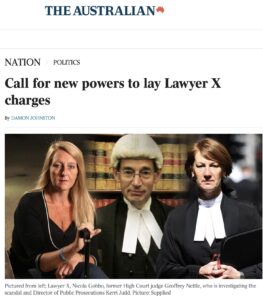
Pictured from left; Lawyer X, Nicola Gobbo, former High Court judge Geoffrey Nettle, who investigated the scandal and Director of Public Prosecutions Kerri Judd. Picture: Supplied
Ann raises a deeply uncomfortable but necessary question about whether institutional pressure, tunnel vision, and “case ownership” can distort the handling of evidence once police become convinced they have the right person. The examples she cites from the Lawyer X Royal Commission, Operation Gloucester, and the prosecution of George Pell reveal recurring concerns that go far beyond any single case.
The findings emerging from Operation Gloucester were particularly alarming because they did not concern isolated administrative errors or innocent oversights. They involved systemic practices that strike at the integrity of the criminal justice process itself: omitting descriptions given by witnesses, “fixing up” inconsistencies, replacing statements, back-dating documents, and failing to disclose material favourable to the defence. Those are not minor procedural defects. They are behaviours capable of fundamentally reshaping the narrative presented to a jury.
What makes Ann’s observations especially compelling is the overlap of personnel and investigative culture. The same detective, Paul Sheridan, appeared in both the Silk-Miller investigations and later the Pell investigation. That does not prove wrongdoing in itself, but it does make scrutiny both legitimate and necessary, particularly when the same criticisms about investigative selectivity emerge in multiple contexts.
The issue Ann highlights regarding the wine cupboard in the Priests’ Sacristy is also difficult to dismiss as trivial. If a complainant describes finding wine in a cupboard configuration that did not exist at the relevant time, and police already possessed information contradicting that account years before trial, then naturally questions arise about why that inconsistency was not more aggressively pursued. The concern is not merely whether a witness can make mistakes — all witnesses can. The concern is whether investigators actively tested evidence that undermined the prosecution theory with the same enthusiasm they applied to evidence supporting it.
That point resonates strongly with my own experience.
In my own case, a witness portrayed me as “scum” in his original police statement and claimed that after 2008 he had never been near my street and had not spoken to me again. Yet under oath he later gave evidence that he attended my home in either 2010 or 2011 to work on a trailer. That alone was a direct contradiction. More importantly, his original statement reportedly placed the event in 2008 — a date that was impossible because the trailer itself was not even purchased until 2009.
That should have been devastating to the reliability of the witness.
Instead of treating the contradiction as fatal, the timeline appeared to be “corrected” and massaged into something merely survivable. The impossible version quietly became a revised version. The broader implication is troubling: once police become locked onto a person of interest, contradictory evidence is too often treated not as a reason to reconsider the theory, but as a problem to be managed.
That is precisely the danger Ann is pointing to.
The public is often told that police investigations are impartial searches for truth. In reality, many wrongful conviction cases demonstrate something quite different can occur once institutional momentum takes hold. Evidence inconsistent with guilt becomes inconvenient. Witnesses are “clarified.” Contradictions are rationalised. Alternative possibilities shrink in importance. The investigation subtly transforms from “What happened?” into “How do we prove what we already believe happened?”
The greater concern is that these problems do not end with police.
In my case, despite obvious timeline corruption, the ODPP did nothing to correct the situation. The prosecutor simply told the jury that the witness’s evidence should be accepted, despite knowing the chronology was fundamentally compromised. Compromised is a kind term his witness was a busted changing his statements to best suit the police case. This witness had been relocated at police /taxpayer expenses.
That matters for two reasons firstly because he had a debt to police and secondly because prosecutors are not supposed to be mere advocates seeking victory at all costs. Their obligation is to fairness and justice. If a witness’s evidence is internally impossible, or only survives because inconvenient facts have been reshaped or ignored, then the Crown has a duty to confront that reality honestly.
Too often, however, the system appears to reward conviction preservation over truth seeking. Too often, juries accept what is said without looking at the statements with any degree of critical thinking – critical thinking being their singular task as members of the jury.
Ann’s examples matter because they reveal a pattern seen repeatedly across different cases and jurisdictions: investigative certainty can become self-reinforcing. Once police, prosecutors, or institutions emotionally invest in a narrative, contradictory evidence is no longer treated neutrally. It becomes an obstacle.
That is why independent disclosure obligations, rigorous defence advocacy, and genuinely sceptical judicial oversight are so critical. Without them, the adversarial system risks becoming less a search for truth and more a contest over whose narrative survives long enough to reach a jury intact.
The news reports and website exhibits about the Lawyer X Royal Commission (Royal Commission into the Management of Police Informants) around the period 2019/2020 were interesting in light of Cardinal Pell matters at the time. Emails made available to that RC revealed that back in April 2014 – just hours before the Herald Sun broke the Lawyer X story – a VicPol assistant media/comms staff member sent an email to Commissioner G Ashton recommending limited response to the Herald Sun story as “the Pell stuff is coming tomorrow and will knock this off the front page.”
With respect to police practices in relation to witness statements – In early 2019, IBAC was conducting public examinations into alleged serious misconduct related to the investigation of the 1998 murders of police officers G Silk and R Miller.
From Operation Gloucester (https://www.ibac.vic.gov.au/operation-gloucester)
Improper statement-taking practices by Victoria Police identified during the hearings:
Omitting a witness’ description of an offender.
Omitting information which is contradicted by other evidence or is otherwise perceived by police to be unreliable.
Speaking to witnesses to ‘fix up inconsistencies’ in the evidence, and not disclosing that intervention.
Taking a replacement statement instead of a supplementary one.
Signing a back-dated statement.
Signing an acknowledgement in the absence of the statement maker.
Making supposed ‘contemporaneous’ notes well after the fact.
Failing to disclose information which may assist the defence.
One of the TV Underbelly programs, “Tell Them Lucifer was Here”, is the story about the Silk-Miller murders and the lead detective is Paul Sheridan who was also involved with Cardinal Pell’s case. Sheridan travelled to Rome and participated in Pell’s police interview in October 2016. According to a March 2018 New York Times article at the Pell Committal, Pell’s barrister :
“… suggested that the police may have avoided specific lines of questioning while collecting evidence and statements that led to the charges against the cardinal.”
“It would be horrible if an investigator decided not to pursue an obvious line of questioning just because he was afraid that the answers might destroy his case,” Mr. Richter said to Superintendent Paul Sheridan, the detective who led the investigation into the cardinal for the last two years.
“I would agree with that,” replied Mr. Sheridan, who stood for the entirety of his cross-examination, angling his body and eyes away from Mr. Richter. At several points, Mr. Richter mentioned that he and Mr. Sheridan had known each other for a long time.”
In Cardinal Pell’s Prison Journal Vol 3, he writes about the prisoner called “Derek” who is in the cell next to his at Barwon prison. “Derek” had been convicted in 2002 for the Silk-Miller murders – and was appealing his conviction. The junior prosecutor in the Roberts 2002 trial was Peter Kidd who was the Judge in Cardinal Pell’s 2018 trials. In 2022 J Roberts was formally acquitted of the murder convictions. A retrial had been ordered in light of new evidence that “improper police practices” were used to base the charges and secure the convictions.
In Pell’s case, one of the issues was that the complainant said he found wine in a storage cupboard (immediately to the left of the door in the Priests’ Sacristy) that was not built until 6 years after the alleged offences took place. At the time, the cupboard was a wardrobe for storing vestments, not a kitchenette cupboard as the complainant described it. (The wine was actually kept in a locked vault behind a white door in a corner alcove area). This is quite clear in the 12 March 2020 High Court video on the HC website when Prosecutor Kerri Judd reads from the Redacted Book. The statement concerning the location of the wine/description of the cupboard etc is redacted from the HC transcript but not from the video on the HC website. In his police interview in 2016, Pell had told officers Sheridan and Reed, the wine had been stored in a locked vault.
Extract from Rome Interview – Detective Chris Reed interviewing Cardinal Pell (Transcribed from video on SMH site 28 Feb 2019)
Detective Reed: Yep. Okay, they’ve walked in, and there was a wood panelled door its been described to a storage area within the room. To your recollection, does the
sacristy have any area such as that within it?
Cardinal Pell: Well, for vestments and things.
Detective Reed: Ah, I don’t know what was ever held in there.
Cardinal Pell: Yeah, well a lot of the vestments were kept there. The archbishop
vestments.
Detective Reed: Yes, ok, immediately on the left as you walk into the room.
Cardinal Pell: Now, are we in the Archbishop’s Sacristy or the Priests’ Sacristy?
Detective Reed: Pauses and moves notes. I presume from these gentlemen it was the
Archbishop’s Sacristy….set up wise.
Cardinal Pell: And what was supposed to be in these cupboards?
Detective Reed: The found some wine in there.
Cardinal Pell: Yes, that’s right well that’s not in my, in the Archbishop’s Sacristy.
Detective Reed: Okay, yes.
Cardinal Pell: Ah, there is a formidable safe which is in the Priest’s sacristy where the wine was locked. Ah.. when the Sacristy was opened it was always supervised by
the Sacristan or his assistant.”
Is is concerning that the police did not raise issues about inconsistencies in relation to where the complainant said he found the wine. They had this information in 2016.
Leaves a bitter taste in your mouth when you engage a defence lawyer who had been a high ranking police officer in the past, & he asks for a large sum of money ‘off the books’!
Yes Rach M, the “Legal Aid Top Up” is not an uncommon request from the very lawyers that will be searching police actions for an illegal procedure done by arresting police, ironic doesn’t even quite describe that situation.