Convicted of a 2012 double murder, Marco Rusterholz believes he is (like Sue Neill-Fraser), a victim of Tasmania’s discredited legal system. To avoid an apprehension of bias, we have sought an independent, structured, adversarial analysis of his case by LIA (Legal Intel AI); a stress test.
- What the Crown case actually rested on
Core facts (largely uncontroversial):
- Two victims (Angela Hallam and Joshua Newman) were stabbed, throats cut, and their bodies burned in 2012. (ABC News)
- Rusterholz denied involvement and went to trial. (ABC News)
- The Crown alleged motive: drug debt + desire to impress girlfriend. (ABC News)
Key evidentiary pillars:
- Alleged admissions/confessions
- Multiple witnesses (e.g. girlfriend, associate) said he confessed. (ABC News)
- Forensic evidence
- Victim’s DNA found on a fuel can at his home. (ABC News)
- Circumstantial narrative
- Rejection of alternative suspect theory
- How a jury could rationally convict
Even if the case is circumstantial, the orthodox pathway to guilt is:
- Admissions + corroboration:
Admissions are powerful evidence if believed; the DNA on the fuel can arguably provides some corroboration. - Motive + opportunity:
Drug dispute provides a plausible motive; presence of victim DNA links him to instrumentalities (fuel can). - Post-offence conduct:
Alleged statements (“birthday present” hair) and burning bodies can be framed as consciousness of guilt. - Alternative suspect rejected:
If the jury found defence witnesses unreliable, the Crown case strengthens by default.
Under the “open to the jury” test (e.g. M v The Queen), an appellate court asks: was it open to the jury to be satisfied beyond reasonable doubt? On the face of it, a court could say yes.
- Stress-testing the conviction (defence / miscarriage lens)
This is where the case becomes genuinely interesting.
- Heavy reliance on informant-type witnesses
- The alleged confessions came from:
- Drug associates
- Romantic partner
- These categories are classically high-risk:
- Incentive to lie (self-interest, leniency, revenge)
- Memory contamination
- “Jailhouse confession” dynamics
Critically, commentary suggests these witnesses were of “very low credit” yet still decisive.
👉 Stress-test question:
If you removed the alleged admissions, is there still a case?
- Forensic evidence: weak linkage vs strong narrative
- DNA on a fuel can does not prove:
- he committed the murders
- he used that can at the scene
- It proves contact or transfer, which could occur:
- before or after events
- indirectly
👉 Weakness:
- No clear time linkage
- No direct scene-to-accused forensic chain (e.g. blood at scene, weapon, fingerprints)
- Purely circumstantial structure
Even critics (including advocacy sources) emphasise:
- Case was “entirely circumstantial.”
That’s not fatal legally—but it raises the bar:
- Every inference must be consistent with guilt
- No reasonable hypothesis consistent with innocence
👉 Stress-test:
Construct alternative hypothesis:
- Someone else committed murders (as defence alleged)
- Witnesses fabricated or misattributed admissions
- DNA explained by secondary transfer
If that hypothesis is reasonably open, conviction becomes unsafe.
- Alternative suspect (Coventry theory)
Defence directly accused a prosecution witness of being the killer. (ABC News)
That is unusually aggressive—and significant.
Why it matters:
- If a plausible alternative perpetrator exists:
- Crown must exclude that hypothesis beyond reasonable doubt
Risk point:
- If jury rejected it due to credibility impressions rather than objective disproval, that can be fragile on appeal.
- Appellate tension already identified
One critique (summarising the appeal reasoning) claims:
- Court accepted circumstantial case was not strong enough alone
- But held admissions made verdict “safe and reasonably open”
That creates a classic appellate fault line:
Weak objective evidence + questionable admissions = conviction upheld
This combination has been present in multiple wrongful convictions historically (UK, Canada, Australia).
- Absence of “hard” forensic anchors
Compare with strong murder cases:
- Blood spatter linking accused
- Weapon with fingerprints
- CCTV / phone location coherence
Here:
- No clear placement at scene at time of killings (based on available reporting)
- No murder weapon tied to accused
👉 That makes the case credibility-driven, not science-driven.
- Prosecution counter-arguments (why conviction may still be sound)
A fair stress test must include this:
- Multiple independent admissions → less likely all fabricated
- DNA corroboration, even if limited, supports involvement
- Motive evidence aligns with violence
- Brutality and concealment consistent with deliberate offender
- Jury heard 70+ witnesses and deliberated for ~10 hours → not cursory (ABC News)
Appellate courts traditionally defer strongly to:
- Jury credibility assessments
- Trial judge directions
- Bottom line: where the conviction is most vulnerable
If you were mounting a fresh appeal or inquiry, the pressure points are:
- Reliability of admissions
- Were they independently corroborated?
- Were witnesses incentivised or contaminated?
- Forensic insufficiency
- Does the DNA evidence actually advance the Crown case materially?
- Failure to exclude alternative perpetrator
- Was the Coventry hypothesis properly tested or just disbelieved?
- Unsafe verdict (M v The Queen standard)
- Could a rational jury have had reasonable doubt on the whole of the evidence?
- Overall assessment (cold, forensic view)
- Legally sustainable?
Likely yes (given appellate deference and presence of admissions). - Factually robust?
Debatable. - Hallmarks of potential miscarriage?
Present:- Informant-driven case
- Weak forensic backbone
- Alternative suspect
- Strong narrative overlay
That combination doesn’t prove innocence—but it’s exactly the profile seen in a number of later-overturned convictions.
The court of appeal dismissed his appeal; was that justified?
Short answer: the dismissal was legally orthodox and therefore likely “justified” in a narrow appellate sense—but it sits on evidence that is open to legitimate doubt, especially if you approach it from a miscarriage-of-justice perspective.
Here’s the disciplined way to analyse it.
- What the Court of Appeal had to decide
The Supreme Court of Tasmania Court of Criminal Appeal was not retrying the case. Its task (under the Criminal Code / common law) is essentially:
- Was the verdict unreasonable or unsupported by the evidence?
- Was there a miscarriage of justice?
The governing test comes from M v The Queen:
Could a reasonable jury, properly instructed, have been satisfied of guilt beyond reasonable doubt?
This is a highly deferential standard to juries.
- Why the Court of Appeal upheld the conviction
Although we’re not quoting the full judgment here, the logic of dismissal in cases like this is predictable and consistent with Australian appellate doctrine:
- The admissions were decisive
- The court would have treated the alleged confessions as:
- admissible
- capable of belief
- Appellate courts rarely overturn verdicts based on credibility findings.
👉 Key principle:
If the jury could believe the witnesses, the appeal usually fails.
- Some corroboration existed
- The DNA on the fuel can gave the court something to point to beyond pure testimony.
- Even if weak, it prevents the case from being characterised as “confession-only”.
- Circumstantial cases are valid
The High Court has repeatedly said:
- A case can be entirely circumstantial and still prove guilt beyond reasonable doubt.
The Court of Appeal likely concluded:
- The combined evidence formed a coherent inculpatory narrative.
- Rejection of the alternative suspect
- The defence theory (another perpetrator) was:
- put to the jury
- rejected
Appellate courts almost never second-guess that unless it is objectively compelling.
- No legal error at trial
Unless there was:
- misdirection
- wrongful admission/exclusion of evidence
- procedural unfairness
…the appeal is very hard to win.
- Why the dismissal is still contestable (seriously)
Now the harder question: was it convincingly justified?
This is where the tension lies.
- The case appears “admissions-heavy”
Courts say they treat confession evidence cautiously—but in practice:
- Multiple witnesses repeating alleged admissions
→ can create a false sense of corroboration
This is a known risk category in wrongful convictions.
- Weak objective forensic backbone
- DNA on a fuel can:
- does not place him at the murder scene
- does not prove use in the হত্য (killing)
So the case may boil down to:
“We believe the witnesses” rather than “the science proves it.”
- The appellate “safety valve” is narrow
Compare with Pell v The Queen:
- High Court overturned because:
- evidence of a single complainant
- significant inconsistencies with objective facts
In Rusterholz-type cases:
- If there’s any plausible path to guilt, courts tend to uphold.
👉 This exposes a structural issue:
- The M v The Queen test is not a full re-evaluation of credibility.
- Alternative suspect problem
If there was a genuinely plausible alternative offender:
- The Crown must exclude that hypothesis
- But appellate courts often treat this as:
- “jury didn’t believe it” → end of matter
That can be logically thin if the alternative scenario had real evidentiary support.
- The real answer (no hedging)
In strict legal terms:
Yes — the dismissal was consistent with Australian appellate law.
In evidentiary robustness terms:
It is open to serious criticism, because:
- The conviction may depend heavily on:
- credibility of compromised witnesses
- The corroboration is:
- limited and indirect
- The appellate framework:
- does not aggressively re-test those weaknesses
Bottom line
- Was the Court of Appeal wrong in law?
→ Probably not. - Was the conviction immune from reasonable doubt concerns?
→ No — the evidentiary structure leaves room for unease.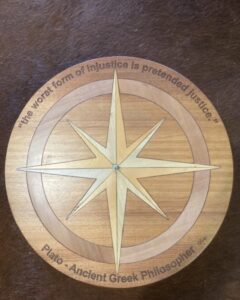
“The worst form of injustice is pretended justice.” – Plato -Ancient Greek Philosopher
Marco’s clock
This is the clock that Marco made for Andrew L. Urban (without the clock mechanism), and how he made it, in his own words.
The design is called a compass rose cross. I find it to be a beautiful cross, very similar to the ancient Fylfot, which is itself very similar to the ancient Celtic cross found on headstones of the fallen in Gallipoli. A ring with a cross through the middle of it. Both have history in the church throughout Britain and even Europe. The words I placed on it is a quote that Plato had made inspired by you in other literature of yours that the Hofs had sent me. I felt inspired to put that together for you after a Bible study session. It just felt right that I needed to make up that design in wood for you, Andrew.
It took the better part of the day to measure up the lazy Susan I used as a base for the clock and then precisely draw up that, which I had to hand trace with the digital pen using the coral draw program on a laptop. Once I had the image drawn, I coppered it to make a blank burn out image sent to the universal American laser burner in order to burn the whole shape out of the laser susan down to approximately three to four millimeters deep. Then I modified the image in order to cut out the individual pieces out of selected four millimeter thick pieces of Tasmanian woods that would be eventually inlaid into the burnt out region. To burn out the base and then cut out the bits took up another day. Each bit to be inlaid is resized, enlarged by about 0.15 millimeter to allow for cutout burn erosion.
When the burnout is completed along with cutting out the various bits to be inlaid, the whole lot has wood glue applied, then assembled like a jigsaw, then placed in an old fashioned hand wound press after the whole lot is covered in brown wrapping paper so that the press itself isn’t glued to the actual wood. After 24 hours of drying and setting, the new inlaid lazy susan is then sanded to smooth up the surface nice and flat, to remove all surface wood glue and paper. The grit gets ultra fine till the job is smooth and clean. I then place the job back into the laser and trace it with a guide beam in order to line up the image with the job. I then set up the border settings of the wood in order to outline the joined areas in effect highlighting every piece and covering up the glued joints.
During that process, I had worked out where I wanted to put the plato quote on the job. So then a shallow burn or engrave setting raster is used to darken the wood, but not too deep as an inlay would be into the shape of the woods. And once burnt rasted, I then go back over the burn or raster to then vector outline the edge of each letter in order to give it a clear, concise edge, similar to outlining the inlaid pieces of various woods. The net effect is to make the image pop out. The shades of the woods available for both inlay and the base are very variable depending on the felled wood we have available at the time. The available wood will vary from tree to tree, so sometimes one has to sort through many different cuts of wood in order to get something to really stand out.
Some parts of what I drew up became the bit that is burnt out. Other parts of the drawing become the bits to be inlaid whilst the remainder bits become the detail put on the neatly completed job. Day one, draw up and burn out, then cut out the bits to be inlaid. Day two, glued and pressed, allowed to dry and set. Day three is sending and prep, sanding and prep for details burn and any wording plus whole for clock shaft and routing for clock motor base. Day five and six, wipe down and then send to spray shop for gloss or satin ceiling, then dry. The pilgrim cross I made up for you is a labor of love, which I really enjoyed doing. It is one of the positive things I’ve learned whilst incarcerated. I am currently doing up another grand aversion that I hope will be displayed at an artist’s with conviction exhibition due in Hobart, the Seaside Pavilion, I believe, about September this year.
The works of prisoners and ex- prisoners only, I’m told. This particular pilgrim cross I intend to do up as a genuine lazy Susan for people’s table tops.
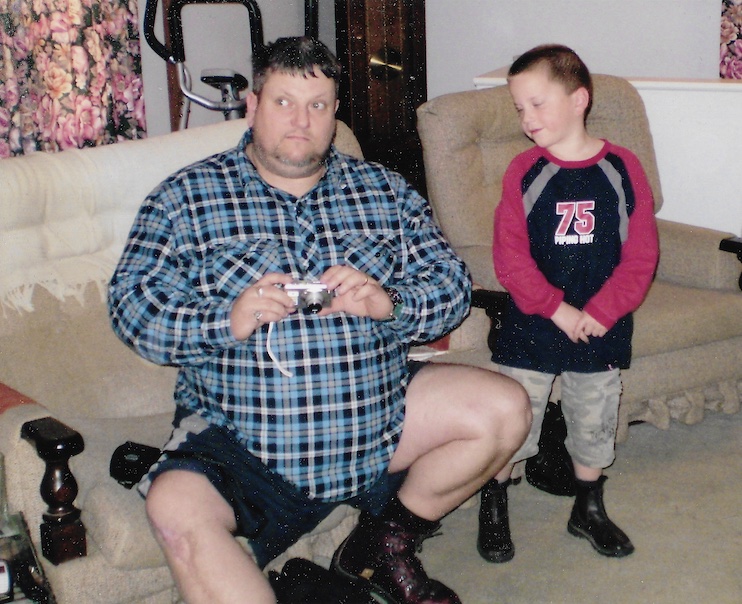
Marco & son Saxon, in 2012 before his arrest
Yet you fail to mention the threats he made to my son in the days prior to his murder.
The fact that this animal was a known drug dealer and was in a sexual relationship with Angela and the drug debt that was owed to him. Also the amount of knives in his house and the swastikas that decorated his unkept home and tattooed on his skull. The fact he burnt the wrong fuel can in his ‘stolen car’ and that my sons dna was on the fuel can the fool locked up in his own shed.
If these ridiculous articles continue to be published I will seek legal counsel due to the extreme distress it is causing me and our family. He had his chance to defend himself in court but chose to play sudoku instead,
Friends of Rusterholz have responded privately to say he has no tattoos on his head; “anything like piercing and tattoos are totally against his beliefs.
“We visited him and his family in Launceston in 2010 and the house was a bit chaotic, as it would be with 8 children from 10 years down and there were certainly no swastikas around. It’s almost like she is describing someone else.”
He definitely committed the murders
He previously threatened my son prior to killing him. He knew my son was there that night. I do believe that police corruption and drug debts and the removal of a cigarette lighter from a double murder scene where both bodies were set on fire to be returned to a known criminal Wayne Howlett and other outright lies I have been witness too there is other elements to this case need to be reexamined.