
Andrew L. Urban
“It’s a new world. It’s the same Constitution.” Coming from the Chief Justice of the US Supreme Court in the context of the consequential birthright citizenship debate, this is disturbingly lacking common sense. Arguably the best definition of common sense is basic intelligence which allows for plain understanding and without which good decisions or judgments cannot be made.
Justice John Roberts’ words came as a retort to an argument from Solicitor General John Sauer, who sought to defend President Trump’s executive order in the face of the Constitution, the law and precedent that have long stood for a basic premise of American life: If you’re born in America, you’re a citizen … even the child of an illegal immigrant gang member or a Chinese birthing tourist.
The context of the words of Justice Roberts is relevant: it was put to the Supreme Court during oral argument the other day (April 1, 2026) that the constitution gave birthright privileges to the newly freed slaves, in a very different world, before illegal migration and before (lucrative) birthright tourism – both phenomena new to America in the recent past. Dismissing the context of the original intent, Justice Roberts rejects common sense and with that, good judgement.
The solicitor general turned to citing “media reports” that estimate more than 1 million people coming from China, as well as a congressional report about “Russian elites” going to Miami through “birth tourism companies.” He said the “media reported” that “based on Chinese media reports,” there have been at least 500 such companies in China.
“Having said all that,” Roberts replied, “you do agree that that has no impact on the legal analysis before us?”
That’s a judicial way of saying it’s irrelevant. But, with respect to his learned Honour, it is very relevant indeed. It is the result of the constitution’s original intent on this matter having been usurped by change. It is the very reason the President wants to end birthright citizenship.
We are not picking on Justice Roberts, but are prompted by his retort, which reveals an underlying lack of common sense. Sadly, judges’ decisions are too often characterised by the failure of the required fusion of law and common sense – ‘without which good judgements cannot be made’. Let’s grab a few more examples.
Judge Oliver Wendell Holmes Jr. stressed that legal reasoning must reflect real life. His classic observation “The life of the law has not been logic; it has been experience,” is one of the most famous in American jurisprudence and highlights the importance of practical reasoning over abstract doctrine.
Judge Robert H. Jackson criticised convoluted legal reasoning used to admit unreliable evidence. “The naïve assumption that prejudicial effects can be overcome by instructions to the jury… all practicing lawyers know to be unmitigated fiction.” This quote is often cited when courts assume juries can ignore damaging evidence simply because a judge tells them to.
Two of the most famous Australian cases where common sense was held at bay are those of Lindy Chamberlain and Cardinal George Pell.
In the latter, after a jury found Pell guilty of historical sexual abuse in the aftermath of a cathedral mass, appeal judge Mark Weinberg issued a dissenting opinion saying that the alleged events were so improbable in the circumstances that a jury should have had reasonable doubt. He stressed that the alleged offences occurred in a busy cathedral environment and numerous witnesses contradicted the possibility of the scenario.
He wrote that the evidence should be tested against “the probabilities and the common sense of the matter.” The conviction was later unanimously quashed by the High Court, reinforcing the concerns raised in the dissent, using the words that “a jury acting rationally…”
In the Lindy Chamberlain case, Murphy J criticised the conviction as resting on speculative forensic evidence and reasoning that ignored the realistic possibility of a dingo attack.
His dissent suggested the verdict did not accord with rational inference from the evidence. The conviction was later quashed and the Chamberlains exonerated.
In the older case of Andrew Mallard, earlier courts accepted a supposed confession that was actually a speculative reconstruction suggested by police. When the case reached the High Court, the judges indicated that no rational jury should have treated the statement as a genuine confession.
Legal commentators often cite the case as an example where earlier judicial reasoning failed basic common-sense interpretation of evidence.
The wondrously named US judge Felix Frankfurter wrote that constitutional interpretation must not descend into “A wooden application of technical rules divorced from common sense.”
Frankfurter argued that the law risks becoming mechanical and irrational when doctrine overrides practical reasoning.
In my latest book, Frank Valentine Guilty by Say-So, I report how the judge in his trial, Noman J, refused to accept actual evidence from the defence (regarding a summer camp being false) and chose to believe the contrary allegation of a complainant .
While judge-bashing, remember the Australian High Court’s decision last month, known as EGH19, is the latest in a string of defeats for the government over its attempts to protect the community from foreign criminals who are in this country unlawfully. The ruling in EGH19 struck down the latest regulation imposing ankle bracelets and curfews. But the seven judges produced six separate judgments that ran to 153 pages, including the two dissents.
The issue itself (foreign criminals in this country unlawfully) is outside our remit and we’re only referring to the decision to highlight how different judges can form very different opinions even in the crucial area of national security.
It should be noted that sometimes it’s more than just a failure of common sense and more a case of abject stupidity.
At the Central Park Five trial in New York, the confessions of the accused were accepted even though they contradicted each other and the physical evidence.
Later courts vacated the convictions after another man confessed and DNA evidence confirmed it. Judges reviewing the case noted the logical inconsistency of the original evidence.
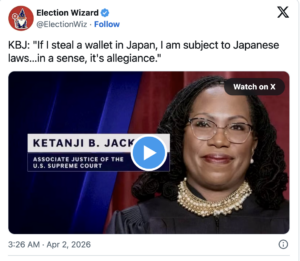
But never mind Chief Justice Roberts, the cake in common sense deficiency was taken by his colleague who can’t define a woman, Ketanji Brown Jackson, who really did say during that oral argument: “I was thinking, I, a U.S. citizen, am visiting Japan. And what it means is that if I steal someone’s wallet in Japan, the Japanese authorities can arrest me and prosecute me,” Jackson began. “It’s allegiance, meaning can they control you as a matter of law.”
She continued, “I can rely on them if my wallet is stolen to, under Japanese law, go and prosecute that person who had stolen it. So there’s this relationship, even though I’m just a temporary traveller, I’m just on vacation in Japan, I’m still locally owing allegiance in that sense.”
So by committing a crime, tourists owe allegiance ….?
I rest my case, Your Honours…
Further reading on the debunking of ‘birthright citizenship’ rights
This seems to be at odds with your (Andrew’s) “the US constitution does not refer to birthright citizenship“?
In your ‘debunked’ article [ https://pursuedemocracy.com/2026/04/06/us-birthright-citizenship-rights-debunked/ ] you mentioned the Mark Levin video. I watched it but did not find his arguments compelling … probably difficult’ is the better descriptor (smile!)
Yea, well, I suspect the interpretation relies on a) one’s opinion of D. Trump and b) a legalistic understanding of “subject to the jurisdiction thereof”. But for me, the overwhelming argument is that the framers of the Constitution could not and did not contemplate the circumstances that apply these days…that, and the absence of the phrase ‘birthright citizenship’ in the text, convince me that the it is as much a matter of common sense as anything. Hence my starting the article with the John Roberts (Chief Justice) quote in an article wishing for judges to exercise more of that stuff.
I’m sorry you found Mark Levin’s video ‘difficult’…
In any case, it’s a fascinating issue for the judges of the US Supreme Court! (Excluding Miss Jackson…)
Yes Andrew, thanks for your reply: yes, one of those difficulties that I was referring to was Mark Levin’s handling of that ‘jurisdiction’ question. I thought his approach to the words subject to the jurisdiction thereof” was quite laboured … for me, they didn’t pass the common-sense test.
On a different tack, I guess my own view of the 14th Amendment is as you yourself point out – “that the framers of the Constitution could not and did not contemplate the circumstances that apply these days ” However, I don’t think that the way to solve a deficiency in a law, (or in this case, a deficiency in the 14th Amendment to the American Constitution) is to say that the words should be expediently taken to mean something different to what they patently do: “All persons born or naturalized in the United States, and subject to the jurisdiction thereof, are citizens of the United States and of the State wherein they reside. ”
My point is that, okay, if the 14th Amendment is not fit for modern situations, then change it … there is an amendment process … it should be used, rather than having a court come in the back door and say that common sense means that we should accept that we abandon literalism … then it would become a bit like ‘1984’ and Newspeak. I’m all for using an ‘as it reads‘ approach.
Many seem to think that the USA is the world’s greatest democracy – by which I have always assumed that they are talking about the nature of their electoral system. Me, I think Australia’s is much, much better … we have preferential voting – which is far more representative than the first-past-the-post system that the USA and the UK use. And in relation to matters such as the 14th Amendment (if Australia had a similar provision in its Constitution), we citizens could update it by referendum. In the USA (if I understand it correctly) amendments of the Constitution are the province of the state legislatures … and Joe Citizen doesn’t get a say.
Tasmania is the jewel in the Australian electoral crown, as I see it: we have the Hare-Clarke system and multi-member electorates… it means our Parliament better reflects the actual cross-section of electors’ choices … in my state electorate of Lyons, for example, we voters returned 3 Liberals, 2 ALP, 1 Green and 1 Shooters, Fishers, Farmers TAS. [ https://www.tec.tas.gov.au/house-of-assembly/elections-2025/candidates-elected.html ] This Tasmanian system gives an electorate a variety of voices in the Parliament. It’s the sort of representative Parliament that mainland state electoral systems don’t achieve, where it’s a case of one member represents all ‘persuasions’ in a particular electorate.
Postscript: In the USA, (unqualified?) birthright citizenship is there in the Constitution. In Australia, citizenship questions are dealt with by the Parliament. A useful Wikipedia entry [ https://en.wikipedia.org/wiki/Australian_nationality_law ] begins:
Agree on all your points. Update the 14th amendment – pronto!
Birthright Citizenship Circus I Posit Is Just Another Trump Distraction
The 14th Amendment is straightforward. All persons born in the United States and subject to its jurisdiction are citizens. Period. It was put there after the Civil War to protect the kids of freed slaves. It has worked that way for over 150 years. You’re born on American soil, you’re American. End of story.
But not for Donald Trump. On Day One he tried to wipe that out with an executive order, targeting the children of undocumented immigrants and so-called “birth tourists.” Lower courts slapped it down fast. Now it’s in front of the Supreme Court, and even some of the judges he put there look sceptical. Good. Because this whole fight is nonsense dressed up as policy.
Let’s be blunt: this is racist garbage. Trump paints these babies as threats, kids of “illegal immigrant gang members” or Chinese tourists coming to drop a kid for a passport. It’s the same old fear-mongering he’s used for years: brown people, Asian people, anyone who doesn’t look like his base is supposedly ruining America. Never mind that the same rule applied to the children of Irish, Italians, Poles and Jews when they were the ones being hated.
Punishing a newborn for where their parents came from isn’t tough on immigration—it’s just cruel and stupid.
And Trump himself? The man is a full-blown idiot when it comes to the Constitution. He treats it like a suggestion he can ignore whenever it gets in his way. Add in the undiagnosed psychopath streak, the constant chaos, the personal vendettas, the glee in tearing things down and you’ve got a dangerous mix running the show. He doesn’t care about borders or law; he cares about headlines and keeping his followers angry.
This latest drama is pure distraction.
While everyone argues about birthright citizenship, the Epstein files keep dropping with more names, more questions, and still no real justice for the victims. Powerful people stay protected. The Attorney General already lost her job over it. But instead of demanding full transparency and accountability, we get this circus. Classic Trump, create a loud fight about something emotional so nobody looks too closely at the real scandals.
The Constitution isn’t a toy for politicians to rewrite when it suits them. Birthright citizenship isn’t a loophole; it’s a basic American principle. You don’t rip it up because some demagogue throws a tantrum.
The evidence is clear. The Amendment says what it says. Trump’s order is unconstitutional on its face. This isn’t about securing the border it’s about feeding division and changing the subject from Epstein and elite accountability.
America shouldn’t punish babies for their parents’ mistakes. That’s not justice. That’s the same kind of twisted logic that leads to wrongful convictions and ruined lives. We’ve seen enough of that already.
Trump’s birthright crusade will fail, just like it should. But the distraction tells you everything about where his priorities really lie.
If there is a rational argument to justify birth tourism or mass-birth ‘factories’ funded by wealthy Chinese, I haven’t heard it.
A bit more info on this:
A child born in Australia only receives citizenship at birth if at least one parent is an Australian citizen or permanent resident.
The case of Xu Bo, a Chinese billionaire with an extraordinary claim of fathering over 100 children through surrogacy in the United States, reveals the murky waters of the surrogacy industry and its implications for U.S. citizenship laws. Federal response intensifies as Chinese billionaires exploit birthright citizenship to commission more than 100 American children.
Donald Trump first made public statements of concern over birthright citizenship during his 2016 presidential campaign, where he suggested that the practice should be ended.
I am a huge supporter of common sense and fact over outdated law. However, I think that, in this case, the judge is hamstrung by the words of the Constitution. It is a legally binding document. I may be completely wrong, but I think what he is saying is that he has no choice but to make a judgment based on the content of the Constitution, absent any amendment of that document amending the right to claim USA citizenship if born in the USA. While he might not agree with that approach, he is bound by the document. That is the correct approach, in my mind.
I guess it comes down to what the founders intended…
After a bit of research … the US constitution does not refer to birthright citizenship. see
https://pursuedemocracy.com/2026/04/06/us-birthright-citizenship-rights-debunked/