Andrew L. Urban
The judge whose summing up was convoluted and in places incomprehensible even to lawyers, told the jury that the accused had “made admissions” of the offence – which is not true – but as one barrister puts it, “the jury had NO CHOICE but to find him guilty“.
In another example of uncorrected wrongful convictions, we reveal how a statement by the presiding judge sealed the fate of an accused where, contrary to the judge’s assertion, even the complainant had denied that the accused had made any admissions of guilt.
This is the case of a man we call Paul, convicted of historical sexual abuse of his step daughter years earlier. (see here for more on Paul) Jailed and living with the restrictions of the sex offenders register, vehemently insisting on his innocence, Paul wishes to remain anonymous to protect his family members from further trauma by public exposure.
In the 21,777 word petition to the Governor (via the Attorney-General) prepared pro bono for Paul by a lawyer outraged at his conviction, many flaws are exposed, including this matter of ‘admissions’:
“The accused person made admissions, the accused has denied that and I believe [his wife] denied that as well”
- The Complainant acknowledged that I [the accused] did not make any admission to her in relation to her allegations as demonstrated by the transcript of her cross examination at page 101 line 40 (Volume 1), when she gave the following answer:
“He didn’t admit to – it was like he was admitting that he made a mistake, but that he was only trying to help me. So he didn’t actually admit that he was molesting me. He admitted that he was trying to help me. And that he had crossed the line.“
The barrister familiar with the case explains that “it is the DPP’s office which owes the duty to correct the judge. And the DPP knew perfectly well that the complainant had stated that [Paul] never made an admission.”
One could argue that the admission having been denied by the applicant herself (not just the defendant) and thus nullified, it should not have been mentioned at all in front of the jury. It poisoned the jury’s mind; “the jury had no choice but to find him guilty”.
The barrister points out that “There is protection from liability for people acting under the aegis of the DPP (section 35 of the Director of Public Prosecutions Act 1986) . It doesn’t apply in this case because (police officer) had the statement in question from [the complainant] and she should have corrected Taylor J’s summing up to the jury (by saying that you had not admitted anything). By failing to discharge her duty she automatically consigned you to a penal sentence. You can sue the police officer for not saying anything and letting the case be decided on facts which were wrong.”
In 2023, he complained about the police officer to the Law Enforcement Conduct Commission, who replied to say ” we have decided we will not investigate your complaint. We cannot overturn criminal convictions.” The LECC wrote:
#####
we have assessed your complaint and note that you have previously directed some of your complaint issues to the NSW Police Force (Police ref: LMI1701869) and the former Police Integrity Commission (Our ref: C2017-00456)
we have decided we will not investigate your complaint.
we cannot overturn criminal convictions.
Further correspondence
After this advice, you have written to us on 7 and 10 July 2023 providing additional information. The information indicated that:
[your] conviction is the result of police misconduct.
That the Law Enforcement Conduct Commission Act 2016 does not highlight there
should be a limitation according to resources.
We have carefully reviewed your correspondence.
In response to the points raised, the Commission notes:
Section 46 of the Law Enforcement Conduct Commission Act 2016 highlights the factors that the Commission may consider when deciding whether to investigate conduct that falls within the description of serious misconduct or serious maladministration. The effect of the Commission’s limited resources is applied to the below subsection:
- d) the availability of the Commission or any other public authority or official with the responsibility, jurisdiction or power to investigate conduct of the kind concerned, (Law Enforcement Conduct Commission Act 2016 (NSW) s46(d).)
The actions of the police during the investigation and prosecution of [you] were tested in Court on several occasions: the District Court, the Court of Criminal Appeals and the High Court of Australia. This has resulted in [your] initial conviction, which was upheld in later court instances. As previously advised, the Commission cannot overturn criminal convictions determined by the criminal court process. [No, the High Court refused leave to hear the appeal. And no again: this paragraph also incorrectly implies that the failure of the police officer (through the ODPP) to correct or clarify the judge’s statement had been dealt with in court.]
The misconduct matter has previously been assessed by the former Police Integrity Commission (PIC reference: C2017-00456). The PIC determined that no action would be taken, and the matter referred to the NSW Police Force (Police Ref: LMI1701869)
Considering the points above our previous decisions communicated to you on 7 July
2023 , remain unchanged as you have not raised significant new and cogent information that would require further action.
Our decision
Hence, we will not take any further action regarding your complaint.
Please note that if you continue to write to us with information that does not raise significant new and cogent information that would require further action by the Commission, then your correspondence will be filed without a response to you and we may consider placing restrictions on your contact.
Shraddha Patel
Acting Team Leader, Assessments
#####
As we say …
‘Case closed. Shut up and stop bothering us’ – the legal system’s response to appeals
______________________________________________________________
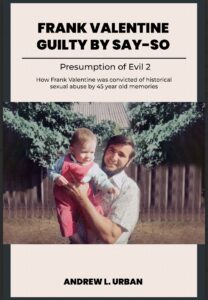 The author investigates the circumstances that led to the trial and conviction of child welfare officer Frank Valentine on charges of historical sexual and physical abuse at the Parramatta Training School for Girls decades earlier. It is his fifth book exposing what he considers to be unsafe convictions.
Kindle $11.99 Paperback $23.20