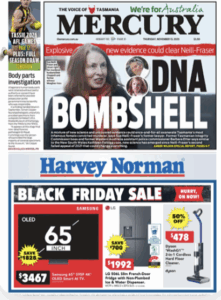
If you see furious senior Tasmanian police lurching red faced out of their HQ, they are probably clutching a 78-page report that just landed which sets out why an independent inquiry into the conviction of Sue Neill-Fraser can no longer be avoided, by Barbara Etter APM and Hugh Selby. It dismisses the dismissal by the prosecutor of DNA evidence as a ‘red herring’.
Readers familiar with the case may agree that the most disturbing aspect of the trial was the speculation by then DPP Tim Ellis SC about how the murder occurred, what weapon was used, what injuries he sustained and how she disposed of Bob Chappell’s body (it has never been found) … all without evidence. And condoned by trial judge Alan Blow.
Infamously, Ellis described the DNA found at the crime scene, the deck of the Four Winds yacht, as a ‘red herring’ which gave its name to our recent series inaugurating the Red Herring Certificates.
But it was the flawed police investigation that dragged the case into court. That is the focus of this latest bombshell of a report, by Neill-Fraser’s former lawyer Barbara Etter and former Canberra barrister Hugh Selby. Here is an excerpt:
“There are five sound reasons for questioning the conviction in what was an entirely circumstantial case.
 First, recent research, along with a Forensic Biology Report by a member of TASPOL’s Forensic Science Service Tasmania (FSST), Paul Holloway, produced in 2020, but not considered by the 2021 appeal court, gives support to (Meaghan Vass) MV’s DNA being left on the yacht deck on Australia Day 2009. That objective scientific evidence, when combined with the lack of opportunity for her DNA to have been left at a later time, compels a review of her recantation at the appeal, especially as it corroborates her earlier sworn statements in 2017 and 2019 that she was on the yacht on Australia Day.
Second, in 2019 the issue of the MV DNA was referred by FSST to Dr Duncan Taylor, Principal Scientist, Forensic Statistics Forensic Science SA (who is associated with Flinders University and has published extensively on DNA related issues), for “activity level reporting case” which relates to the “when and how” regarding a DNA sample, as opposed to the “who”.
Dr Taylor’s report/response via email dated 7 June 2019 (and any associated material) has, so it seems, never been released beyond the ODPP. Given that it was sought between the granting of leave to appeal in March 2019 and the 2021 appeal it is a reasonable assumption that if the contents were favourable to the police/prosecution case that they would have been disclosed to the appellant. The non-disclosure prompts the hypothesis that the contents were not favourable to the police/prosecution case. Contact with Forensic Science SA is not mentioned on the FSST running sheets also released under RTI in the same disclosure.
Dr Taylor’s response or possible report does not get mentioned in subsequent FSST reports which refer to previous reports in the matter. The referral to Forensic Science SA regarding the MV DNA was not known by the authors until after an External Review by the Ombudsman this year (R2310-016) of the RTI disclosure (following an application by the Hon. Meg Webb dated 27 October 2023). This led to a new set of documents with altered exemptions and additional information released.
The Ombudsman held in his decision of 27 May 2025 that legal professional privilege did not attach to a document or email per se but to the communication recorded within it. Therefore, his finding that s.31 was a valid exemption did not extend to information contained in the address lines, time stamps, signature blocks, salutations and confidentiality disclaimers contained in these emails.
The limited, but nevertheless revealing, new information was not provided by Tasmania Police until June 2025. There is also a Tasmania Police Subject Report dated 3 June 2019 (v 6) headed “RE: CHAPPELL MURDER – DNA RESULT REGARDING MEAGHAN ELISABETH VASS”. It is 10 pages long and the content is completely redacted (other than header, signature block and version details) under s.31 of the Right to Information Act 2009 which relates to legal professional privilege.
These questions follow:
- What was Dr Taylor’s opinion/s or advice?
- Why is his opinion or report not properly referenced in later FSST documents (including running sheets and the Holloway report)?
- Were Dr Taylor’s opinion/s shared with anyone outside FSST, Police and the ODPP? If so, who and when?
Third, significant developments and published research, since the 2021 appeal, in the science of DNA Transfer, Persistence, Prevalence and Recovery (DNA-TPPR) and Time since Deposition (TsD) (see below). It is ironic that critical research supporting our comments in this report regarding DNA persistence has been published by leading scientists/academics from Flinders University in South Australia in 2023.
Fourth, the police claimed that MV, her associates, or both, entered CleanLift Marine and that was when her DNA sample was left. Our recent review of the police records shows those claims to be farfetched. What’s more, those same records show that if police ever thought that claim had legs, then they made no inquiries, open to them at the time and since, to verify that claim.
Fifth, drawing on the above, it is now more likely than not that MV was on the yacht on Australia Day 2009. If so, she was not alone. Others were with her. At no time has there been a suggestion that MV was capable of getting to the Four Winds on her own, let alone overpowering and killing Bob and disposing of his body. That said, it’s a possibility that has to be raised with her at an Inquiry.
The evidence (including the results of several years of RTI (aka FOI) applications to reluctant police) demonstrates that the police had reason to suspect the involvement of others but chose not to properly investigate. In so far as they did make inquiries, it seems they failed to share that information with the prosecution and the court, a fundamental contravention of their duty. It now seems, for instance, that there were two “Sams”. There was also a well known boat thief at the time who should have been properly investigated. Then there are the comments of then Inspector Peter Powell about Vass’ young male associates who were known to break into boatyards and steal things from boats. Why did that failure to investigate and properly disclose information happen?
Only an independent Inquiry with coercive powers, sufficiently broad Terms of Reference and with the resources to retain appropriate experts and skilled investigative and support staff, can give us a reliable answer to that question.”
I understand that this report may be redacted Andrew however is there a link that you are aware off to the redacted report or is this report just simply unavailable?
HERE
REDACTED-SNF-REPORT-as-at-6-Nov-2025-final-for-tabling-1.pdf
Key-points-for-an-inquiry-6-November-2025-FINAL-for-tabling.pdf
Sorry, try this:
https://www.parliament.tas.gov.au/legislative-council/tabled-papers/legislative-council-tabled-papers-2025/REDACTED-SNF-REPORT-as-at-6-Nov-2025-final-for-tabling-1.pdf
Sorry, try this:
https://www.parliament.tas.gov.au/legislative-council/tabled-papers/legislative-council-tabled-papers-2025/REDACTED-SNF-REPORT-as-at-6-Nov-2025-final-for-tabling-1.pdf
Thanks Andrew.
Is there a link to this report? is it easily accessible somewhere?? Sounds intriguing.
However, the DNA evidence is a bit like finding a book on the deck of the Four Winds. We can read the title and author, but the book itself cannot tell us how long it was on the deck. That can only come from other info, like eye witnesses, CCTV etc. Even the condition of the book can be of limited value – if it looks quite new, was it on the boat for one day, two days or a week. Your guess is as good as mine (and it is a guess) – the book by itself is not very good at informing you as to how long it had been on the deck. Same with DNA.
REDACTED-SNF-REPORT-as-at-6-Nov-2025-final-for-tabling-1.pdf
Key-points-for-an-inquiry-6-November-2025-FINAL-for-tabling.pdf
The report is redacted to protect the privacy and other rights of persons named in the full report, to ensure as much as possible the personal safety of key players and to ensure the fair and proper administration of justice.
I read the report, and it seems to suggest DNA can last on a metal surface like the deck of a boat for months – how does that help either side? It confirms my previous point – you cannot use any of the scientific evidence on its own to narrow down when DNA was deposited to a particular day of the week! Based on the scientific results, MV’s DNA could have been directly deposited on Australia Day, or tracked in as contamination by careless police officers, or directly deposited when the boat was parked in full public view in Constitution Dock or later in the shipyards. Even Max Jones tripped himself up here by venturing an unscientific opinion of “very recent deposition” based on over-confidence in his expert ability to read the tea leaves. Why did it take days before FSST scientists were called in to do a proper forensic examination of the boat – more Keystone Cops antics down south – lets trample all over the boat then declare it a crime scene and call in the boffins.
Chris,
having no credible explanation to explain how/when MV’s DNA arrived on the deck of the Four Winds, remains an alternative competing hypothesis for explaining Bob Chappell’s disappearance. Failing to properly explain how/when MV’s DNA arrive on the deck, doesn’t eliminate the possibility that others (other than SNF) were in fact involved. DNA at a ’crime scene’ is compelling circumstantial evidence that needs a rational and complete explanation. To uphold the Presumption of Innocence, then any reasonable possibility of another’s involvement cannot (rationally) renders guilt to be beyond a reasonable doubt. Simply by refusing to accept or investigate competing hypotheses is not a reason to eliminate them from the equation – it is a procedural methodology where the discovery of truth, plays second fiddle to securing and ensuring a conviction. It is not a Fair Court. Fundamental Human Rights, ratified by this nation, are not being upheld in the State of Tasmania.
Whenever you have a group of People/Individuals who are beyond any investigation, who can manipulate the Press – Judges – Members of Parliament – you’re always going to have within our Government those who are above the Law.
The new report by Barbara Etter APM and Hugh Selby is more than a forensic critique it’s a call to conscience. At 78 pages, it methodically exposes the gaps, omissions, and selective blindness that have plagued the investigation and prosecution of Sue Neill-Fraser from the outset.
For too long, the phrase “red herring” once used by former DPP Tim Ellis SC to dismiss DNA evidence on the Four Winds has hung over this case as shorthand for irrelevance. Etter and Selby have now turned that on its head. Their report demonstrates, with scientific precision, that the DNA evidence linked to Meaghan Vass is anything but a distraction. It is central, credible, and consistent with her own sworn statements that she was indeed on the yacht on Australia Day 2009.
The authors’ careful reconstruction of the record reveals what appears to be a pattern of selective disclosure and investigative neglect. Key expert input such as the 2019 referral to Dr Duncan Taylor, Principal Scientist at Forensic Science SA appears to have been withheld from both the defence and the appeal court. If this material had favoured the prosecution’s theory, one would reasonably expect it to have been disclosed. That it was not raises questions that only an inquiry with full access to documents and witnesses can answer.
Equally troubling are the revelations about the police investigation itself. As Etter and Selby show, claims that Vass’s DNA was transferred via secondary contact at CleanLift Marine have no evidentiary foundation. Despite their own records suggesting other credible lines of inquiry including the possible involvement of known offenders frequenting local boatyards and police did not pursue those avenues. Such failures go beyond error; they strike at the heart of investigative integrity.
The report’s findings are supported by recent scientific advances in DNA transfer and persistence, which reinforce the likelihood that Vass’s DNA was left directly on the yacht’s deck on the night of the incident. Combined with the lack of evidence for any alternative explanation, the conclusion is inescapable: the DNA was real, relevant, and wrongly dismissed.
What emerges from Etter and Selby’s work is not only the need for Sue Neill-Fraser’s conviction to be urgently reviewed, but also a broader reckoning with Tasmania’s justice institutions. The opaque handling of forensic material, the inconsistent use of privilege to block disclosure, and the failure to revisit flawed assumptions have eroded public confidence.
Tasmania now faces a simple choice: confront these issues openly through an independent inquiry with broad terms of reference and coercive powers, or continue to defend the indefensible behind redactions and legal technicalities.
The Etter–Selby report provides the evidence. What is needed now is courage from decision-makers, from the legal community, and from the public. As this report makes clear, the “red herring” was never the DNA. It was the narrative built to make us look away from it.
Whatever happened to justice in Tasmania ??
There has been so much plain evidence collected & written about , showing that Sue was not capable of the murder, ignored by Tasmanian authorities, or in fact never acknowledged.
This woman needs her name to be cleared & evidence examined fairly by an independent (?) member, are there any left in Australia??
Disgusting state of affairs that she was ever charged, surely someone can get this overturned as is a national disgrace.
There is a reason for the local cowardice.
Generations of knowing how it all works in Tasmania; and any resistance against “them”, you are a done dog. Does everybody know about the Wasp Files. Paul Moder, re Port Arthur, just asking questions….
G’day Andrew, and the resident contributors.
I have seen the Wasp Files; recommended.
Thanks Andrew, for posting this. Sue’s supporters seek her exoneration … and see an Inquiry as a step towards achieving that goal. Yet there is more that an Inquiry should achieve: it, for example, should examine the role of TasPol in this whole, sorry affair – the investigation they conducted, the blocks and inhibitors that they appear to have put in place (over years and certainly not just connected to these latest RTI redactions). Also the role of the Office of the Director of Public Prosecutions – over the years of the Bob Chappell disappearance and/or the Sue Neill-Fraser saga.
The Terms of Reference need to be wide. We want to know who killed Bob, we want Sue to be exonerated and personally, I want the Inquiry to be wide enough to include an examination of our Justice system itself … e.g. including the performance of the Integrity Commission and of the Ombudsman’s Office as well as that of the Parole Board. There are other matters that in my opinion should be examined as well … that of Eden Westbrook … is another case in point. So too would I want to have Tasmania’s legal profession (e.g. the LPBT) put under the spotlight. Too much has been going on, too much covering-up, too much corruption of justice in Tasmania, my State.
That’s a great ‘shopping list’ Garry! Sadly, I doubt the Tasmanian legal establishment (from police to the lawyers to the judiciary and even most politicians) would ever allow such a process to even begin. Unless, of course, public opinion forced the issue … which doesn’t seem likely given how cowed the public has appeared to be, with notable exceptions, of course.
Well Gary, Christmas is coming perhaps Santa will give you some of that wish list
Now that I’m in the Justice Supermarket, I’ve just realised that I left Prisons off my shopping list! Who can forget the later-ruled-illegal surveillance conducted against lawyers visiting clients in prison? I believe such surveillance included legal visits to Sue. Who can forget how Sue was put into solitary confinement for … writing an ‘Inmate’s Day in the Life’ account of Risdon’s Mary Hutchinson division? It was accepted by the prison’s censor, done openly and legally, then passed to you, who published it. Result? Solitary … put in the slammer when the top brass found out. Who can forget Sue’s hunger strike response to the attempt by prison authorities to have Sue placed next to Karen K. an inmate who they hoped might learn something incriminating about Sue … Karen herself being squeezed in a legal vice … she subsequently had her own trial discontinued … a suppression order imposed, or am I remembering incorrectly.
I once imagined I heard a man living in a tent by the river Tamar call out to the gulls: “Tasmania! Abandon ye all hope who enter here!”. It started to rain and the gulls ignored him. He went back into his tent. It was a sombre day.
Andrew/Garry this is a great excerpt from the report for us all to read. I may have missed it but is there a link to the full report? Marvellous work by the way and full credit to Barbara and Hugh for their on-going preparation for Sue’s full exoneration. This is madness for any system or arm of so-called justice to be denying credibility to these and other such findings. It’s also great to read that at least the Tasmanian Independent MLA /s continue to pursue this legal travesty and I do hope that all those implicated in the cover-ups are sweating it out knowing fine well that their day will come. As with all of this I often think of the family of Bob Chappell and what they have had to endure also. They like any family I would venture to say would dearly love to have all withheld information made available to help any inquiry that may lead to their father’s remains.
REDACTED-SNF-REPORT-as-at-6-Nov-2025-final-for-tabling-1.pdf
Key-points-for-an-inquiry-6-November-2025-FINAL-for-tabling.pdf
The report is redacted to protect the privacy and other rights of persons named in the full report, to ensure as much as possible the personal safety of key players and to ensure the fair and proper administration of justice.