“Consistent with” has probably done more quiet damage in this field than any single dishonest witness. A system that does not flinch at it is not a review tool. It is a typist,” writes ADRIAN BERTINO-CLARKE, President & CEO, FIA Labs / Federated Intel AI LLC, on the launch of his latest legally trained AI tool: LIA Pro, a serious new legal tool coming at a time when concerned attention is focused on AI in general and in the legal context in particular.
When I wrote here about LIA Apex, the problem I was trying to name had not changed, and it has not changed now.
Wrongful convictions still rarely begin with a single dramatic failure. A doubtful identification is treated as stronger than it is. A forensic opinion is allowed to sound more certain than the method permits. A confession is read as if the words proved themselves. Disclosure gaps stay buried. An early theory takes hold, and after that the record starts to look like a conclusion rather than a collection of open questions.
What changed is the machine I thought I was building.
Apex, as I described it, was a governed workspace. A case would persist. Analysis would accumulate. There would be an internal governance log for the practitioner, and a thinner, discoverable proof layer for the day a judge, an insurer, or a disciplinary body asked not for the strategy but for some assurance that the work had been disciplined. Challenge would be a function, not a mood. The point was reviewability without recklessness.
That design was a serious answer to a serious problem. It was also ahead of what I was prepared to put in anyone’s hands. I did not build Apex. I built LIA Pro.
This is the follow-up, not the brochure.
The attractive mistake
The attractive mistake in legal technology is to lead with the furniture. A persistent matter. A dashboard of uncertainties. A log that can be shown to a court without waiving privilege. All of that sounds like the opposite of a chatbot, and this readership has every reason to prefer the opposite of a chatbot. Fluency has already done enough damage in criminal cases. Nobody here needs a second closing speech.
The trouble is that furniture can certify a bad inference.
If a system upgrades a weak identification, smooths an expert’s overclaim, or fills a gap with an authority it invented, a governance log does not repair that. It records it. Worse, it can make the leap look like due diligence, because the leap now has a process around it. Reviewability of an unsafe step is not a virtue if the step is then relied on because it was logged. The first discipline is not logging the leap. It is not making it.
That is the bet behind LIA Pro. The constraint sits in the reasoning, in the sentence that comes back, not in an architecture I was still describing in the future tense. Apex would have been easier to demonstrate. Pro is less impressive in a demo and harder to flatter yourself with at midnight. I have come to think that is the better option for this work.
What “better” actually means
Better does not mean that Pro retries cases, detects innocence, or finds the disclosure someone failed to make. It does not know a document it has not been given. It does not know what the unused material says. It does not replace a lawyer, an investigator, a conviction integrity unit, or a family that has lived with the file for years. Anyone who wants a tool that will tell them the conviction is unsafe, full stop, wants the same thing bad forensics offered: certainty outrunning the material.
What Pro is built to do is narrower, and I think more useful.
It keeps fact, allegation, and inference from changing clothes. A complainant’s account remains an account until something in the material makes it more than that. A police summary is not the exhibit. A ground of appeal that someone hopes exists is not a ground that has been made out. In innocence work, the drift usually happens in that change of clothes. The case becomes coherent because the theory has trained everyone, including the person trying to undo it, to write as if the hard parts were already resolved.
It will not invent the missing piece. No date that was not supplied. No amount. No case name. No holding. A fabricated authority is not a drafting blemish. In a leave application or a fresh-evidence argument it is a new false exhibit, and it will be the first thing a respondent finds. Families and volunteers are already vulnerable to any system that sounds sure. A beautiful submission built on a case that does not exist is not help. It is another way the record gets polluted.
It will not let possibility do the work of probability. “Could have” is not “did.” Consistency with guilt is not proof of guilt. Consistency with innocence is not proof of innocence either, and a tool that only ever stresses the second half of that sentence is just tunnel vision with a friendlier client. Association is not causation. A general proposition — that a method can produce errors, that a condition can be caused in more than one way — is not a finding that it happened that way here. A medical cause, even where one is genuinely in dispute, is not a legal cause. Legal causation does not get to invent the factual link that the evidence has not supplied. And a real scientific impossibility is not the same thing as two experts disagreeing. Pro is not there to pick the expert who helps the theory and call that a challenge.
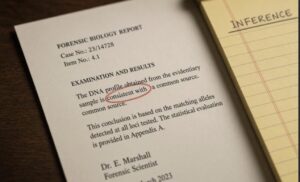
Those distinctions sound academic until you have watched a miscarriage accumulate. They are the ordinary joints at which a doubtful item becomes a strong one. Identification. Confession. Jailhouse information. An expert who says “consistent with” and is heard to have said “this is what happened.” A cause-of-death opinion that slides from mechanism to guilt. A disclosure gap that is described, after a while, as if its contents were already known. Pro is built to flinch at those joints. “Consistent with” has probably done more quiet damage in this field than any single dishonest witness. A system that does not flinch at it is not a review tool. It is a typist.
It also treats some questions as high-stakes even when they are asked casually. Is the application still in time? Has privilege already been put at risk? Was something not preserved, and what follows from that? Is this expert’s method one a court should treat as reliable, or only one an expert is willing to speak about confidently? Do these two forensic accounts actually conflict, or do they only sound as if they do? Is this an adverse inference the record can bear, or a suspicion with a legal label on it? Would this paragraph, if a court accepted it, be an unsafe leap from evidence to a finding? A casual question on any of those is still a question that can sink a review or manufacture a false hope. Pro is meant to slow down there, not to match the user’s confidence.
How it can be used, and how it should not
The use I trust is unglamorous. Someone puts the material in front of it — a judgment, a summing-up, an expert report, a chronology a family has built over years, a draft submission — and asks a question no larger than the material can bear.
What in this passage is a fact the court found, what is counsel’s assertion, and what is an inference? Where does the expert’s language outrun the method as described? What would still have to be true for this ground to be arguable, and which of those things is not in the papers? What contradicts the account we prefer? What have we assumed because the theory needs it? What must be verified before a journalist publishes, or before a lawyer tells a family there is a point worth taking?
That last use matters as much as the heroic one. Miscarriage-of-justice work begins, often, outside any elite setting: a parent, a student, a local solicitor, a reporter who suspects the official story is cleaner than the investigation was. Those are the people most likely to be harmed by a system that completes the pattern for them. Pro can help organise a concern without converting grief into a legal conclusion. It can draft a letter, a note of what is still unknown, a chronology that marks its own gaps, a challenge to a paragraph that has been allowed to sound finished. The human still decides what is sent, filed, or published. If the draft is more certain than the papers, the draft is wrong, including when the certainty runs in favour of the person in prison.
It is also useful on the other side of the file, which I said about Apex and still mean. A prosecutor, or a conviction integrity unit, can use the same flinch before a case hardens, or before an old case is defended out of habit. The question is not whether a theory can be made coherent. Almost any theory can. The question is whether the coherence was purchased by under-reading the identification, over-reading the expert, or leaving a disclosure gap unnamed. A tool that only ever helps the defence narrative is not a check on tunnel vision. It is a second tunnel.
What I would not use it for is the thing the marketing language always reaches for. It will not “prevent wrongful convictions” as a result. No writing tool can promise that. Convictions are prevented, and miscarriages are corrected, by investigation, disclosure, competent advocacy, fresh evidence, and courts willing to look again. Pro can interrupt one contributing habit: the upgrade of a weak item into a strong one, in the document someone is about to rely on. That is a real contribution. It is not a verdict.
The log, and why I am no longer leading with it
I have not abandoned the problem Apex was trying to solve. Privilege, confidentiality, and work product are not technicalities. A system that turns every internal doubt into a discoverable trail can hurt the person it was meant to help, and a system that hides the substance of the advice behind a performative “process was followed” stamp can mislead the tribunal it was meant to reassure. Courts and regulators are entitled to care whether AI-assisted work was disciplined. They are not entitled, by that fact alone, to the client’s instructions.
The difference is sequence. A discoverable assurance layer is only as honest as the reasoning it attests. If I had shipped the log first, I would have given this field an auditable record of whatever overconfidence the model happened to produce. That is a worse artefact than an unlogged draft, because it looks like a control. Pro’s reviewability, for now, is in the prose. A reader can see what was treated as established, what was treated as alleged, what was inferred, and what was left open. If those categories have been collapsed, the failure is on the face of the page, where a lawyer, an editor, or a sceptical family member can still catch it. That is less grand than a governance architecture. It is harder to fake.
There is a related limit I would rather say plainly than imply. Pro answers the question asked. It does not, unasked, generate a full reconstructed case. Over-production is its own risk. A stack of confident paragraphs about hypotheses nobody briefed can later be mistaken for the file. Innocence work already suffers from records that look more complete than they are. Adding a machine that writes until the story feels finished is not a safeguard.
What I would want a reader of this report to take
If you work these cases, you already know the failure mode. The theory trains the eye. Contradictions lose weight. “Consistent with” hardens into “was.” A gap in disclosure is talked about as if its contents were known. By the time someone asks for a review, the task is not finding a missing melodrama. It is unpicking an accumulation.
LIA Pro is a tool for that unpicking, used on the papers you actually have, under constraints that forbid it to invent the authority, the date, or the causal link that would make the story close. It is a poor storyteller on purpose. It will disappoint the user who wanted the case to become clear. Disappointment, here, is the feature. The most dangerous sentence in a review is not “this is not yet known.” It is “the case is clear.”
 I still think legal AI, if it is used at all in this work, has to be accountable. I no longer think the way to start is with a grander machine. The way to start is with a system that will not say more than the record allows, and that will show you the joint when you try to make it do so. Apex described the workshop I wanted. Pro is the habit of mind I was willing to release. For this subject, the smaller claim is the one I can stand behind.