Andrew L. Urban
That’s not my headline: it is the headline on an editorial in The Australian (April 9, 2026) and mirrors my own of the day before, referring to the five murder war crimes charges against Ben Roberts-Smith. The difference is that the Australian’s editorial expresses confidence in that legal system. I question that confidence.
I agree with the headline. But in the very first paragraph, the editorial says: “We can have confidence that our justice system is well equipped to deal with the individual circumstances of what is put before it.” This is a bit naive, in my view. Especially in the challenging case against Roberts-Smith.
In the final paragraph that sentiment of “we can have confidence” is slightly altered to “we must have confidence…” I suggest we must not. Here’s that par in full:
We also agree with Sky News commentator Andrew Bolt, who said this was an opportunity to demonstrate to the world that we are a nation that takes its responsibilities seriously. We fully understand the demands that are placed on our soldiers in theatres of war and think it is proper to ask whether too much was asked of the Special Air Service in Afghanistan. But we do not condone the killing of unarmed prisoners of war under any circumstances and insist that claims that this had happened be properly investigated and dealt with. The criminal charges against Mr Roberts-Smith are a tragedy on many levels, but to ignore the claims would diminish us as a nation and empower our enemies who seek to humiliate us in international forums, including the International Criminal Court. Former prime minister John Howard is right to say the rule of law is a core Australian value, fought for over generations, and fundamental to the operation of the rule of law is that no man or woman is above or beyond its reach. We must have confidence in our laws and legal institutions and trust that justice will be served, including to the accused, who has not been found guilty of any crime.
And here’s my rationale for why confidence in our legal system is misplaced. (Given this blog is called wrongfulconvictionsreport and is dedicated to exploring and exposing miscarriages of justice, readers will not be surprised by my views.)
In short, I maintain that the track record of our legal system is not shiny; it is rather shitty. Like a grand avenue fouled with litter and faeces. The system has a poor record in reaching safe convictions and in subsequently correcting those miscarriages of justice. Even from our small corner of the Australian legal universe, we can see that despite lessons that should have been learnt decades ago (eg Lindy Chamberlain case), the system stumbles ahead with scant regard for reforms crying out for action (eg forensic labs to be independent of police).
I have concerns that prosecutors remain focused on getting convictions rather than finding the truth. The fact that this is a systemic flaw in our adversarial system is of little consolation. I am not alone in this concern. One example: over a decade ago we reported on the Symposium on Miscarriages of Justice, (Flinders University, Adelaide, South Australia, Nov. 7 & 8, 2014).
“If the Australian public was aware that dozens of innocent people are serving lengthy sentences for murders and rapes they didn’t commit – and the real criminals are living free among us – we could expect considerable outrage and demands that ‘something be done’,” suggests Dr Robert Moles, co-author of Forensic Investigations and Miscarriages of Justice (Irwin Law, 2010), the definitive book on Miscarriages of Justice. That ‘something’ is a range of reforms from simple to complex (see below) that the symposium (which he instigated) explored in detail.
REFORMS & CHANGES NEEDED
A sample of the potential reforms as highlighted at the symposium:
Police investigations:
training to avoid ‘tunnel vision’ approach
training to adhere strictly to investigation procedures, notably accurate record keeping, witness statements, evidence collection management culture to emphasise serving the court not the prosecution
Forensic scientists, laboratories, professional bodies:
develop a system of quality standards, with documented policies and procedures
training to explain evidence in court so that it is understood
requirements for validation of evidence
training to avoid contextual bias
emphasis on serving the court not the police or prosecutio
Prosecution:
adherence to rules of law (e.g. not presenting speculation as fact)
explain forensic evidence rationally
presentation of evidence fairly
seeking conviction must be subservient to seeking of truth
accountability: penalties to apply for misconduct
Judges:
demand clarity and understanding by jury of scientific & forensic evidence
ensure prosecutors adhere to rules of trial behaviour and fairness
accountability: penalties to apply for misconduct
The forensic science labs independence issue has been bubbling away for years. Forensic science faces an institutional crisis: laboratories claim scientific independence while operating under the administrative and financial control of law enforcement hierarchies. This tension between truth and power is ancient, appearing whenever those who generate knowledge must answer to those who wield authority.
But there are several other contributing factors (mostly unknown by the general public) that dog the justice system. Dr Rachel Dioso-Villa at Griffith University led a study team to identify them. This is the chart they published in the Flinders Law Journal:
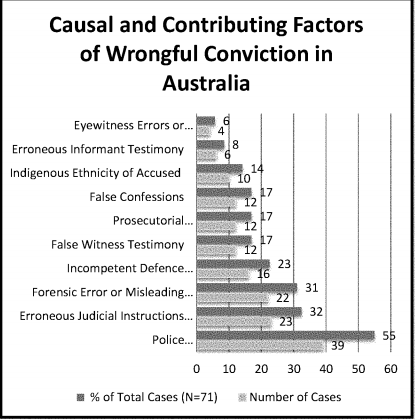
Griffith University research
In the case of Ben Roberts-Smith, the complexities and challenges are magnified and multiplied, as we outlined in our report yesterday. This is a perfect example of a trial in which the jury deliberations should be recorded for review by the judge.
bring in Judge Deed!
When Assertion Replaces Evidence A Prosecutor’s Duty to Truth
Subscribers to Wrongful Convictions Report come from a wide cross-section of backgrounds, united by a serious interest in miscarriages of justice. I do not pretend to be detached, but I am committed to being fair, evidence-driven, and open to challenge.
I write under my own name and welcome reasoned debate. The cases discussed here are matters of record, supported by transcripts and evidence. But this article is not about what was merely said in court; it is about what was known but withheld, what was presented untruthfully, and what was therefore not presented accurately.
That distinction matters. That distinction matters especially in the kind of high-stakes prosecution Andrew Urban is referring to. Because while all evidence is important, not all evidence carries equal weight, and more critically, not all evidence is presented to a jury in a way that reflects its true value.
A jury does not assess evidence in its raw form; it assesses what is put before it, how it is framed, and how it is explained. If strong exculpatory evidence is downplayed, buried in complexity, or stripped of context, while weak or speculative material is elevated and repeated with confidence, the balance is distorted.
The outcome may appear to rest on “all the evidence,” but in reality it rests on a curated version of it. Focusing solely on the role of the prosecution, for the sake of space, not because the other failures or points are insignificant. I can only speak from direct experience. What follows is not theory or commentary from a distance; it is grounded in facts that, while always open to scrutiny, are not open to change.
In my case, the central issue was not simply error, it was transformation. Facts were bent, altered, and reframed until what reached the jury was not the truth, but a filtered version of it. This goes directly to the prosecution’s core obligations; adherence to the rules of law, fair presentation of evidence, and the duty to seek truth over conviction. These are not abstract ideals; they are the safeguards that separate justice from theatre.
Take something simple. A cheese sandwich and a cheesecake both contain “cheese”—but no reasonable person would confuse the two. Yet in my trial, that level of distinction collapsed. The prosecution asserted I had gambling debts. Not demonstrated just asserted with words and theatre. Wonderful charts compiled by the ODPP with the forensic accountant which were shown to the jury.
In a courtroom, the prosecution often relies on the visual “theatre” of forensic accounting to bridge the gap between simple facts and a criminal narrative. They present the jury with vibrant, high-contrast charts that highlight spending spikes or financial fluctuations, using the authority of an expert witness to lend these documents an air of objective truth. This is a classic case of confusing correlation with causation; just because a financial event happened in the same window of time as an alleged offense does not mean one prompted the other.
To an untrained jury, a steep red line on a graph looks like “desperation” or “mounting pressure,” but in reality, that data may have no actual relevance to the case. A spike in expenditure could represent anything from a long-planned family holiday to a necessary car repair a legal, mundane actions that are transformed into “motive” through nothing more than suggestive framing. By focusing on the math rather than the meaning, the ODPP uses forensic charts to excite the jury’s imagination, leading them to believe they are seeing a smoking gun when they are actually just looking at the noise of everyday life.
The actual forensic accounting evidence, when read plainly and without implied embellishment, showed the opposite: no gambling debts, and a net position ahead by tens of thousands. Even allowing for variance in calculations (the experts own contradictions), the conclusion was clear. But clarity did not prevail, persuasion did.
The prosecution’s narrative carried more weight than the underlying evidence.
This is where the system begins to fail. If speculation can be presented with the confidence of fact, and if assertion can overshadow documented findings, then the rules of law are not being adhered to—they are being performed.
The same pattern appeared in the use of expert witnesses. A fingerprint expert, a blood spatter expert, a DNA expert. There was days of testimony, and significant public cost. Yet the prosecution itself conceded in it’s opening statement there was no direct evidence to prove that I was guilty. So what was the purpose?
There is a classic, arguably apocryphal, courtroom exchange that captures this absurdity perfectly. An attorney asks a doctor whether a patient might have been alive during an autopsy. The doctor replies that the patient was dead and his brain was sitting on the doctor’s desk in a jar. The lawyer presses on: could the patient still have been alive? The doctor dryly responds, “It is possible that he could have been alive and practising law somewhere.”
The point is not the joke, it is the mindset. When the absence of evidence is confronted, it is not accepted; it is argued around. In my case, the effect was similar. If experts are called, the jury assumes there must be something of substance. The absence of evidence is masked by the presence of authority. Suggestion stands in for proof. Guilt by assassination; linked to association with the very experts that had nothing empirical to bring to the prosecution.
This brings us to accountability. In practical terms, there is very little. Prosecutors operate with broad immunity, provided they claim a belief in what they are presenting. The distinction between mistake and misdirection becomes almost irrelevant. If you can say you believed it, the consequences disappear. That is not a safeguard. It is a loophole.
Andrew Urban questions whether we should have confidence in the system. On this point, I agree we should not. Confidence must be earned through conduct, not assumed as a matter of principle. A system that allows the line between fact and assertion to blur, that tolerates persuasion over proof, and that lacks meaningful accountability for those who cross that line, does not justify confidence. It demands scrutiny.
There are further issues, significant ones linked to my case that I am unable to address at present due to ongoing legal proceedings. In the case we are reviewing I posit that there will be missing evidence, failed memories and a prosecutor chosen as an expert orator, a raconteur, a focused storyteller. That to me is clear evidence that the prosecution ain’t got dick.
For now, it is enough for me to say that the concerns raised here are not isolated. They go to the heart of how prosecutions are conducted, and whether the system is truly seeking truth or simply securing wins. Until that question is answered honestly, confidence is not just premature; it is misplaced.
Defence lawyers and barristers should read Steven Fennell’s post (and his earlier ones) as textbook exmples drawn from a real case. This one in particular is a lesson in how to see through prosecution theatre and negate or at least minimise its effects on a jury. As for the prosecutors who engage in such dishonest theatre, they deserve the contempt of decent citizens. It’s not their job to cheat …