
Andrew L. Urban
April 2, 2026: I was reintroduced to Jesus through Dr Barbara Thiering. She deciphered the hidden meanings in his story from the Dead Sea Scrolls. A bastard by religious rules, derided as a ‘wicked priest’, executed as a rebel (sedition) … he’d been believed dead for some 2,000 years, but her research of the Dead Sea Scrolls had brought him – his philosophy and motivations – into sharp focus within the context of his complex religious and political world. Her life-long research also found he didn’t die on the cross; his last recorded appearance in Revelation was at a council in AD 70. Dr Thiering worshipped God and regarded Jesus as a brilliant, enlightened man. Among other things, he confronted the overt sexism of his religion.
What Jesus was preaching both as a religious platform and political one (absolutely fused together at the time) was reform: “He attacked the orthodox priests for using religion as an instrument of hate and exclusion, rejecting everyone, and for teaching that God hated Gentiles, women, and almost everyone else,” according to Dr Thiering.
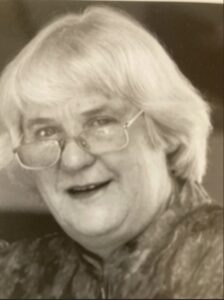
Dr Barbara Thiering (supplied)
Dr Thiering’s research has led her believe the miracles were a brilliant literary device used by Jesus and his followers to write history on two levels: that “the virgin birth” was really a play on words: and that the resurrection was, in effect, a conspiracy, to encourage the mystique surrounding this astonishing figure, Jesus. That’s not how she puts it, but that’s how it can be seen.
But for most people, it will be Thiering’s detailed and controversial reconstruction of the crucifixion – with its astonishing ending – that will stand out, either amazing or infuriating them. Or perhaps reassuring them … The Easter challenge is to consider the story of Jesus the man through Thiering’s scholarship.
Gained in Translation
It started with the coloured A4 flyer on a salesman’s desk at a screen industry trade fair in 2012 which caught my eye: it proclaimed the then newly produced Australian TV documentary, provocatively titled The Wicked Priest. I jumped to the same (wrong) conclusion as I suspect you might have done about the subject matter. It is a perfect example of how contemporary usage and understanding can betray and distort the language and idioms of a distant past – translated from a foreign language; how words can have more than one meaning, a notion at the very heart of Thiering’s work.
The Wicked Priest was just one of the works of this controversial Australian theologian and scholar, Dr Barbara Thiering (November 15, 1930 –November 16, 2015), noted for her lifelong study of the Dead Sea Scrolls, using the pesher* which resulted in several books as well as that ‘Wicked’ documentary. They were all and still are in contradiction of the ruling orthodoxy about when the Scrolls were written, and therefore the characters portrayed in the writings. The fact that she attributed crucial passages of the Scrolls to the time of Jesus – and that many of the Scrolls were reports about him – drew other Scroll scholars into a lifelong debate with her. And, she would boast, none have been able to demonstrate she was wrong.
This is how a layman journalist like me discovered the actual meaning of the words, Wicked Priest – and many other crucial words in the testaments of eons and languages apart, that we misunderstand. For example, when Jesus claimed “I’m the Son of God,” he was simply claiming – in the Hebrew idiom of the time 2000 years ago – that he was a high priest; this was a revolutionary claim, since only those born into the tribe of Levi could be high priests. Here was a layman, albeit a descendent of King David, claiming to be a priest. It ended badly for him. Although Dr Thiering showed that the crucifixion was not the end of him. No wonder she caused such a fuss … To this day, her work is roundly derided – but still not disproved – by scholars, as well as those who might readily believe a supernatural resurrection but refer to the proposition of a resuscitation as ‘not credible’. And did a virgin give birth to a son? What does ‘virgin’ mean…? See below.
Scholarship & Faith
Having followed Dr Thiering’s work in the later stages of her life almost until her death, it became clear to me that she was driven by scholarship and faith in equal measure and she believed her work was often tragically misunderstood to be an attack on the foundation of Christianity. Nothing could be further from the truth.
Her scholarship lifted the veil of superstition and the supernatural to reveal the underlying historical truths. To maintain her faith in her god, she didn’t need Jesus to have died on the cross, risen from the dead, ascended into heaven. That was the supernaturally inflated version of the real story of the man and his environment in the 1st century for the unsophisticated, the “babes in Christ”, as she affectionately called them.
Dr Thiering’s body of work sought to help ‘strip away the myth from the man’ – as the lyric has it in Heaven on their Minds from the Andrew Lloyd Webber & Tim Rice rock opera Jesus Christ Superstar – and show how and why in the eyes of his religious sect, Jesus (in line through his father to the throne of King David) was technically a bastard; in the eyes of his community he was a rebel; and in the eyes of his strict sect, he was a Wicked Priest. Those words resonate today with magnified meanings.
The fundamental proposition that comes out of Dr Thiering’s work is that the Qumran sect of which Jesus was a member, represented the form of Judaism out of which Christianity developed. I urge readers to seek out her books in major libraries for a full understanding of this subject. This article is a pale reflection, a simplistic reduction of her scholarship and merely a reminder of the rich well of information and knowledge that is her legacy.
I argue that what Jesus started with his religious rebellion (in the context of the times) could even be described as the first enlightenment, the light of compassion banishing the darkness of a cruelly applied religion, setting the groundwork for the Judeo-Christian doctrines that were picked up and eventually expanded through every facet of life, promulgated and celebrated through the flowering of Western civilisation.
if not on Friday …
“Jesus did not die on the cross.” Those words begin the chapter “The Death That Failed” in Dr Thiering’s book, Jesus the Man (Jesus and the Riddle of the Dead Sea Scrolls in hardcover). She continues: “This is not conjecture, but comes from a reading of the text by the pesher method. Its basic assumption is that nothing supernatural took place, no visions: these are the fictions for the “babes”. When Jesus “appeared” in a “vision” to Peter or Paul in subsequent years, as recorded in Acts, it was the real flesh and blood Jesus, holding an audience with his ministers.”
It’s worth noting that Paul did not put the weight of his case on the resurrection as Dr Thiering pointed out: “Rather, the central event was the crucifixion. For Paul, the suffering of Christ was the means of atoning for sin…” In Catholic churches the world over, the obligatory 12 stations of the cross bear this notion out. But the story of the resurrection had been propagated (propagandised?) by Simon Magus above all, a man who had been at the centre of events and who knew the value of myth making in advocating a religious belief. Today he might be hailed as a master promoter. How different would have been the trajectory of the spread of Christianity without a resurrection story.
Thiering writes: “Mark’s gospel, in its original version, ended at Chapter 16, verse 8, with the women running away from the empty tomb. It contained no appearances of Jesus. These were added in a later appendix. The appearances seemed to vary in each of the Gospels, not apparently giving unanimous testimony such as would obviously be required for proof of such an event. John’s gospel says that Mary Magdalene alone went to the tomb. The other three gospels say that three women went. John and Luke speak of two angels, or men (in the case of Luke). Mark and Matthew of only one, and for Mark he’s a young man in the tomb, while for Matthew he’s an Angel, apparently sitting outside. Each gospel records different appearances on subsequent days.
To understand how Jesus could have avoided death by crucifixion we have to understand how exactly the crucifixion unfolded. And most importantly, when. In Thiering goes into minute by minute detail. Here is the very, very short version.
The crucifixion took place on a Friday (probably April 3, AD 33), on the eve of the sabbath, in the afternoon. If it had taken place just one day earlier on Thursday, Jesus would have certainly died on the cross, as intended. There could have been no ‘resurrection’. The history of the Christians and probably the history of the world, would have been different. His ‘team’ could not have had reason to take him down on religious grounds.
Observance of the sabbath rules was mandatory and Pilate, already on notice by Rome for breaking Jewish laws, had to be careful. By 3pm, for example, it was no longer permitted to make a journey of more than 1000 cubits (457 metres) and by 6pm it was no longer permitted to lift up a burden. These rules helped the plotters who were attempting to save Jesus from death.
poison to simulate death
The plotters were able to administer Jesus snake poison to simulate death before he really died on the cross. (All the Hellenistic doctors were skilled in the use of poisons, and especially snake poison, giving them their name, the Serpents. In essence, this was a medical intervention …)
Once apparently dead, taken down from the cross, in accordance with rules of the Jews and placed in a nearby cave. He was attended by some of his supporters and administered the thick syrupy liquid squeezed out of the aloe leaves, which acts as a purgative. It was sent gradually down the throat of Jesus over about six hours until midnight. During that time he would have been sufficiently conscious to co-operate.
In the days and months that followed, Simon Magus started to talk about a resurrection. He was known for his magic tricks… He was one of the first to see the powerful pull of such a story. Jesus rises from the dead. Imagine the impact at a time when people believed the impossible as the work of god or gods. The story spread like a fire. It was also a great cover for the escape. Nobody went looking for him; he was in heaven…
In 1995, Dr Thiering published her remarkable book, Jesus of the Apocalypse – The Life of Jesus after the CRUCIFIXION. In the Introduction, she writes, “Jesus was no solitary preacher appearing suddenly on the shores of Lake Galilee. He was a central figure in a major political movement which was working at overthrowing the pagan Roman empire.” But Jesus was not a Zealot. He said to his followers, “give to Ceasar what is Ceasar’s and to God what is God’s.”
“The Zealots, who were against Rome and wanted to destroy all pagans in a holy war; and the Christians, the followers of Jesus, who believed that they should love their enemies, including the Romans. Judas was a Zealot. To him it seemed that Jesus had gone over to the enemy and deserved the punishment set down in the Temple Scroll…he should be crucified.” So it was that Jesus’ quasi-political beliefs led to his own “party” turning against him, leading to the crucifixion.
FOOTNOTE (as it were): Dr Thiering provided handy ‘Rules for the pesharist’, one of which is that ‘no words are to be assumed’ This rule helps to understand why Jesus was able to stand. In Lk 24:40, Jesus after the crucifixion “showed them the hands and the feet”. There are no words indicating that they were injured. John 20:25 shows that there were nail holes in the hands, but there is no mention of feet. The rule that no words are to be assumed means that Jesus’ feet were not injured, so that he was able to walk after the crucifixion.”
* To Dr Thiering, the pesher was like a solution to a puzzle – a bit like a cryptic crossword. Some aspects of the technique rely on giving ancient foreign words their modern meanings, for example:
to die: to be excommunicated
raised from the dead: to be reinstated
saint: celibate monk
sinner: married man
virgin: nun
Son of God: High Priest
angel: Levite (one of the priestly class)
child: novice – all Gentiles were “children” and could not be full members of the Qumran community; hence, “Let the little children come to me” assumes a bigger, broader meaning.
man: initiate, or full member
I am the Light: I am the High Priest
the Poor: celibates, monastics who gave up their property
the Blind: uneducated, lowly villagers. Jesus let them into monastic schools
drunk: not an ascetic, drank fermented wine (Jesus was sometimes referred to by detractors as a ‘drunk’)
Consider how those meanings revolutionise our understanding of the gospels …
Poets use idioms and symbols in their work which schoolteachers carefully explain to students of English literature (still?). Shakespeare’s plays used language of his time – which also requires to be read in the context of historical usage. The language of the scriptures might be seen in similar light.
OMG…Andrew has caught the URBAN disease…as you well know JESUS had to get out of town ! The Roman Gestapo don’t allow escape. JESUS and his family travelled to Northern India.They settled there and had many children. Ancestoral descendants live today in Uttar Pradesh .The family history has been handed down for two thousand years in the Prayagraj region.However there is a surviving Christian enclave in Santokh Majre: The DNA evidence is VERY interesting, to say the least .
Maffeo Barberini (Pope Urban V111) sent envoys with gifts of the typical lousy Italian Frankincense and Myrrh. Missing persons enquiry with an arrest warrant. That Pope URBAN had some spare time after doing over Galileo Galilei..Say no more..!
a good time to explain the work of Dr Thiering and understandably a lifelong study pursuit by her. Her work is fascinating.
Can anyone offer any advise of anyone being able to help me and my partner or know of anyone that can go over a case
My partner has been convicted of murder which he is innocent
He has lost his appeal, and a case that was going to the high court with the same grounds we were waiting on ,of a miscarriage of justice from wrong jury verdict ,if he had won , the lawyer would have taken my partners case to the high court too, but unfortunately he lost so our lawyer basically said he has no avenues and just has to do his sentence
He wont get out till he is 89 years old and if he lives that long he will then be deported
This was on circumstantial evidence, terrible police work, and a biased jury.
Perhaps a bit more info first: email me the details of the charge on which he was convicted, the defence closing address and the judge’s summing up.
andrew.urban@wrongfulconvictionsreport.org