Andrew L. Urban
Recorded and with availability restricted to relevant judges, jury deliberations hold the key to many wrongful convictions.
Of the 12 member jury at Robert Xie’s third murder trial in 2015, (the longest in NSW history), most voted NOT GUILTY. Some didn’t, resulting in a hung jury and a fourth trial, in 2016/17.
Had the 2015 jury reasoning been recorded, it is beyond doubt that it would have been found so flawed as to cause the jury’s verdict to be quashed. This is my informed view, after studying the case for three years prior to publishing the book FRAMED – how the legal system framed Robert Xie for the Lin family murders. There was no direct evidence that Robert Xie viciously murdered five members of his wife’s family in 2009, nor any credible circumstantial evidence.
Robert Xie always maintained and his wife Kathy Lin swore on oath that after they turned off their computers they went to bed in their Beck Street, Epping, home at around 2am on July 18, 2009. Computer records confirm the timing. The prosecution set about establishing the time of the murders after 2am, with no supporting evidence; but it was essential for the prosecution’s narrative if Xie was to be found guilty.
Yet …. his conviction – going against his alibi and absent a credible motive – rests on just a couple of unreliable elements that the prosecution urged the jury to accept as reliable evidence, to negate Xie’s alibi. One was a secret (and preposterously unbelievable) recording made by a jail inmate while Xie was awaiting trial; the other was speculation made out thin air by police and unsupported by evidence that Xie sedated his wife so he could slip away in the middle of the night to butcher her family living 200 metres down the road. Among the five brutally murdered were Robert’s much loved two pre-teen nephews.
Why cheat to negate the alibi if the system is seeking the truth?
The big question for those who have never accepted the jury’s guilty verdict is what reasoning led the 11 who voted guilty to that conclusion? Of all that’s wrong with this conviction, that is the most important. Alibi is a trump card; if Xie was in bed all night, he could not have committed the murders. The failure of that one key assertion destroys the entire Crown case.
Robert Xie’s prosecution is one example of the vulnerability of the legal system to the secrecy of jury deliberations.
One reader, Linda, writes: “I believe juries absolutely need to be recorded to make sure they are making their decision on the evidence. In my partners case there was so much doubt and I just cannot fathom how they found him guilty. He has also lost his appeal so will now die in prison.” Some might say Linda is biased…but that’s a copout.
Reader Steven Fennell (a frequent commenter) provides a thought provoking example (also from personal experience) of why jury deliberations should be made known (to a relevant cohort):
[Appeal] Courts are required to assess whether a jury’s verdict was “unreasonable” in simple terms, whether it was open on the evidence. But because juries give no reasons, appellate courts are left guessing what the jury might have thought. That problem was exposed in Fennell v The Queen.
At trial, the Crown case depended heavily on identifying a hammer as the alleged murder weapon. The High Court later described key parts of that case as “extremely weak” and the identification evidence as “glaringly improbable” (see, for example, [78]–[91]). The conviction was unanimously quashed.
But what matters here is how the Court got there. The appeal run by Andrew Anderson (instructing solicitor), Kate Gover (barrister), and argued by Saul Holt KC—relied in part on principles drawn from Clout v The Queen, particularly the observations of Michael Kirby about the dangers of identification evidence.
Those principles go beyond identifying a person. They apply equally to identifying objects especially where memory is affected by delay, suggestion, or reconstruction. In Fennell, that reasoning was used to challenge how the hammer was identified and relied upon.
Here is the contradiction:
• The jury accepted that evidence without explanation.
• The appellate courts had to reconstruct why.
• The High Court ultimately found that no rational jury could have been satisfied beyond reasonable doubt.
So the system ends up in an awkward position. It says the jury’s reasoning must be respected—but then overturns the result because that reasoning, whatever it was, cannot be supported. You cannot properly test reasoning that was never given.
The most frequently cited concern about recording jury deliberations is that jurors must be able to speak freely and candidly.
If they knew they were being recorded, jurors might self-censor, avoid expressing doubts or some defer to the stronger personalities.
Many judges believe this would damage the deliberation process. But restricting the availability of such recordings to, say, the trial and/or appeal judges, would dismiss such concerns while ensuring that the jury had properly considered the evidence.
The same applies to concerns that since jurors discuss sensitive matters, including credibility of witnesses, moral judgments and personal reactions to evidence, recording deliberations could compromise jurors’ privacy and safety, especially in notorious criminal cases. The flip side of that is the potential upside of self-managing jury behaviour and improved responsibility.
(Other cases we have explored crying out for jury transparency include Sue Neill-Fraser, Marco Rusterholz and Derek Bromley.)
In short, the carefully controlled availability of recordings of jury deliberations would make a considerable beneficial difference to the administration of justice. In other words, record but restrict public access. Reviewing judges would write their decisions concerning the jury deliberations and the reasons for them, providing the necessary transparency without the risks. The reviews of jury deliberations should occur at the request of the judge or the defence, once a guilty verdict is announced but before it is recorded.
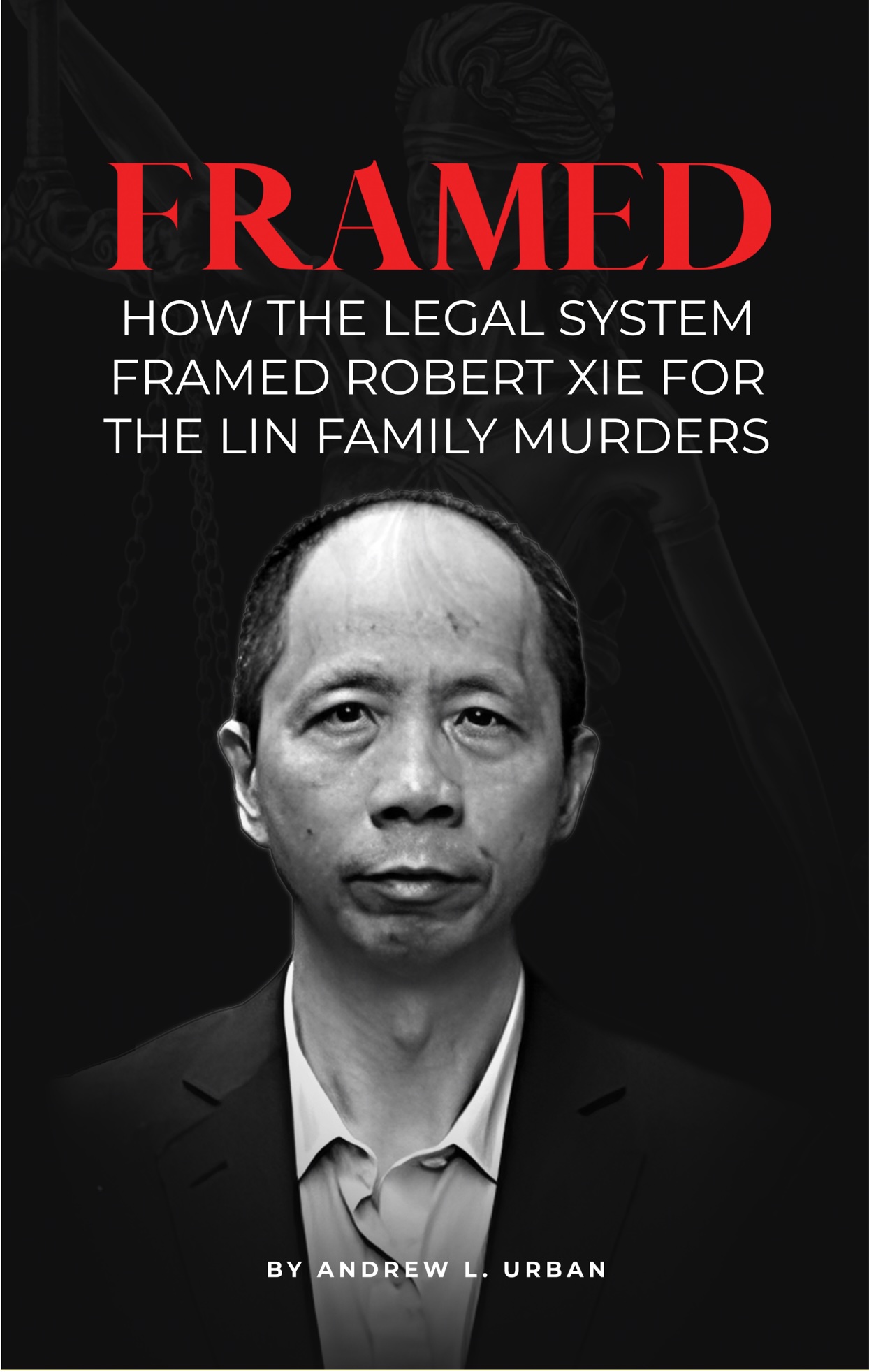
This book examines the trials and conviction of Robert Xie. After four trials there are many unanswered questions.
I applaud the author for asking the questions that need to be answered.The introduction issues the challenge “This book sets out to prove he was telling the truth.
Sadly, this is the task every accused who has been subjected to the carefully orchestrated media campaigns now faces. The golden thread our system was founded on “Innocent until proven guilty” no longer applies. Anyone with only access to media reports would have no concerns that Xie’s convictions were unsafe and unsatisfactory.
I am overwhelmed by the conclusion that Robert Xie’s convictions are unsafe and unsatisfactory and my doubt is more than reasonable; it is substantial.
Stuart Tipple
Former lawyer representing Lindy Chamberlain
Kindle $11.99 Paperback $26.39
Untrained Jurors Wield Life Shattering Power- It’s Time to Record Their Deliberations
Every day in Australian courts, twelve ordinary citizens, plumbers, teachers, retirees, shop assistants are handed a power that no single judge, no trained lawyer, and no appeal court can easily undo. They decide whether a fellow human being will walk free or spend the next twenty, thirty, or forty years behind bars. One verdict, one afternoon of discussion, and a life is effectively over.
Yet these jurors arrive with no legal training, no experience weighing circumstantial evidence, no instruction in the frailties of human memory, and no obligation to explain how they reached their conclusion. Andrew Urban has rightly called this system a dangerous blind spot. In his recent piece on the Robert Xie case the longest criminal trial in New South Wales history he exposed how jury secrecy can shield wrongful convictions from scrutiny.
The 2015 jury split: most voted not guilty. Had their reasoning been recorded and reviewed by judges, the glaring weaknesses in the Crown’s narrative would have been laid bare before a fourth trial ever began. Instead, the case rolled on, and a man with a verified alibi and no credible motive now sits in prison for life.
This is not an isolated failure. It is the predictable result of giving untrained people absolute, unaccountable authority over someone else’s future. Consider what we ask of jurors. They must evaluate complex forensic claims, assess the reliability of jailhouse informants, decide whether police speculation about sedation is “evidence,” and weigh an alibi backed by computer records against a story built on thin air. They do this after hearing days or weeks of conflicting testimony, often in emotionally charged cases involving the brutal murder of an entire family. Then they retire to a room with no legal guidance beyond a judge’s summing-up, no access to transcripts, and no requirement to produce reasons. Their decision is final unless an appeal court can guess what they might have been thinking.
The High Court itself has described this situation as absurd. In Fennell v The Queen, the prosecution’s entire case hinged on identifying a hammer as the murder weapon an identification the Court later called “glaringly improbable.” Yet the jury accepted it without explanation. Appeal judges were forced to reconstruct reasoning that had never been given. The conviction was quashed, but only after years of imprisonment and enormous cost. How many other cases never reach that rare High Court rescue?
The human cost is devastating. A 20-year sentence is not an abstract number. It is a father missing his children’s childhoods, a partner losing the best decades of life together, a person ageing behind bars while the world moves on. For the wrongly convicted—and for their families, this is not merely a legal error. It is a slow, state-sanctioned destruction of a life.
The standard objection to recording deliberations is that jurors will self-censor if they know they are being watched. But the proposal Urban champions is modest and targeted: record the sessions, restrict access strictly to the trial judge and appeal judges, and allow review only at the request of the defence or the court before the verdict is formally recorded. Jurors would still speak freely among themselves; the public would never hear a word.
The only difference is that a trained judicial eye could check whether the verdict was actually based on the evidence or on misunderstanding, prejudice, or pressure from dominant personalities in the jury room. This small safeguard would not undermine the jury system. It would strengthen it. It would force jurors to stay focused on the evidence rather than on speculation or emotion. It would give appeal courts concrete material instead of forcing them to guess. And most importantly, it would protect the innocent from the terrifying reality that twelve untrained people, acting in secret, can take away the rest of their life.
We already trust judges to make life-and-death decisions with full transparency and written reasons. We record police interviews, court proceedings, and even some witness statements. Why do we treat the single most consequential moment in a criminal trial—the moment when ordinary citizens decide guilt; as the one moment that must remain completely invisible?
The golden thread of our justice system“innocent until proven guilty” is only as strong as the process that tests that guilt. When that process is hidden behind a veil of secrecy, the thread frays. Untrained jurors hold extraordinary power. The least we can do is ensure their decisions are open to the kind of quiet, professional review that prevents the next Robert Xie, the next Lindy Chamberlain-scale miscarriage, or the next family destroyed by a verdict that no rational mind could reach.
It is time to lift the veil. Record the deliberations. Protect the innocent. Restore faith that our courts deliver justice, not just verdicts.
Yes. And in my view recording jury deliberations for judicial review in specific circumstances strengthens the jury trial structure. The case that motivated my investigations into wrongful convictions back in 2013, was that of Sue Neill-Fraser. In the 2010 trial transcript, pored over many times by lawyers and interested observers, the most notable aspect is the absence of any evidence of the murder for which she was sentenced to 23 years in prison. That is not really surprising given poor Bob Chappell’s body was never found, no murder weapon was found, no witness testimony and no credible motive established. Oh, and the prosecution’s speculative scenario was risibly impossible. Sadly in that case, the judge was no help and I am not confident he would have usefully reviewed the jury’s deliberations…but we should give him the benefit of the doubt.
You say “Why cheat to negate the alibi if the system is seeking the truth?”
But that’s the point. In the adversarial system, the discovery of truth is incidental. If it is uncovered, well and good, but the ultimate aim is “to win”. The show is put on for its practitioners and devil take the hindmost. That is why the adversarial system of law isn’t fit for purpose and consistently convicts innocent people.
In short, it’s a bloody disgrace.
I truly believe, juries need accountability for their verdicts.
Especially in cases where the accused is pleading not guilty,
And on circumstantial evidence, where prosecutors make up their story with no proof., but juries go along with that.
Either they should be recorded or some sort of person who understands law to be in the room keeping the jury on track and sticking to the facts and not their own scenarios etc.
In my partners case the police did not even get a statement off another suspect of where he was on the night, who had an extensive criminal history, nor get his DNA , which interestingly they got it 16 years later and his numbers matched but was of a low reading if they had taken it back when the murder took place it could have been a different story .and no DNA taken from another suspect.
When my partner appealled and lost one of the grounds were the jury made a mistake and was a miscarriage of justice and the standard reasoning for losing was like the case Andrew has written above basically saying the jury couldnt get it wrong. Which seems to be a few standard lines they use in the injustice system.
The jury couldnt get it wrong, the person staged the scene, hes fabricated the story etc.
The other thing juries dont realise is what they are doing and how many lives they ruin, not just the person they put in prison but there whole families.
People have no idea how devastating this injustice system is.
Once I ceased throwing up after reading ‘Framed’ given the clear failure of the Juries in the Xie cases I referred myself back to the bunch of fools all 10 of them led by an illiterate foreman Earnie Short in my trial in 1996 presided over by a district court judge who hung himself a few years later, who stated when approached by me as did the rest of the bunch of 10 who I approached in the knowledge same was prohibited, “none of us thought you were guilty, but there was something going on so we put you down anyway!” when asked:- well Earnie what did you think was going on? He just shook his head!
The FACT is when a bunch of mainly unwilling persons are forced to attend a trial and sit in judgement, they, in the majority:-
1) Have no idea of what it is the “ill” legal system requires of them?
2) Who the Parties are at court and what their jobs are?
3) What the hell: “beyond reasonable doubt” actually means? (I am yet to meet someone who does!)
4) They are highly intimidated by the Crown, much less by Defense counsel who they consider as guilty as the accused.
5) That a criminal trial does not deliver Truth, it is determined by the side that performs the best, crown or defense. A verdict of guilty does not prove guilt, likewise a verdict of acquittal does not prove up innocence. A criminal trial is so distant from truth in its purest form to be nothing more than part of an unintentionally corrupt program. The S N Fraser verdict arrived at by what must have been a bunch of dopes clearly and painfully demonstrates the fools had no idea as to what the show was about and a “Circus Show” was all it was except, for Fraser.
Something has to give and soon.
Yes, it seems from our commenters that thoe who have gone through a trial by jury will share your lack of confidence in them. The general public sleeps in blissful ignorance of how rotten our legal system really is.
Tony – your case reminds of a virtually unpublicised wrongful conviction. Janelle Patton was murdered on Norfolk Island exactly 24 years ago today.
NZ chef Glenn McNeill was freed on restricted parole in 2024 after 17 years in NSW jails for his 2007 conviction of her murder by a Norfolk Island jury. Lots of people know that, under threat from the actual murderers, Glenn dumped her body but otherwise was not involved in her murder. Jurors have told about how they needed to stitch up an outsider who wasn’t from the island eg at https://www.stuff.co.nz/world/5133724/Convicted-killer-Glenn-McNeill-is-innocent-says-juror ….. or …. https://www.theaustralian.com.au/news/latest-news/janelle-patton-killer-glenn-mcneill-is-innocent-says-juror-we-decided-to-slot-him/news-story/547ef730451ffd7acb7855aa771689b9.
Janelle’s body was covered in female DNA, so a male – Glenn with his mental health issues – was the fall guy because he’d made an unsworn statement – later withdrawn – in which he confessed to killing her in ways which were totally inconsistent with her injuries. All the evidence indicated that Glenn dumped the body and did no more than that.
It’s yet another good example of how juries operate.
Yes, jury discussions should be recorded. The Judges at any appeal should have access to the recording, I’m not sure who else should have access to the recording. Maybe – given that implementing a CCRC (Criminal Cases Review Commission) in Australia seems politically unmanageable – the HCA could appoint a Conviction Review Panel of 3 people who have access to the recording et al and who replace the overworked time-deficient HCA Judges as the people who decide which cases get reviewed by the High Court. If so, I’d vote for Andrew Urban, Michael Kirby and Peter McClellan as Australia’s first CRP. Jane Delahunty Goodman and Tracy Chapman are other names that come to mind as good CRP members.
The CRP would replace the overworked HC Judges only for the first phase of the two phases in any HCA appeal. Thus would solve many of the serious problems and regrets which Michael Kirby has written about, especially when he was pondering why he and the rest of the HCA got the Folbigg case so wrong in a really bad stuff-up. A CRP would also most likely have led to Lionel Murphy’s dissenting view in the HCA’s botched Lindy Chamberlain appeal becoming the majority decision, instead of Lindy having to wait in jail until the fluke of that matinee jacket turning up.
I hope I’m not writing crap – I’m just writing random thoughts on the spur of the moment.
If you have 20 minutes to spare, the parody Twelve Angry Men Inside Amy Schumer is relevant to this topic and is well worth watching – it has a 9.1 out of 10 rating on the IMDB movie database.
Maybe Peter Gill would be a good replacement for Andrew Urban on the CRP….