
Andrew L. Urban
The High Court’s decision last week, known as EGH19, is the latest in a string of defeats for the government over its attempts to protect the community from foreign criminals who are in this country unlawfully. The ruling in EGH19 struck down the latest regulation imposing ankle bracelets and curfews. But the seven judges produced six separate judgments that ran to 153 pages, including the two dissents.
The issue itself (foreign criminals in this country unlawfully) is outside our remit and we’re only referring to the decision to highlight how different judges can form very different opinions even in the crucial area of national security. Our starting point is the apparent anomaly that a jury of 12 must arrive at a unanimous (or at least 11:1) verdict and must not provide any reasons or comment – versus a judge or a panel of judges up to 7 (High Court) who might arrive at any majority decision and must write detailed reasons for all decisions.
In EGH 19, five judges agreed but for different reasons, while two judges disagreed. That’s the rough equivalent of 9:3 in a 12-member jury verdict. No judge would accept that result in, say, a murder trial. A split jury verdict (hung jury) triggers a retrial – but not when judges dissent. There are valid arguments for both judge alone and jury trials, but equally, there are valid arguments against both.
Juries allow ordinary citizens to participate directly in the justice system. (Whether competently or not is another matter.) Courts often describe juries as a safeguard against state power. A jury reflects the values and moral judgment of the community, not just the legal profession. But perhaps the main criticism of jury trials is that juries deliver a verdict of “guilty” or “not guilty” but do not explain why, which means appeals cannot easily identify reasoning errors. This surely goes against the crucial presumption of innocence. For example, in the case of the late Cardinal Pell, the High Court found that a “jury acting rationally” ought to have formed reasonable doubt about his guilt.
As for judge alone trials, the perceived benefits of transparency and ability to assess complex expert testimony, the presumption of judges ignoring irrelevant prejudice can be reversed when judges fall into error due to unconscious bias (or make judicial error in the application of laws).
One category of crime, however, has come to defeat both jury and judge alone trials for delivering justice: crimen exceptum. As we have reported in three cases, historical sexual abuse of minors, the nature of the alleged crime has become crimen exceptum; a crime so exceptional that the established rules of justice need not be applied to it, according to sociologists. There is no place in an evidence based criminal justice system for crimen exceptum. Studies of early modern witchcraft contain many references to witchcraft as a crimen exceptum — an exceptional crime that was not subject to regular judicial procedures or standards of proof.
It has been made possible by the changes in the law across all Australian jurisdictions, which no longer require corroboration to support such claims.
Two of the trials were by jury, the third by judge alone. Neither the juries nor the judge acted rationally. We can’t assess why in the case of the juries, but the judge alone trial was followed by an appeal running to some 500 points of criticism.
What stands out is that disagreements over verdicts between judges is accepted when the result is a guilty verdict. Are we confident that judges have such impeccable records as to lower the barriers for convictions? As we have reported here many times, a Griffith University study into contributary causes in wrongful convictions found that erroneous judicial instructions were responsible in 32% of such cases – judges being the second highest contributor, after the police.
The accused does not enjoy the benefit of the doubt in judge alone trials and appeals; in the refusal of the latter, if the three judges decide 2:1 against the applicant, the applicant loses. Given the unreliability & variability of judges’ decisions, that seems rather thin grounds on which to incarcerate a defendant, sometimes for life. If the legal system were to display moral and intellectual consistency, not to mention rationality, appeals resulting in a split decision would be declared in the appellant’s favour.
______________________________________________________________
 The author investigates the circumstances that led to the trial and conviction of child welfare officer Frank Valentine on charges of historical sexual and physical abuse at the Parramatta Training School for Girls decades earlier. It is his fifth book exposing what he considers to be unsafe convictions.
Kindle $11.99 Paperback $23.20
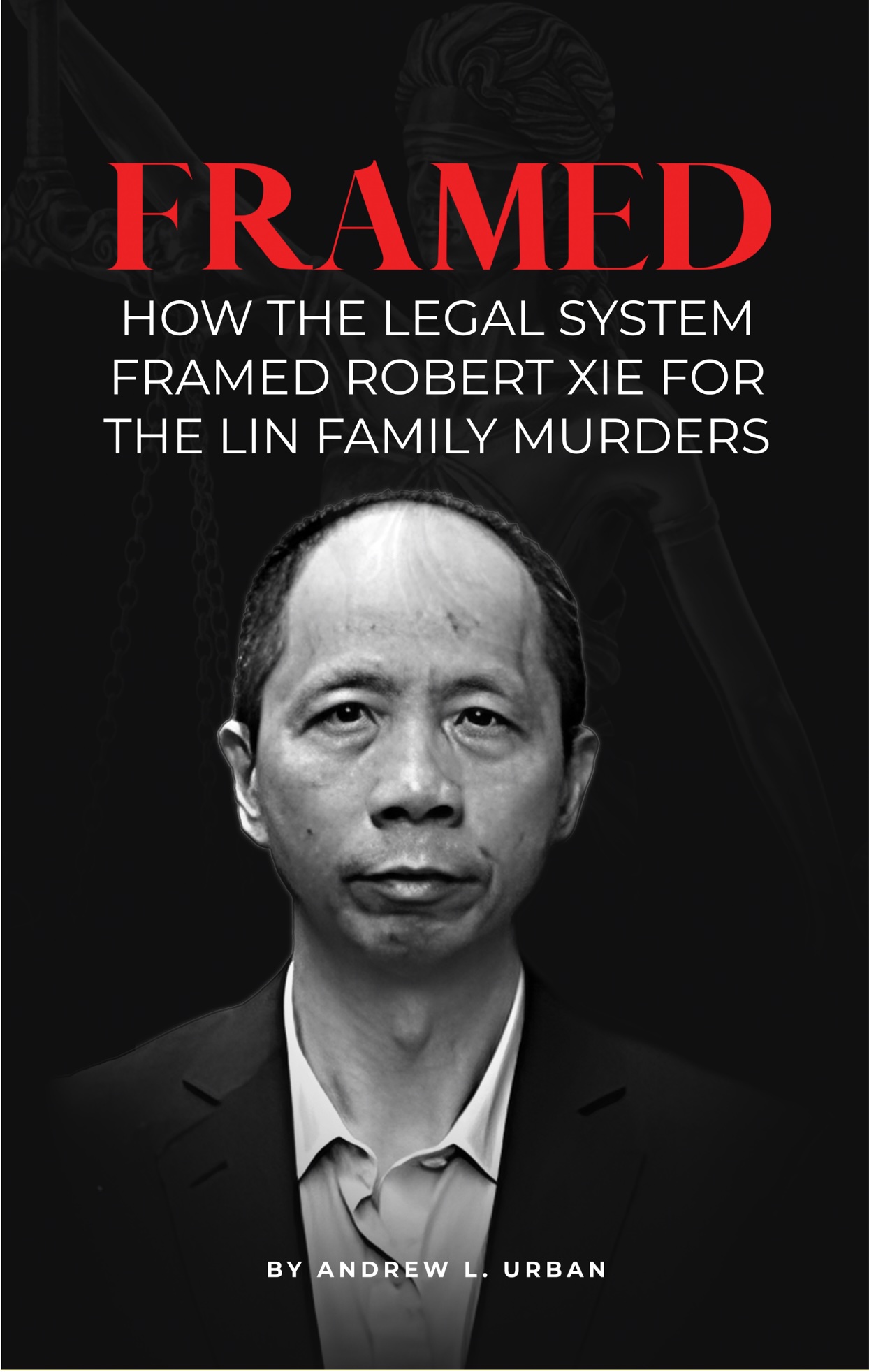
This book examines the trials and conviction of Robert Xie. After four trials there are many unanswered questions.
I applaud the author for asking the questions that need to be answered.The introduction issues the challenge “This book sets out to prove he was telling the truth.
Sadly, this is the task every accused who has been subjected to the carefully orchestrated media campaigns now faces. The golden thread our system was founded on “Innocent until proven guilty” no longer applies. Anyone with only access to media reports would have no concerns that Xie’s convictions were unsafe and unsatisfactory.
I am overwhelmed by the conclusion that Robert Xie’s convictions are unsafe and unsatisfactory and my doubt is more than reasonable; it is substantial.
Stuart Tipple
Former lawyer representing Lindy Chamberlain
Kindle $11.99 Paperback $26.39
I believe juries absolutely need to be recorded to make sure they are making their desicion on the evidence.
Like the experiment that was done death on the staircase on SBS about the jury it was very disturbing and shows exactly why juries need to be recorded and checked.
In my partners case there was so much doubt and I just cannot fatjom how they found him guilty.
He has also lost his appeal so will now die in prison
And partners also get a life sentence.
It is so unfair, and we desperately need a ccrc
Yes, absolutely, we need a co-ordinated national network of CCRCs. But since that seems well nigh impossible given the lack of political will (and courage), reforms must be addressed in the shorter term. I would not be surprised if your partner’s trial and failed appeal bore the signs of the legal system’s failures.
And yes, juries should be recorded. (Pity the poor sods having to listen, transcribe and analyse the recordings!)
For readers wondering why I keep referring to my own case, in my opinion piece the answer is straightforward it’s the one I know. This isn’t about self-promotion; it’s about using a real example I’m familiar with, rather than speaking in generalities. In a discussion about how the system operates in practice, firsthand experience is more useful than abstraction.
Inconsistent Standards of Decision-Making in Criminal Trials
1. When reasons matter and when they don’t.
One issue sits at the centre of this discussion: the legal system applies completely different standards to people making the same life-altering decision. A jury decides guilt or innocence but is never required to explain why. Once discharged, jurors are effectively barred from discussing how they reached their verdict. The result stands, but the reasoning disappears.
Judges operate under the opposite rule. They must explain their reasoning in writing. On appeal, multiple judges may agree or disagree, each publishing detailed reasons that are open to scrutiny.
The question is not which model is better. The issue is that both exist side by side without a clear justification. This becomes a real problem on appeal. Courts are required to assess whether a jury’s verdict was “unreasonable” in simple terms, whether it was open on the evidence. But because juries give no reasons, appellate courts are left guessing what the jury might have thought. That problem was exposed in Fennell v The Queen.
At trial, the Crown case depended heavily on identifying a hammer as the alleged murder weapon. The High Court later described key parts of that case as “extremely weak” and the identification evidence as “glaringly improbable” (see, for example, [78]–[91]). The conviction was unanimously quashed.
But what matters here is how the Court got there. The appeal run by Andrew Anderson (instructing solicitor), Kate Gover (barrister), and argued by Saul Holt KC—relied in part on principles drawn from Clout v The Queen, particularly the observations of Michael Kirby about the dangers of identification evidence.
Those principles go beyond identifying a person. They apply equally to identifying objects especially where memory is affected by delay, suggestion, or reconstruction. In Fennell, that reasoning was used to challenge how the hammer was identified and relied upon.
Here is the contradiction:
• The jury accepted that evidence without explanation.
• The appellate courts had to reconstruct why.
• The High Court ultimately found that no rational jury could have been satisfied beyond reasonable doubt.
So the system ends up in an awkward position. It says the jury’s reasoning must be respected—but then overturns the result because that reasoning, whatever it was, cannot be supported. You cannot properly test reasoning that was never given.
2. A “right” that isn’t really a right
The second issue makes the first more difficult to defend. In Queensland, an accused person can apply for a judge-alone trial under section 615 of the Criminal Code (Qld). On paper, that looks like a genuine choice: trial by jury (no reasons) or trial by judge (reasons given).
In reality, that choice is not in the hands of the accused. The application can be refused often by the same judge who will go on to preside over the jury trial. That raises a basic question: what is the point of a “right” that can simply be declined?
If the system truly believes juries are the best safeguard, then say so and remove the option. But if the law recognises that some cases are better decided by a judge because of complexity, prejudice, or evidentiary issues then the accused should have a real say in that decision.
At the moment, it sits somewhere in between. The option exists, but it is rarely granted. In practical terms, it operates more like a privilege than a right.
3. The contradiction at the centre
When these two issues are put together, the inconsistency becomes harder to ignore.
• Juries make decisions without giving reasons.
• Judges must give reasons and can be criticised when they get it wrong.
• Accused persons are told they can choose between the two but that choice can be refused.
Cases like Fennell show what happens when this structure breaks down. The system is capable of very careful, detailed reasoning drawing on cases like Clout, but that reasoning only appears after the fact, once a conviction has already been entered.
The jury never had to explain how it dealt with the very issues that ultimately undid the case. That is the contradiction. If reasoning matters and clearly it does at the appellate level, then it is hard to justify why it is absent at the point where guilt is first determined. And if a reasoned decision is sometimes preferable, it is equally hard to justify why an accused person cannot insist on it.
4. A question of consistency
This is not an argument to abolish juries, nor to elevate judges. It is a simpler point the system should be consistent in how it treats decision-making. At present, it demands transparency in one setting and enforces silence in another. It offers a choice but does not fully allow it to be exercised. It corrects errors in reasoning without ever seeing the reasoning itself. That may be historically explainable. It is harder to defend as rational.
One of the many valid points raised here – “That raises a basic question: what is the point of a “right” that can simply be declined?” – also applies to the right to lodge an appeal for Mercy to the relevant Governor vis the Attorney-General. That, too, can simply be denied by the A-G …with no reason given.
The issues raised in successive reports and comments really expose a legal system that is badly in need of reforms.