
Andrew L. Urban
April 5, 2026: Sorry, can’t resist the headline…. an eagle eyed reader of this blog living in Moscow alerted us to the 1990 wrongful conviction of David Tamihere for the 1989 murder of Urban Höglin and his girlfriend Heidi Birgitta Paakkonen. Tamihere has now had his convictions quashed by the Supreme Court, 36 years after he was found guilty of murdering the two Swedish backpackers in New Zealand’s Coromandel Peninsula.
This is a text book case of a circumstantial case leading to a wrongful conviction, including elements such as a key witness in the crown case, prison informant Robert Conchie Harris, who was found guilty of perjury in 2017. It’s yet another instance of the dangerous unreliability of prison snitches. For example, in Australia, the Robert Xie (according to our research wrongful) conviction, in the absence of actual evidence, also relied on the absurd and totally unreliable testimony of a snitch, which fooled the jury into disregarding his corroborated alibi. (The case is deconstructed in my book, FRAMED – how the legal system framed Robert Xie for the Lin family murders.)
Tamihere took the case to the Court of Appeal (Court of Appalling more like…) which in 2024 found there had been a miscarriage of justice because of Harris’s evidence but it did not quash its conviction because the court remained convinced beyond reasonable doubt that Tamihere was guilty.
The Supreme Court found the Court of Appeal did not have the right to make a call on Tamihere’s guilt after it had found the miscarriage of justice – that could only be made by a jury.
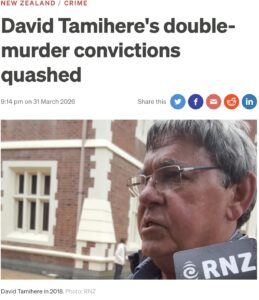
RNZ news report
Tamihere was released on parole in 2010, but his conviction stands.
The whole sorry saga of this case is reported in full in RNZ News
And the question remains: who murdered Urban (no relation) and Paakkonen?
_________________________________________________________
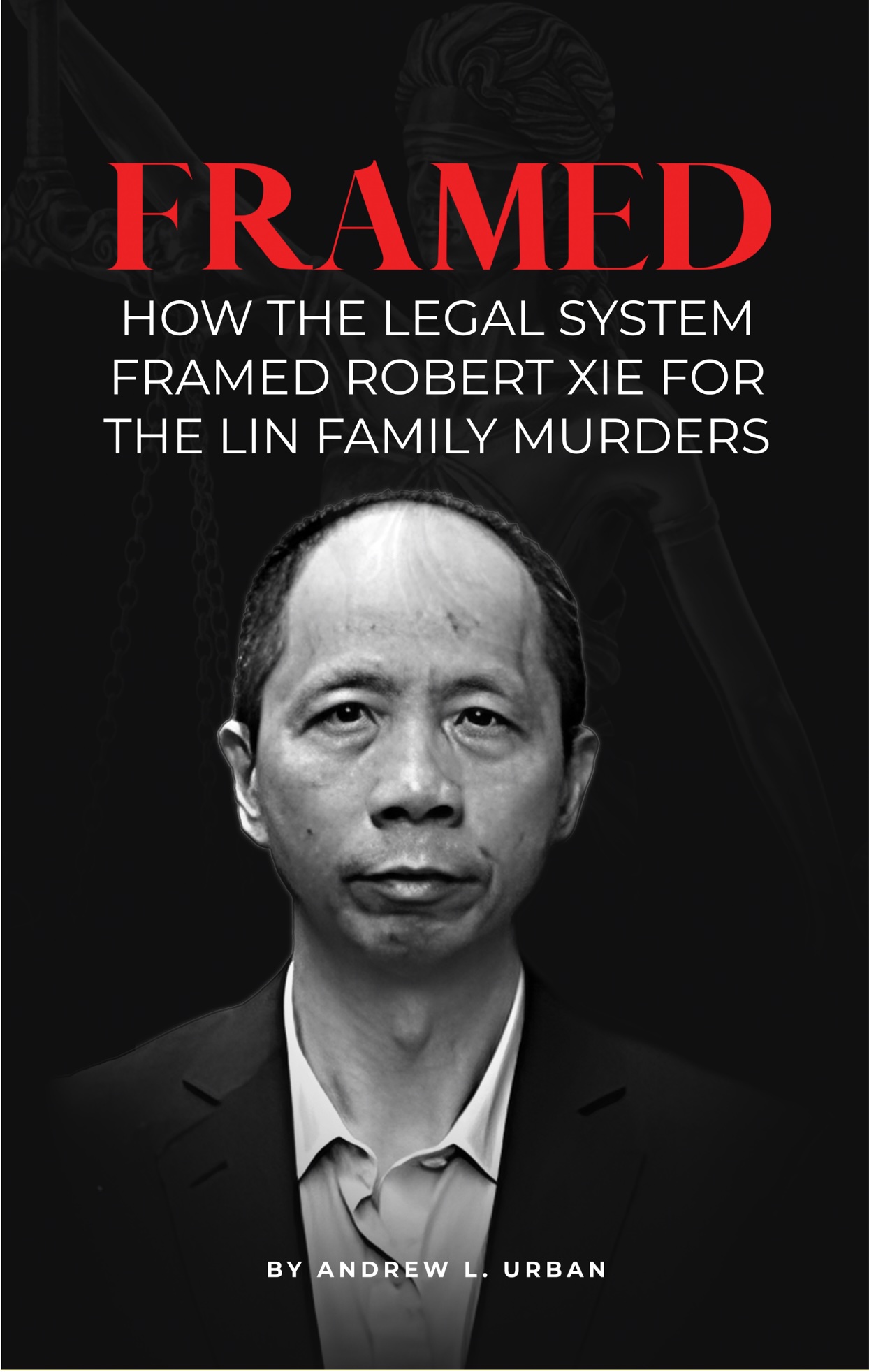
This book examines the trials and conviction of Robert Xie. After four trials there are many unanswered questions.
I applaud the author for asking the questions that need to be answered.The introduction issues the challenge “This book sets out to prove he was telling the truth.
Sadly, this is the task every accused who has been subjected to the carefully orchestrated media campaigns now faces. The golden thread our system was founded on “Innocent until proven guilty” no longer applies. Anyone with only access to media reports would have no concerns that Xie’s convictions were unsafe and unsatisfactory.
I am overwhelmed by the conclusion that Robert Xie’s convictions are unsafe and unsatisfactory and my doubt is more than reasonable; it is substantial.
Stuart Tipple
Former lawyer representing Lindy Chamberlain
May the actual killer/s & deceased’s body be found, to allow overdue justice be served for the two young people & their families, & the wrongly convicted.
Freedom Without Innocence, The Quiet Scandal Behind a Quashed Conviction.
This is an evidence analysis. It is not written by a lawyer, but from the perspective of someone who has lived through the machinery of a serious criminal prosecution, someone acquitted, looking at another man, David Tamihere, who should have been, or hopes still to be.
When you have seen the inside of that system, patterns stop being abstract, they become unmistakable. One of those patterns is the corrosive role of prison informants. I make no attempt to disguise my view: jailhouse “snitches” are among the most unreliable sources of evidence routinely accepted by courts, yet they continue to carry extraordinary weight with juries. Closely tied to that is perjury, not an accidental misstatement, but a deliberate distortion of truth, often incentivised and rarely punished in proportion to its consequences.
If a man can lose decades of his life on the back of such evidence, then perjury should not be treated as a secondary offence. It should carry a floating sentence, one that reflects the damage done; at the very least equivalent to the sentence imposed on the person convicted as a result of it. That is not a legal argument. It is an evidentiary one, drawn from experience; when false testimony becomes the foundation, the entire structure that follows is unsafe. Not of what a jury once believed but of what the system now knows, and still struggles to admit.
Because the case of David Tamihere presents a question so stark it should unsettle every court in every common law country: How does a man get parole, but not acquitted on evidence now known to be fundamentally flawed?
The System Knew—But Stopped Short
Tamihere was released on parole in 2010 after serving two decades in prison for the murders of Swedish backpackers Urban Höglin and Heidi Paakkonen.
Yet his convictions stood. For years, the legal system maintained a position that cannot withstand scrutiny:
• He could be safely released
• But remained guilty beyond reasonable doubt
This is not a contradiction born of legal nuance. It is a compromise. And in wrongful conviction analysis, it is a familiar one.
Across New Zealand, Australia and the United Kingdom, parole has too often functioned as a quiet release valve. A release valve used when the system senses something has gone wrong but resists the full consequences of saying so.
The Perjury That Didn’t End the Case
At the centre of the Crown case was prison informant Robert Conchie Harris. In 2017, Harris was convicted of perjury. This was not a peripheral witness. His testimony went directly to the most powerful piece of evidence a jury can hear, an alleged confession. Harris claimed Tamihere admitted to the murders while in custody. That assertion alone had the capacity to override weaknesses elsewhere in the prosecution case. But the problems were deeper, and provable.
He gave evidence that was factually wrong. Most notably, he claimed Tamihere had passed on a victim’s watch. That watch was later found on the victim’s body. This was not hindsight reinterpretation. It was demonstrable falsehood. And still, the conviction stood.
Why the System Didn’t Collapse When the Evidence Did
When Harris was exposed, the Court of Appeal of New Zealand acknowledged a miscarriage of justice. But it refused to quash the conviction. Instead, it relied on a legal mechanism known as the proviso—allowing a court to say: yes, there was error… but the accused is still guilty. This is the fault line. Because perjury by a central witness is not a technical defect. It is a structural failure. It means the jury’s verdict was reached on contaminated evidence.
To uphold a conviction in those circumstances is not to correct error; it is to work around it. It took the Supreme Court of New Zealand in 2026 to state what should have been obvious, some errors are so serious that they cannot be “saved.” Guilt must be tested again by a jury, not inferred by appellate judges. But that correction came 36 years after conviction.
This Pattern Is Not Unique
Observers like Andrew L. Urban have long tracked cases where weak evidence is reinforced by unreliable witnesses and hardened into conviction. He has drawn parallels with cases such as Sue Neill-Fraser, where persistent concerns remain about:
• the absence of direct evidence
• the construction of a narrative over proof
• and the system’s reluctance to fully revisit its conclusions
Even in cases like Robert Xie often cited in discussions about informant testimony, the broader concern persists: juries can be powerfully influenced by witnesses whose reliability is later called into question. The jurisdictions differ. The pattern does not.
Shared Legal Systems—Shared Vulnerabilities.
The legal frameworks of New Zealand, Australia, and the United Kingdom share a common ancestry. That includes the same strengths and the same blind spots. One of those blind spots is the proviso.
It exists to prevent technicalities from overturning otherwise sound convictions. But in practice, it can allow courts to preserve convictions even after identifying serious flaws. The Tamihere case shows how dangerous that can be.
Because once a court convinces itself of guilt, the focus shifts:
• from whether the trial was fair
• to whether the outcome can still be justified
That is a fundamental shift from process to conclusion. And it raises a critical question: If a trial is unfair, how can its verdict be trusted at all?
The Unspoken Factor: Compensation
There is another dimension that cannot be ignored. Full exoneration carries consequences:
• substantial compensation
• institutional accountability
• public acknowledgment of failure, well partial remedies do not. So a pattern emerges:
• identify a “limited” error
• release the prisoner
• avoid formally declaring the conviction unsafe
Parole, in this context, becomes more than a correction. It becomes a containment strategy. It resolves the immediate injustice, continued detention without triggering the full legal and financial consequences of a wrongful conviction. Whether intentional or not, the effect is the same.
The Lawyers—and the Limits of Relief
Tamihere’s lawyer, Murray Gibson, welcomed the Supreme Court decision. But even now, after decades, the system stops short. There is no acquittal. Instead, there is the prospect of a retrial decades after the original evidence was gathered, in a case where the Crown’s own theory has “radically changed.” This is not closure. It is deferral.
The Question That Should Trouble Us All
So the question remains and it is not confined to one case or one country. If a man can be convicted on perjured evidence, released on parole, and still not acquitted what does it actually take to overturn a wrongful conviction? Until that question is answered clearly, the risk is not that the system occasionally fails.
It is that it fails in a consistent, predictable way:
• by resisting full acknowledgment
• by managing error instead of correcting it
• and by leaving individuals in a state of permanent uncertainty
The Tamihere case is no longer just about who committed a crime in 1989. It is about whether modern justice systems are capable of confronting their own mistakes fully, openly, and without qualification. Because anything less is not justice. It is maintenance.
Sources & References
• RNZ News (31 March 2026): David Tamihere’s double-murder convictions quashed
• Timeline, evidentiary background, and Supreme Court findings (RNZ reporting)
• Perjury conviction of Robert Conchie Harris (2017)
• Supreme Court of New Zealand – miscarriage of justice and retrial ruling
• Court of Appeal of New Zealand – application of the proviso
• Commentary and case-linking by Andrew L. Urban on wrongful conviction patterns
As Steven says, “If a man can be convicted on perjured evidence, released on parole, and still not acquitted what does it actually take to overturn a wrongful conviction?” Good question. A reasonable person would surely agree that where perjury is the cause of a wrongful conviction and subsequent prison sentence, the penalty should be equal to the prison sentence – and the conviction quashed. Although perjury is in the same category as perverting the course of justice, it is deemed less severe, and is narrower in scope. But Queensland gets it right, with a 14 year maximum prison sentence for both.
All other jurisdictions in Australia have lower penalties for perjury. Surprisingly, under the Federal statue, the penalties are the lowest, with 5 / 10 years prison respectively. Victoria’s are the harshest at 15 / 25 years respectively.
And it’s not just prison snitches…we have published several stories of women making false claims of sexual abuse / rape.
The prison snitch is not exclusively male.
To that comment “The prison snitch is not exclusively male.” Julie I would add that the prison snitch is not always a real prisoner.