Andrew L. Urban*
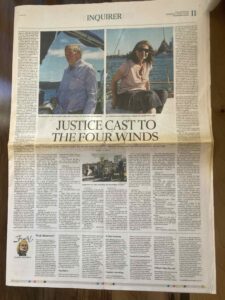
The Australian featured this extensive article in the March 25, 2015, edition. It was the first detailed mainstream media analysis of the Sue Neill-Fraser case and serves to inform those new to the subject – and a briefing to those who have recently become interested.
Sue Neill-Fraser was convicted of murder in 2010, after her partner of 18 years, Bob Chappell, disappeared from their yacht, Four Winds, anchored off Sandy Bay in Hobart on Australia Day 2009.
In the afternoon, Neill-Fraser had taken the dinghy ashore while Chappell stayed on board doing maintenance work. At dawn the next morning the yacht was reported sinking slowly, with no sign of Chappell. What appeared to be a clumsy attempt at sabotage had caused the Four Winds to take on water. It was a mystery.
Tasmania Police soon fixated on Neill-Fraser, after a shady character with a history of animosity towards the couple accused Neill-Fraser of having invited him to help kill her brother as well as Chappell, some 11 years earlier. Neill-Fraser, who had no criminal record or history of violence, denied it. Not to be deterred, the police stayed focused on Neill-Fraser. In the absence of hard evidence — not to mention the body — they were scratching for circumstantial evidence.
Neill-Fraser was arrested and charged with murder on August 20, 2009, and was denied bail.
Legal academic and author on miscarriages of justice Bob Moles explains how the law stands in circumstantial cases: “In such a case, a person cannot be convicted unless the fact of their guilt is the only rational explanation of the circumstances. The law says that if there is a single rational explanation of the facts, other than the guilt of the accused, then the person cannot be convicted.”
There is the possibility that Chappell was perhaps enticed or forced to leave the yacht by parties unknown, or kidnapped, murdered or held captive — in a yet to be discovered criminal act.
“If there was a reasonable possibility that Mr Chappell just disappeared,” says Moles, “or if he committed suicide or had an accident, or was killed by some other person, then the accused cannot be convicted. Each of those alternative explanations have to be excluded ‘beyond reasonable doubt’; otherwise, any one of them would constitute a reasonable doubt and be inconsistent with a finding of guilt.”
This alone, says Moles, warrants the conviction to be set aside. But there is more, as they say.
The following excerpts from the transcripts show that:
In the absence of the jury, the DPP, Tim Ellis, tells the judge that he “never believed” there was any of Chappell’s blood in the Four Winds dinghy, but talks to the jury about the blood testing anyway.
In the absence of the jury, the DPP admits to the judge that he has no direct evidence to support his speculation that a fire extinguisher was used to weigh down Chappell’s body, but puts it to the jury anyway — and the judge refers to it in his summing up as well as in the sentencing.
In his closing address to the jury, the DPP repeats his speculation about how the murder was committed but admits he doesn’t really know what was the murder weapon he alleges she used.
There are several other perceived problems with the trial, including forensic evidence that was led which is arguably not admissible and the failure to properly investigate the DNA of a stranger that was found on the yacht but not matched until later.
Although at first the police did not see anything on board that would suggest the disappearance was a murder, their investigation eventually focused on Neill-Fraser, a middle-class Hobart woman with two grown-up daughters. She was co-owner of the yacht with Chappell; they had recently taken delivery of it from Queensland.
Within 24 hours of Chappell’s disappearance, a local man, Phillip Triffett, went to the police claiming Neill-Fraser had wanted him to kill her brother Patrick as well as Chappell more than a decade earlier. Neill-Fraser denies this vehemently. (Triffett had not reported these claims to police at the time.)
There was a history of animosity between Triffett and Neill-Fraser; she reported to Bellerive police in 2001 her concerns for her own and Chappell’s safety after a serious falling-out with Triffett.
Neill-Fraser told the court Maria Hanson, then Triffett’s partner, told her “that Phillip had burnt down her house for the insurance and also that he’d shot a young man when he was very young at the Lakes and hidden the body and followed this up saying, ‘If you go to the police you’ve got a very overgrown back garden and Phillip’s revengeful and he could hide there with a gun, and you’ve got to think of (Neill-Fraser’s daughters) Emma and Sarah’.”
The police did not disclose before the trial that Triffett had made an approach to them asking if his evidence against Neill-Fraser would be helpful in his own matters due to go to court.
It only became known during the trial when an anonymous caller alerted defence counsel.
The following are extracts from the trial transcript; legal observers say these are just some of the elements that undermine the safety of the guilty verdict.
EXTRACT 1
DPP Ellis speculates about the murder weapon/s but does not produce any in court. Prosecution speculation without evidence is generally inadmissable as was stated by the Chief Justice of NSW in the Gordon Wood appeal, but the judge does not intervene.
CT 1297 DPP ELLIS
It was a wrench, wasn’t it, or a similar sort of tool with which you struck Mr Chappell from behind and killed him.
NEILL-FRASER: Mr Ellis, I have never struck anybody, let alone somebody I loved dearly.
EXTRACT 2
DPP Ellis pursues and embellishes his speculation about the method of the murder and admitting not knowing what the murder weapon in his speculative scenario might have been — but keen to convince the jury there was one.
CT 1381 DPP ELLIS:
You picked up something and struck him intending to kill him and killing him?
NEILL-FRASER:
This is just not true.
CT 1392 DPP ELLIS CLOSING
Anger, bang. Maybe once, maybe twice. But here comes the — here is perhaps the significance of there being no body found. Why, if this is a complete stranger to Mr Chappell and a complete stranger to the boat, would there be no body left on board? That doesn’t make sense, does it?
But if in fact it was someone who was closely connected to the boat, closely connected to Mr Chappell, and who would be able to be behind him without raising his attention because they’re known to be in that space, where there’s only one way in.
She’s walking backwards and forwards and delivers blow — a blow or blows, or maybe stabs him with a screwdriver, I don’t know …
EXTRACT 3
In the absence of the jury, the DPP tells the judge he has no direct evidence to support his hypothesis that Neill-Fraser weighed down the body with a fire extinguisher before disposing of it in the water.
P 14 SUBMISSIONS — JURY ABSENT — HIS HONOUR to DPP ELLIS, 21/9/2010
Can I just ask you about one small point? I haven’t yet got my head around every aspect of the Crown case. What is the evidence that tends to suggest — that the Crown says tends to suggest a weighing down with the fire extinguisher? Is it simply that the fire extinguisher has gone and Mr Chappell has gone, or is there more than that?
MR ELLIS SC:
No, there’s not — there’s not more than that.
EXTRACT 4
In his summing up, His Honour the trial judge asserts that Chappell must be dead, ruling out accident, suicide or any other possible explanation. To make such claims without any proper evidential basis is contrary to proper trial practice as was [also] stated by the Chief Justice of NSW in the Gordon Wood appeal, says Moles.
CT 1507 HIS HONOUR SUMMING UP, 14/10/2010
… it seems to me that you can fairly readily conclude that Mr Chappell has died.
So there’s also evidence that tends to suggest that what happened was not an accident. All the evidence that the Four Winds was sabotaged tend to suggest there was no accident. The blood in the yacht tends to suggest that there was — that there was no accident.
There’s evidence that tends to suggest that Mr Chappell didn’t commit suicide. Tim Chappell, for example at page 119 of the transcript, said that he wasn’t depressed or suicidal. He — the evidence was that he was interested in his work, regarded it as important, and if he did commit suicide it’s hardly likely that he would have scuttled the yacht and tied the fire extinguisher to himself and disappeared without a trace. The — there’s evidence that tends to suggest that Mr Chappell’s body was winched out of the — winched up onto the deck and taken away and dropped in the unsearched deeper waters of the River Derwent.
EXTRACT 5
DPP Ellis talking to the jury about Chappell’s blood and DNA found on the dinghy (Chappell’s own dinghy, where traces of his DNA would not be unremarkable).
CT 71 ELLIS — OPENING ADDRESS TO JURY, 21/9/2010
But the tender itself was also subjected to a screening test for blood called luminol, and what happens with luminol is you put it — you put it on objects where there might have been blood and turn off the lights and it gets lum — it goes luminous in the presence of blood, and so that reacted quite strongly, the tender and the inside of the tender for the presence of blood, and swabs taken from the tender were found to match, with a high degree of probability, Mr Chappell’s DNA.
But on the other hand another screening agent for blood taken on that tender showed negative and one of the forensic scientists looked under the microscope to try and find some — what they look for is red/brown indications of blood and couldn’t find any, so some indications of blood, his DNA, but others — others, no.
EXTRACT 6
DPP Ellis explaining to the judge (in the absence of the jury) that he never believed there was any blood in the dinghy.
CT 1486 HIS HONOUR, COUNSEL, JURY ABSENT — SUBMISSIONS, PRIOR TO SUMMING UP, 13/10/2010
MR ELLIS SC: The next point is, it was attributed to me that I said it was Mr Chappell’s blood in the dinghy. Now I don’t believe I did.
MR GUNSON SC: Yes, you did.
MR ELLIS SC: Okay — I don’t know why I’d say it —
HIS HONOUR: — Well —
MR ELLIS SC: — because I’ve never believed it.
HIS HONOUR: In opening.
MR GUNSON SC: Yeah.
MR ELLIS SC: Oh in opening.
MR GUNSON SC: Yes, in opening.
MR ELLIS SC: Oh okay, I abandon that, if I said it in opening.
HIS HONOUR: All right. Well I’ll do nothing about that point. What’s the next point?
EXTRACT 7
When sentencing Neill-Fraser, His Honour stated that in his view her disposal of the body was an aggravating factor — and increased the sentence he imposed on her — even though no evidence had been put to support any such speculation. He even refers to the fire extinguisher, despite having been told by the DPP that there was no direct evidence of its use, only its absence.
CT 1565 SENTENCING, HIS HONOUR, 18/10/2010
I am satisfied beyond reasonable doubt that Ms Neill-Fraser used the ropes and winches on the yacht to lift Mr Chappell’s body onto the deck; that she manoeuvred his body into the yacht’s tender; that she attached an old-fashioned fire extinguisher weighing about 14 kilograms to his body; that she travelled away from the Four Winds in the tender with the body for some distance; and that she dumped the body in deep water somewhere in the river.
As a result of the means that she adopted to kill Mr Chappell and dispose of his body, Ms Neill-Fraser made it necessary for the police to undertake a very time-consuming investigation. It involved a large number of officers making thorough inquiries over a long period. In my view the steps that Ms Neill-Fraser took on the night in question to conceal her crime, and the inconvenience and expense of the investigation that she made necessary, are aggravating factors that I should take into account.
Some may wonder how it is possible that these (and the other errors at trial) went unnoticed by the various lawyers present, two for the defence, two for the prosecution, as well as the judge. It is a pertinent question and one not fully explained by the failure of the appeal that was lodged.
On the fifth and perhaps key ground of the appeal, the Court of Criminal Appeal found that: “Concerning His Honour’s use of a wrench in the examples he gave to the jury, it would have been obvious to the jury that examples were being given and that the judge was not endorsing the theory raised by counsel for the Crown.
“No miscarriage of justice has been demonstrated in support of the ground.”
But as Bill Rowlings, chief executive of Civil Liberties Australia, points out, “If a judge chooses to give examples of a murder weapon precisely identical to the murder weapon hypothesised by the Crown prosecutor, it is an obvious endorsement of that hypothesis as a clear possibility as a preferential choice over another possibility — the judge did not choose a hammer or frying pan, for example, as a theoretical weapon.”
Neill-Fraser’s request for leave to appeal (restricted as it is to points of law) to the High Court was refused. The request was based on the fact the prosecution failed to recall Meaghan Vass for fuller cross examination.
Vass was a then homeless 16-year-old whose DNA had been found on the yacht and was only cursorily questioned during the trial, when she claimed she had never been on the boat.
The DPP advised the High Court that her DNA was a secondary or transfer sample, perhaps left there from the bottom of a policeman’s shoe. Ellis said: “The core evidence was … she (the homeless girl) was not on the boat.”
But in August last year, a new report from the Victorian Police Forensic Services Department, obtained by Neill-Fraser’s current lawyer, Barbara Etter APM, confirms it to be of primary transfer in nature, contradicting the evidence she gave at trial.
Neill-Fraser remains in jail**, wheelchair-bound (due to deteriorating mobility symptoms), her only hope resting in new Right of Appeal legislation that is now being finalised. Attorney-General Vanessa Goodwin stated on March 5 that “a draft bill will be released for public consultation” by the end of this month.
Like the South Australian bill passed in 2013, this bill intends to provide a further right to appeal for those who believe their convictions are unsafe. Sue Neill-Fraser is at the front of the queue.
*Andrew L. Urban has been a freelance contributor to The Australian since 1985.
**She was released on parole on 4 October 2022
Andrew. “From the archives” thanks for that! Lest we forget ? No matter how often some “stuff” is revisited- there are new readers and forgetful old…codgers..
Pre archival murders- ” hangings”by the Police Prosecutors ! Robert Ryan and Jean Lee – political executions . Police behaviour in the conviction of poor Jean –
a can of the usual police political worms – sealed for 75 years ? The shutting up (gagging) of Sue Neill- Fraser – same old shenanigans?
In another comment thread, Karen Keefe posted the following comment (which Andrew asked to be posted here):
[ https://wrongfulconvictionsreport.org/2026/04/21/a-high-profile-bar-for-bail/#comment-194904 ]
Karen’s is one of a number of instances of the various negative spin-offs coming from the trial and conviction of Sue Neill-Fraser. Where to start? I think that a wide-ranging Inquiry is needed …i.e., wide terms of reference for an Inquiry into the death of Bob Chappell and the subsequent conviction of Sue.Neill-Fraser.
Remember the recording devices that were left running for a considerable length of time … recording Jeff Thompson visiting Steven Gleeson (hope I’m remembering correctly). Those recording devices also capture Barbara Etter in: one of her visits and/or a visit she made to the jail. And Karen Keefe has written that she too was listened to and recorded from the jail … it’ worth reposting the whole of a comment that she made to WCR some years ago:
MY OWN COMMENT: For some time I’ve been thinking that the Prison Service itself had acted to do the bidding of TasPol. And the service has shown itself to be vindictive … remember Sue being placed into ‘solitary’ confinement as some sort of punishment for … ? For what? For her writing for WCR a ‘Day in the Life’ account of being in the prison … which she submitted to and was allowed for postage from the prison by whoever was acting as the prison censor. Remember the loss of privileges and transfer for having – what was it – lipstick and a sewing needle and thread (properly obtained by her from the prison staff)? I remember.
I remember the – still current – Parole Board threat that if she continues to directly or indirectly tell the media and/or others, that she is not guilty, then she will be returned to prison. ‘Darkness at Noon’ stuff? There was also the hunger strike … occasioned by the Prison placing Karen Keefe next door to Sue in whichever wing of Mary Hutchinson she was in at the time. Was that an attempt to have them together so that more recording could be done … was it hoped by the Prison that Karen could be a snitch – I’m not suggesting that she was, but rather, am suggesting that the Prison may have been hand-in-glove with TasPol hoping to record them or hoping to have Karen be a snitch for them later on.
Yes, I’d like Karen to tell her story, Andrew. Would she be willing to tell it to WCR? I’d think there’s a chance that she would … she was present (as I recall) at ‘The Royal’ (Yacht Club of Tasmania, Sandy Bay) for the launch of your book ‘Murder by the Prosecution’.
We need a wide-ranging Inquiry … will/can we ever get it? At present the motion-on-notice by Mike Gaffney, to have the Legislative call for such an Inquiry to be initiated by the Govt, seems to be stuck in the doldrums …perhaps we will learn more about the pause that MLC Gaffney placed on his motion … when the Leg Co next sits.
-Garry Stannus
Thank you Garry, this is a valuable contribution to the history of what can now be called the Sue Neill-Fraser saga. And of course, WCR would be keen to publish any of Karen’s story she is prepared to share.
The facts thatBlow J was appointed Chief Justice soon after this trial when his adjudication of the case was so biassed, will remain as one of Tasmania’s many grave injustices. Who appointed him? Why? especially given this case.
The official version John is :- Justice Alan Blow was appointed Chief Justice of the Supreme Court of Tasmania in April 2013 by the Tasmanian Governor, based on the advice of the state government led by Premier Lara Giddings and Attorney-General Brian Wightman. He succeeded Ewan Crawford, having served on the Supreme Court since 2000. For more on the background of this case, read the comments at Tasmanian Times.
Andrew. Steven Fennell is impressive – hey ? Putting in words- some of which which we know – jury fooling is an art form..we know it ! But Stephen Fennell explains in a clear manner the technique of many a Judge/prosecutor team. The practice of little chats without the jury seems downright manipulative. Manipulation of the defence (and jury). Since- as in many cases we read of in Andrews Wrongful Convictions – this agreed upon technicality or circumstances is then ignored or hidden from the jury by the judge/prosecutor team. Since when did these pompous gits have God given right to conceal “stuff” from the jury of wize men and women?
Indeed … and a top example is in this story above, where the prosecutor Tim Ellis SC tells the judge (jury absent) that he doesn’t believe there was blood in the dinghy. When told by the judge and the defence that he said the opposite in his opening, he demurs. And neither he nor the judge nor even defence counsel correct the assertion when the jury return. Dishonest, unethical, misleading, prejudicial all rolled into one.
Andrew. “From the archives” – keep that up. Great idea! Like a thorn in the paw of the gutless Tasmanian Law Society and their Taspol cohort ! It took 400 years to free Galileo Galilei from “that” Pope Urban. Only 19 years for David Eastman to be free of the Federal Police Drug Gang involvement. Then we sink back into 40 years for Derrick Bromley and the same South Australian flexible forensics that hung Ray Bailey (with help from the Queensland Police Force Corruption darlings). We must never let the archives on the attempted hanging of Darryl Beamish by the future WA police commissioner-just fade away..or the absolute multitude of other West Australian Police scurrilous antics. Little John Pats brain being kicked loose by drunken WA police in front of disappeared witnesses. Andrew – one per week or per month – blow the dust of one of these disgusting police outrages..never forget that Stacy Train the school teacher who hated guns – was lying on the ground wounded and firing with the best of them – the Queensland Police Helicopter Observer reported that she – the female was unarmed and crawling for cover under the dwelling. There’s one from the archives..
Andrew. There seems to be no “proper” mention that Meagan Vass clearly stated to the full mob in the court room – that she and friends were on the Four Winds and that Sue Neill-Fraser was not ! Meagan only shit herself after an overnight friendly chat with Taspol. Was a holiday in the teenage rape centre on offer..?
Meagan was clearly in a state of sheer terror of Taspol…
Justice Cast to the Four Winds — Judicial Framing and the Illusion of Neutrality
In my reply I will focus on one point, the reason for that is simple it stands out to me that does not lessen other points or arguments.
This case has been presented as a circumstantial puzzle. It is more accurately understood as a trial in which one inference was progressively stabilised, despite the acknowledged absence of direct evidence, through a combination of prosecutorial speculation and judicial framing.
At the centre of that process lies a point made by Bill Rowlings: “when a judge adopts, even illustratively, the same hypothetical mechanism advanced by the prosecution, the effect is not neutral. It is endorsement.”
The Legal Threshold in Circumstantial Cases
As Bob Moles explains, a person cannot be convicted unless guilt is the only rational explanation of the circumstances.1
This requires that all reasonable alternatives be excluded:
a) accident
b) suicide
c) third-party involvement
If any one of these remains reasonably open, the standard of proof is not met.
Yet in the case of Sue Neill-Fraser:
a) no body was recovered
b) no cause of death was established
c) no murder weapon was identified
d) alternative explanations were not eliminated by evidence
In such a setting, the way possibilities are presented to a jury becomes decisive.
The Prosecution Case: Speculation Without Anchor
The Crown, led by Tim Ellis, advanced multiple speculative scenarios regarding how Bob Chappell may have been killed.
These included:
a) a wrench or similar tool
b) a blow or blows delivered from behind
c) possible stabbing with a screwdriver
d) an unspecified violent act in a confined space
Crucially, this speculation was maintained while conceding uncertainty. In closing, Ellis stated he did not know what the murder weapon was.2
Ordinarily, such uncertainty should expand reasonable doubt. Instead, through repetition, it began to form a narrative.
Judicial Example Selection: Where Neutrality Breaks Down
It is here that Rowlings’ observation becomes critical. The Court of Criminal Appeal dismissed concerns about the judge’s use of a “wrench” example, suggesting it was merely illustrative.
That reasoning does not withstand scrutiny.
A jury hears judicial examples:
a) after sustained exposure to prosecution theories
b) in the absence of evidentiary clarity
c) under instruction to treat the judge as authoritative
In that context, the selection of an example that mirrors the prosecution’s hypothesis is not neutral.
If the judge had chosen:
a) a hammer
b) a frying pan
c) any unrelated object the effect would have been to emphasise uncertainty.
Instead, by selecting the same class of weapon proposed by the Crown, the judge narrowed the field of possible interpretations.
This is not illustration. It is convergent reinforcement.
Reinforcing Speculation Across the Trial
This issue is not isolated. It aligns with a broader pattern:
a) The Crown suggested a fire extinguisher was used to weigh down the body, while admitting there was no supporting evidence beyond its absence.3
b) That same theory was later reflected in sentencing as if established fact.4
c) Assertions about blood in the dinghy were presented to the jury, then abandoned, with the Crown acknowledging it had never believed them.5
Each instance reflects the same structure:
a) speculation introduced
b) not effectively withdrawn
c) ultimately normalised
Within that environment, judicial repetition carries heightened influence.
The Authority Effect
The law assumes juries can separate suggestion from proof. That assumption becomes fragile when the source of the suggestion is the judge.
Judicial language carries institutional weight.
This creates a reinforcing loop:
a) the prosecution advances a speculative theory
b) the judge repeats it as an example
c) the jury interprets repetition as validation
At that point, the distinction between “example” and “endorsement” becomes functionally meaningless.
The Displacement of Reasonable Doubt
The cumulative effect is not simply preference for one theory, but the quiet removal of alternatives.
Possibilities such as:
a) accident
b) suicide
c) involvement of another person were not excluded by evidence. They were displaced by narrative consolidation. This is contrary to the requirement that doubt be resolved by proof, not by repetition or framing.
The issue identified by Bill Rowlings is not semantic. It is structural.
When a judge adopts an example that mirrors an unproven prosecution theory:
a) it reinforces that theory
b) it narrows the jury’s interpretive range
c) it lends judicial authority to speculation
In a circumstantial case, where the law demands that guilt be the only rational inference, even subtle reinforcement risks distorting the outcome.
Footnotes
1. Bob Moles on circumstantial evidence standards
2. Trial transcript, closing address of Tim Ellis
3. Trial transcript, submissions in absence of jury
4. Sentencing remarks adopting disposal theory
5. Transcript exchange regarding blood evidence