Tasmania’s Legislative Council will debate a call on the government to establish a Commission of Inquiry into and report on the correctness of the conviction of Susan Neill-Fraser for the murder of Bob Chappell – “arguably one of Australia’s most dangerous convictions,” states Michael Gaffney MP, who tabled the latest Etter Selby Report and moved the motion.
The motion, to be debated on March 24, 2026, “Notes the body of evidence and material that has emerged since the conviction”. Gaffney made the following statement to wrongfulconvictionsreport.org:
“The adjournment speech I made on the 2nd of December 2025 highlighted some of the investigation shortcomings and the consequent errors in the prosecution of Ms Sue Neill-Fraser (SNF) for the murder of her partner Mr Bob Chappell. These were issues raised in the recently tabled paper of Barbara Etter APM and Hugh Selby. The primary focus was upon advances in DNA science and exposing fallacies in police claims about the DNA of Ms Meaghan Vass being left by someone else, or left after the day of the murder, Australia Day 2009. Another area of concern is the documentary evidence which shows the failure of police to make proper inquiries about Ms Vass, her associates, her mobile phones, break-ins to or thefts from boats around the time of the murder and any break-in at Cleanlift marine in Goodwood, to which the yacht was taken before the DNA was found on its deck.
I also made an adjournment speech in August 2021 when I tabled the first Etter-Selby papers about Sue NF’s case, outlining concerns with the police investigation, the forensics, such as the wrongful use of luminol to claim the presence of Mr Chappell’s blood in the dinghy, and the possible misleading of the court. I was elected to Parliament in 2009 and the SNF adjournment speech was the first I had made in 12 years – that’s how seriously I found the treatment of SNF based on the information I received. I was also supported in that initiative by former Premier and Attorney-General Lara Giddings AO.
Two years later, in August 2023, I gave another adjournment speech, highlighting further issues in the case, including concerns about a small blue towel (and the surrounding forensics) and several apparent non-disclosures. Despite all efforts to bring these matters to the attention of the government, there was no action taken. Whatever the reasons for that inaction, the latest independent scientific advances, along with the exposure of further investigative shortcomings, entail that averting one’s gaze or asserting full confidence in the process so far will no longer work. The law needs to keep pace with the science, just as in the Kathleen Folbigg case.
Adjournment speeches, however are constrained by an approximate 10-minute time limit and in my 16 years as a Member of Parliament I have only made 4 adjournment speeches, 3 of those are regarding Sue NF’s case.
I tabled the Notice of Motion on the 3rd December 2025 and it will be debated on the 24th March 2026.There are serious questions regarding the quality and oversight of the police investigation, the independence of the Tasmania Police Forensic Science Service Tasmania (FSST), the handling of the disclosure to the courts by both police and the Office of Director of Public Prosecutions, and the lack of proper management of, and support for, Ms Meaghan Vass after she made sworn statements to having been on the yacht.
By tabling a Notice of Motion I am not constrained by a 10-minute time limit and other members may (if they choose) contribute to the debate.
Unlike the United Kingdom, Canada, and New Zealand, Australia lacks a Criminal Cases Review Commission, so it is extraordinarily difficult to get an independent and effective review of a case. Sadly, there are strong parallels between the cases of Sue Neill-Fraser and Lindy Chamberlain. One really needs to ask what lessons, if any, have been learned in the last 40 plus years.
I will be drawing Members’ attention to the growing body of evidence that the conviction is unsafe. The Court of Appeal in March 2021 also did not have essential information before it when considering the DNA of Ms Meghan Vass and how and when it got there, on the deck of the yacht. Moreover, the science surrounding DNA-TPPR (Transfer, Persistence, Prevalence and Recovery) and Time since Deposition has advanced significantly since the trial and the appeals.
I will be calling on the other Hon Members in the Legislative Council to support an independent inquiry to be established to enquire into and report on the correctness of the Sue Neill-Fraser conviction.
This is arguably one of Australia’s most dangerous convictions – a murder conviction without a body, a weapon, a manner and cause of death, a time of death or a plausible motive. It is now challenged by modern forensic science but has been protected from scrutiny. We need a search for the truth that cannot be provided by another appeal. This conviction does not meet contemporary legal and scientific standards. My expectation (hope) is that the Legislative Council will vote in favour of the inquiry.”
The clock is ticking … 24 March will be here soon enough.
I wrote to each Member of the Legislative Council, asking that they give positive consideration to Michael Gaffney’s upcoming motion calling for the government to establish a Commission of Inquiry “to enquire into and report on the correctness of the conviction of Susan Neill-Fraser for the murder of Bob Chappell.”
I used the Leg Co’s List of Members [https://www.parliament.tas.gov.au/__data/assets/pdf_file/0031/97591/Legislative-Council-Members-List-13-October-2025.pdf] to write to each of them.
A ‘mail-merge’ list is available at: https://www.parliament.tas.gov.au/__data/assets/excel_doc/0015/94002/Mail-Merge-as-at-13-October-2025.xlsx
I think this second list could be used to copy the column of Members’ email addresses and to paste them all into the address-bar of an email, in one hit.
My email to MLCs included the following observations:
REFERENCES:
MLC for Mersey, Michael Gaffney, ‘Etter-Selby’ Tabled Papers:
https://www.parliament.tas.gov.au/legislative-council/tabled-papers/2021-50th-parliament/LCTP14_31_08_2021.pdf
and
https://www.parliament.tas.gov.au/legislative-council/tabled-papers/legislative-council-tabled-papers-2025/REDACTED-SNF-REPORT-as-at-6-Nov-2025-final-for-tabling-1.pdf
HANSARD – Tue 2 Dec 2025 (Legislative Council):
-Michael Gaffney pp140-149, speaking on motion to consider and note the report and its executive summary: ‘Sue Neill-Fraser – An Independent Inquiry Can No Longer be Avoided’.
-Meg Webb pp149-155, speaking in support of the Gaffney motion.
-Tania Rattray p155, speaking to note the report and to give Govt view that an Inquiry is not needed.
-Michael Gaffney pp155-156 briefly replies, drawing parallel to Chamberlain case, foreshadows 2026 Motion calling on Govt to hold Inquiry and discloses that following an anonymous tip-off, he Gaffney) had informed then Police Commissioner Darren Hine of the name of the purported killer of Bob Chappell.
[https://search.parliament.tas.gov.au/search/isysquery/c0e849f2-f4c8-4ebe-b5ec-2a2442398743/1/doc/LC%20Tuesday%202%20December%202025.docx]
Great work, well done Garry.
I was shocked that after we proved trespass , huge property damage , and an attempt to physically harm me by chasing me across a road with clenched , raised fists yelling ” I’ll kill you , you f–g, bitch (in front of 2 witnesses ), and other motor vehicle incidents to force us into trees or into the nearby creek, we were given Restraint Orders by the acting Magistrate (a member of the RACT Board ) who said : “You are persons of IMPECCABLE character, but, just in case ,I will order Restraint Orders on you and you will pay Costs within 7 days “. This is Tasmanian “justice “. The Kiwi woman involved had a criminal record . As South Australians, we were stunned. My suggestion-don’t relocate to Tasmania because Tasmania is corrupt. The woman and her partner then lost their jobs : the Kiwi man for threatening his employer , and both of them for causing a scandal at a Rotary Meeting. They sold their properties next to us and left–her to work at Risdon Prison.
Michael Gaffney has my respect for his continued attempts to undo the wrongful conviction of Sue Neill-Fraser for the crime of murder. I am one of those who seek her acquittal/exoneration and I support Gaffney’s notice of motion, which reads:
“15
Commission of Inquiry – Susan Neill-Fraser Conviction
Given by:
Mr Gaffney
Date:
3 December 2025
To be moved:
That the Legislative Council:
(1) Notes there is no Criminal Cases Review Commission in Australia to enable the independent review of convictions post appeal, as is the case in other countries including the United Kingdom, Canada and New Zealand;
(2) Notes the cases of Lindy Chamberlain, Kathleen Folbigg, Andrew Mallard and Henry Keogh, all of whom had their convictions for murder quashed following significant concerns being raised by supporters regarding miscarriages of justice having occurred in their respective cases;
(3) Notes the body of evidence and material that has emerged since the conviction of Sue Neill-Fraser for the murder of Bob Chappell in 2010 that may raise doubt on the soundness of that conviction; and
(4) Calls on the government to establish a Commission of Inquiry to enquire into and report on the correctness of the conviction of Susan Neill-Fraser for the murder of Bob Chappell.”
[Legislative Council – Notices of Motion No. 17 Thursday 11 December 2025 this will be moved on Friday, 6 March, 2026]
I note that (4) calls on the government to establish a Commission of Inquiry, also I note that the Etter-Selby report, tabled by Gaffney in support of his Notice of Motion, calling for such an Inquiry, in its title, ‘Sue Neill-Fraser: an independent Inquiry can no longer be avoided‘, introduces the notion of an ‘independent’ Inquiry. I’m not sure if this is a nod towards a Criminal Case Review Commission or just noting that CoIs, once set up, are seen as independent of the government … though as usual, the ‘devil will be in the detail’, a.k.a. the ‘Terms of Reference’.
I see that Robert Richter seems to have recommended a ‘Judicial Commission’ as a model for achieving the quashing of SNF’s conviction. I am ignorant of how such a Commission has operated in NSW, but I’ve looked at the Tasmanian Judicial Commissions Act 2024 [https://www.legislation.tas.gov.au/view/whole/html/asmade/act-2024-028], and see (as Richter indicates in his NSW example) that the Act provides for complaints against certain judicial officers and provides for reports to the A-G … but it seems to me that such (Tasmanian) reports would [s49(2)(c)] not do much more that “set out the commission’s recommendation as to whether or not, in the opinion of the commission, the behaviour or physical or mental capacity of the relevant judicial officer warrants the removal of the judicial officer from judicial office.” I don’t see that there is much scope in such a report for recommending A-G intervention in Sue’s case. In any case, it would be useful if Robert (Richter) were to describe the mechanism/s which – following the (Eastman-Winchester) Judicial Inquiry – led a Court to hear/review the case against Eastman and to quash the conviction.
[see: the ‘Susan Neill-Fraser: an independent Inquiry can no longer be avoided‘ by Barbara Etter APM and Hugh Selby. Tabled in the Legislative Council of Tasmania by the Hon. M. Gaffney MLC.(12/11/2025) @ https://www.parliament.tas.gov.au/legislative-council/tabled-papers/legislative-council-tabled-papers-2025%5D
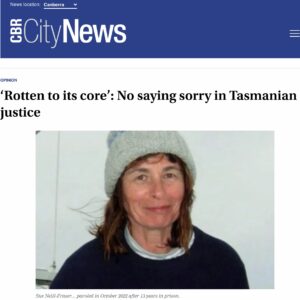
[see also my comment in WCR’s ‘Rotten to its core’: No saying sorry in Tasmanian justice
(https://wrongfulconvictionsreport.org/2026/01/30/rotten-to-its-core-no-saying-sorry-in-tasmanian-justice/). That comment raises the question of what happens after a CoI – does a review of the case against SNF by the Appeal Court occur? And would such a review be held along the lines of a first appeal … or require the ‘fresh and compelling’ criteria (as in 2nd/further appeals) to be met?
I note what you and Bill Jones in his comments here had to say and could not agree more. There are many cases like Sue Neill-Fraser for the crime of murder where evidence was lacking and police had Tunnel vision.
I think the Eastman case, in which he was convicted of murdering Assistant AFP Commissioner Winchester, is very much on point. Eastman had travelled the route of appeals all the way to the High Court. But it took a Judicial Inquiry which was investigatory rather than adversarial, to get his conviction quashed and a retrial ordered. It took 20 years to bring complete justice at a new trial which resulted in a not guilty verdict and compensation for Mr Eastman. That is a case which should be added to the list. The Judicial Commission, which was investigatory, had all the coercive powers and thus managed to uncover sufficient misconduct and non-disclosure to recommended that the conviction be quashed. That is precisely what is needed in Sue Neill-Fraser’s matter.
Susan Neill-Fraser is innocent. GUILTY are the police, the court and legal system of Tasmania. Be afraid if you live in Tasmania, be very afraid.
The Sue Neil Fraser case is in conflict with any just judicial process.
Those being police, prosecutors, members of the bench and politicians that have continually denied Sue Neil Fraser justice should be charged at best with wilful obstruction of a criminal matter and or giving false and misleading evidence in a criminal trial.
Hi Andrew
Perhaps this time an injustice can be rectified.
Once again thank you for the wrongful convictions report.
Take care
Rodger Warren
Parallels in Miscarriages of Justice: Comparing the Cases of Sue Neill-Fraser and Steven Fennell v The Queen
The Australian criminal justice system, while designed to uphold the principles of fairness and due process, has repeatedly demonstrated vulnerabilities that lead to wrongful convictions. Two prominent examples are the case of Sue Neill-Fraser, convicted in Tasmania for the 2009 murder of her partner Bob Chappell, and Steven Fennell v The Queen, where Fennell was convicted in Queensland for the 2012 murder of Liselotte Watson. Both cases exemplify systemic failures in police investigations, prosecutorial conduct, and evidence handling, resulting in prolonged suffering for the accused. Despite these striking similarities, a key difference lies in their outcomes: Fennell was acquitted by the High Court of Australia in 2019, while Neill-Fraser’s conviction persists, though she was paroled in 2022 after 13 years in prison. This essay explores these parallels, drawing on documented flaws in both cases to highlight broader issues in Australian jurisprudence, such as tunnel vision in investigations and institutional resistance to accountability.
Flawed Police Investigations and Evidence Mishandling
A core similarity between the Neill-Fraser and Fennell cases is the inadequacy of police investigations, characterized by incomplete evidence collection, overlooked alternatives, and procedural lapses that undermined the pursuit of truth.
In Neill-Fraser’s case, the Tasmania Police investigation into Chappell’s disappearance from their yacht, Four Winds, was marred by forensic oversights. For instance, a significant DNA sample belonging to Meaghan Vass, a homeless teenager, was found on the yacht’s deck, suggesting the presence of intruders, yet this was downplayed during the trial.
Additionally, items like a small blue towel near the DNA site were not properly documented in initial reports, and requests for independent testing have been repeatedly denied, raising suspicions of non-disclosure or manipulation. The Etter/Selby reports, tabled in the Tasmanian Legislative Council in 2025, argue that these gaps indicate a possible “fraud on the court,” including failures in accrediting forensic services to national standards.
Echoing these issues, Fennell’s case involved Queensland Police’s Operation Kilo Oceania, which relied on circumstantial evidence without thoroughly exploring exculpatory leads. Police alleged Fennell murdered Watson with a hammer to cover financial improprieties, but the High Court later found no credible evidence of motive, such as gambling debts or desperation.
Key oversights included unreconciled bank records and witness statements that required implausible timelines (e.g., implying “time travel” for consistency). Moreover, missing documentation, such as police diaries from encounters with witnesses mirrors the evidentiary gaps in Neill-Fraser.
Fennell’s police complaint, submitted in 2025, details these failures, including the acceptance of “necromantic” claims from Matheson, who alleged spiritual revelations of Fennell’s guilt without substantiation.
In both instances, the police exhibited “tunnel vision,” fixating on the accused while ignoring alternative suspects, boat thieves in Neill-Fraser and potential island intruders in Fennell, leading to convictions built on incomplete records.
Reliance on Circumstantial Evidence and Dubious Witness Testimony
Both cases hinged on circumstantial evidence, amplified by unreliable or manipulated witness accounts, which the prosecution used to construct narratives of guilt despite evidential weaknesses. Neill-Fraser’s conviction was entirely circumstantial: no body, no weapon, and no direct witnesses.
The prosecution speculated on her motive (e.g., financial gain) and opportunity, but overlooked Vass’s later admissions under oath that she and associates were on the yacht during the incident, potentially committing a burglary gone wrong. This testimony was mishandled, with allegations of police pressure on Vass to recant, contributing to what critics call one of Australia’s worst miscarriages of justice since Lindy Chamberlain.
Similarly, Fennell’s prosecution rested on circumstantial strands, including alleged post offense conduct and financial discrepancies, but the High Court deemed the verdict unreasonable due to insufficient proof beyond reasonable doubt.
Witnesses like the Mathesons provided inconsistent statements, with Bob Matheson’s “spiritual revelations” accepted as evidence despite their dubious nature, paralleling the “evidentiary necromancy” critiqued in Fennell’s post-acquittal complaints.
Prosecutorial tactics, such as introducing unredacted transcripts revealing Fennell’s prior convictions in violation of court orders, prejudiced the jury. In both cases, the defence highlighted perjury risks: Neill-Fraser supporters point to undisclosed associations with boat criminals, while Fennell has pursued CCC reviews for perjury by the Mathesons. These elements underscore how weak circumstantial cases, bolstered by questionable testimony, can lead to convictions when institutional biases prevail.
Institutional Resistance and Denial of Accountability
A further parallel is the post-conviction resistance from authorities, perpetuating injustice through bureaucratic stonewalling and reluctance to admit errors. In Neill-Fraser’s case, the Tasmanian Government has repeatedly rejected calls for a commission of inquiry, despite parliamentary motions and reports from experts like Etter and Selby highlighting nondisclosures and forensic accreditation failures. As of December 2025, the Legislative Council debate emphasized the “silence from the police and the ODPP,” with politicians like Michael Gaffney urging an “empowered inquisitorial inquiry” to address systemic flaws.
Fennell’s experience mirrors this, with Queensland authorities slow to acknowledge misconduct despite the High Court’s acquittal. His ongoing complaints to the Ethical Standards Command and Crime and Corruption Commission (CCC) about missing recordings and perjury have met with delays and refusals for interviews, as detailed in his correspondence. Even after acquittal, Fennell has faced barriers a pattern of institutional denial similar to Tasmania’s. Both cases reveal a broader Australian issue: oversight bodies like the CCC or Tasmanian equivalents often refer matters circularly, avoiding substantive reviews and exacerbating victims’ trauma, as seen in Fennell’s medical conditions (OCD and brain injury) necessitating closure.
The Stark Difference: Acquittal Versus Persistent Conviction
While the similarities in investigative and prosecutorial shortcomings are evident, a stark contrast is the judicial resolution. Fennell’s conviction was quashed by the High Court in 2019, which found the evidence incapable of supporting guilt, leading to an immediate acquittal and his release after almost 7 years days in prison. In contrast, Neill-Fraser remains convicted, with appeals exhausted and parole granted in 2022 not equating to exoneration. This disparity underscores jurisdictional differences: Queensland’s access to High Court scrutiny provided a pathway out, while Tasmania’s resistance to external review prolongs Neill-Fraser’s fight.
The cases of Sue Neill-Fraser and Steven Fennell illustrate how flawed police work, marked by evidence gaps, circumstantial overreliance, and dubious testimony, can lead to miscarriages of justice, compounded by institutional intransigence. These parallels highlight the need for reforms, such as mandatory forensic accreditation, independent oversight, and easier pathways for post-conviction reviews.
While Fennell’s acquittal offers hope, Neill-Fraser’s ongoing struggle serves as a cautionary tale, urging Australians to demand accountability to prevent future injustices.
Sources
• High Court of Australia. (2019). Fennell v The Queen [2019] HCA 37. Retrieved from and .
• ABC News. (2019). “Steven Fennell acquitted of elderly woman’s murder on Macleay Island in 2012.” Retrieved from .
• Wrongful Convictions Report. (2022-2025). Various articles on Sue Neill-Fraser case, including Etter/Selby reports.
• Neill-Fraser Support Group. (n.d.). “Miscarriage of Justice in Tasmania.” Retrieved
• Save Sue Campaign. (n.d.). Details on circumstantial evidence and DNA issues.
• Past conversations with Steven Fennell (2025-2026): Summaries from conversations September 1, 2025; October 22, 2025; December 29, 2025; January 20, 2026; and February 7, 2026, detailing Operation Kilo Oceania, witness issues, and post-acquittal complaints.
• The Senior. (2024). “Man acquitted of murder seeks $5.5 million from police.”
Anyone who has read the recently tabled paper of Barbara Etter APM and Hugh Selby can see that this whole saga is due to the police and prosecutors refusing to acknowledge their blatant shortcomings.
Exactly. Add to that the politicians …
I thank you from the bottom of my heart for having the courage to present this to parliament .. it has been known for such a long time that this is such a wrongful conviction but Tasmania is such an incestuous state when it comes to power and policing .. poorly handled and presented incorrect evidence with a shonky prosecutor and totally incompetent defence lawyer .. to add to it .. everyone and I mean everyone is fearful of the powers of police or even challenging them
Very well said Mike. Your comments are so rational and evidence based. Would that the Tasmanian justice system would take thoughtful note and stop their ridiculous defensiveness when they have made a dreadful mistake.
Biggsey. Sorry – but you need correction .
There was no mistake – there was no tunnel vision.
There was the usual wrongful conviction achieved by using Manockistic flexible forensics and jury fooling Tedeschism. Compounded with jury fooling gobbledygook and the scurelous intimidating of the poor young girl
Meagan Vass. She is very lucky she didn’t end on medication in Ashley Juvenile Rape Centre – Soviet Style.
Woops – fermenting apple Island style..
Innocent David Eastman did 19 years to cover the dear policemens murderous involvement in the mafia drug business – Sue Neill-Fraser was lucky
she only did 13 to cover for…?
Stinking Taspol and their rotten apple Island friends.