It was no doubt a shock to Tasmania’s legal establishment when one of its most senior judges delivered a dissenting opinion – not because of his dissent per se, but because he argued to uphold the appeal against the most controversial murder conviction in Tasmanian history – that of Sue Neill-Fraser, a conviction – then as now – protected by the police, prosecution and politicians. He defied the Tasmanian establishment … of which he is a member.
This month – January 26, 2026 to be precise – is the 17th anniversary of her partner Bob Chappell’s disappearance, which ultimately led to Sue Neill-Fraser’s conviction for his murder, notwithstanding the absence of direct evidence, a motive, Bob’s body and of a murder weapon.
“In my view, on an objective assessment of the record, and recognising the limitations in doing so, after taking into account the fresh and compelling evidence of Mr Jones [Max Jones of the Victorian forensic service], there is a significant possibility that the jury, acting reasonably, might have acquitted the appellant had the fresh evidence been before it at the trial. I would uphold the appeal and quash the appellant’s conviction for murder.” – Justice Estcourt’s dissenting opinion at Sue Neill-Fraser’s second appeal (November 2021), where the Meaghan Vass DNA was the central ground*, which Jones testified was most unlikely to have been a secondary transfer, as the prosecution wanted to argue. That anchored the DNA at the crime scene and with it, Vass’ presence. Vass, a homeless 14 year old at the time, wasn’t in the frame for the murder, but as a key witness to a fight she observed involving the victim, Bob Chappell. She admitted she had vomited on the deck of Four Winds, where the fight took place.
Point being, Vass was the last to see Bob Chappell alive – and Sue Neill-Fraser was not there. The murder charge against her is unfounded. That didn’t stop the prosecutor, then DPP Tim Ellis, speculating that she killed Bob with a wrench below deck. The judge, Blow J, allowed it …
*Other grounds for doubting the conviction include that impermissible speculation by the prosecutor and also judicial error, in what was an entirely circumstantial case. Indeed, Estcourt J is not alone in standing with Neill-Fraser and her claim of innocence. Many other lawyers – plus, notably, Flinders University legal academic Dr Bob Moles – have publicly questioned the validity of the verdict. The only ones defending it are those who prosecuted her: and they ‘would say that’.
Neill-Fraser served 13 years in prison and has been on parole since 2022. In December 2024, the Tasmanian Parole Board placed an additional condition on Sue Neill-Fraser’s parole which prohibited her from communicating “directly or indirectly with any media outlet to claim [her] alleged innocence and/or wrongful conviction”.
40,000 also stand with Sue Neill-Fraser
In May 2025, this condition was replaced with a draconian new condition which prohibits her from communicating “directly or indirectly – including through third parties, written statements, electronic communications, social media platforms, television, radio, podcasts, streaming services, online video-sharing platforms, or any other public or broadcast media – to assert claims regarding your alleged innocence, wrongful conviction, or dispute the legitimacy of your conviction or sentencing”. She doesn’t have to: plenty of us do it for her. The petition calling for an independent judicial review of her case has been signed by nearly 40,000 people (as at January 2026).
For further detailed information on the case, please see my book, The Exoneration Papers
Estcourt is no maverick, which makes his dissent significant. He didn’t dissent, for example, four years earlier at the dismissal of Marco Rusterholz’s appeal against his conviction for a double murder. Estcourt was one of the same three judges as at the Neill-Fraser appeal; he sat with Wood J and Pearce J. The Court’s core reasoning there was that although some parts of the circumstantial evidence might not on their own prove guilt beyond reasonable doubt, the totality of the evidence — especially alleged admissions the appellant was said to have made to others — left the convictions as “safe and reasonably open.” Readers might be concerned that “alleged admissions” prevented the appeal’s success. (More on the Rusterholz case can be found at the menu on the right.
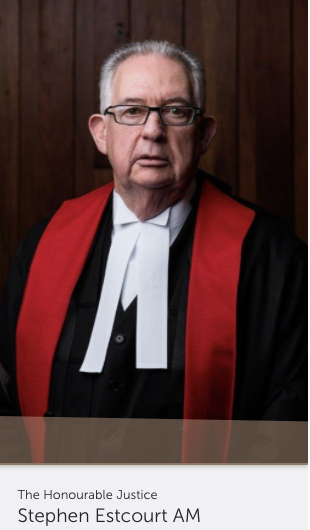
The public Escourt J:
Stephen Peter Estcourt AM was born on 20 March 1953 in Hobart, Tasmania. He grew up in the region, attending New Town High School followed by Elizabeth Matriculation College. Estcourt pursued higher education at the University of Tasmania, graduating with a Bachelor of Laws degree with Honours in 1974.
Estcourt began his legal career immediately after graduation, working as a barrister and solicitor with the firm Archer Bushby in Launceston from 1974 to 1989. In 1988, he served as President of the Law Society of Tasmania. He was appointed as a magistrate in 1989, sitting in Hobart until 1994. In 1994, Estcourt established the Resource Management and Planning Appeal Tribunal for the Tasmanian Government, serving as its inaugural chair until late 1995. He then resigned to join the Tasmanian Independent Bar in 1995.
In 1998, Estcourt was appointed Queen’s Counsel and practiced extensively in the civil and criminal jurisdictions of the Supreme Court of Tasmania, as well as in the Federal Court and High Court of Australia. He held several leadership roles, including President of the Tasmanian Independent Bar from 2003 to 2007 and President of the Australian Bar Association from 2006 to January 2008. From 2001 to 2004, he served as a part-time Deputy President of the Commonwealth Administrative Appeals Tribunal, handling cases nationwide, primarily on visa refusals and deportations, before resigning due to philosophical objections to the oversight practices of then-Attorney General Philip Ruddock. He signed the Victorian Bar Roll in September 2004 and became a Fellow of the Australian Academy of Law by the end of 2011.
Throughout his career at the bar, Estcourt maintained a strong pro bono ethic, particularly in human rights and immigration law, attracting national recognition. Notable cases included Commonwealth of Australia v Wood (2006), Sok v Minister for Immigration (2005), Minister for Immigration v X (2005), and QAAA v Minister for Immigration (2007). He acted as amicus curiae on behalf of the UNHCR in the High Court case Minister for Immigration v QAAH (2006). In 2009, he served pro bono as senior counsel in litigation against the Tasmanian Government regarding conditions in Risdon Prison’s Behavioural Management Unit. During his presidency of the Australian Bar Association, he publicly commented on the arrest and detention of Dr. Mohammed Haneef, criticizing the Immigration Minister’s visa cancellation. He also represented Tasmanian Deputy Premier Bryan Green in a criminal trial, leading to a successful defamation suit against the Hobart Mercury, which resulted in the largest defamation damages award in Tasmanian history at the time.
On 8 April 2013, Estcourt was appointed as a Puisne Judge of the Supreme Court of Tasmania. In November 2017, he was sworn in as one of the Administrators of the Government of Tasmania. In 2022, he was appointed as a Judge of the Court of Appeal of the Kingdom of Tonga, where he heard appeals related to the 2021 Tongan general election. As a judge, Estcourt has contributed to legal scholarship, authoring the book From Convicts to Computers: Two Hundred Years of the Tasmanian Supreme Court*, published in 2024 to coincide with the court’s bicentennial. The book provides a comprehensive history of the court, its judges, and its evolution.
One of Estcourt’s notable judicial contributions was his dissenting opinion in the high-profile appeal of Neill-Fraser v Tasmania [2021] TASCCA 12. Neill-Fraser appealed her 2010 conviction for the murder of her partner, Robert Adrian Chappell, on the basis of fresh and compelling evidence under s 402A of the Criminal Code Act 1924 (Tas). The appeal cantered on new expert evidence from forensic scientist Maxwell Jones regarding the DNA of Meaghan Vass found on the yacht Four Winds, arguing that secondary transfer (e.g., via a shoe sole) was highly improbable and rare, favouring direct deposit by Vass around the time of the murder. The majority (Wood J and Pearce J) dismissed the appeal, finding the evidence neither fresh (as they thought – irrationally according to Dr Bob Moles – it could have been obtained with reasonable diligence at trial) nor compelling, lacking sufficient probative value to undermine the circumstantial case against Neill-Fraser. They concluded there was no substantial miscarriage of justice, as the evidence did not create a significant possibility of acquittal.
In dissent, Estcourt J found the evidence fresh, noting that key documents like the electropherogram (indicating a strong DNA profile from a large quantity of bodily fluid, inconsistent with secondary transfer) were not disclosed until 2014, and the prosecution breached disclosure duties regarding trial expert Carl Grosser’s opinions on secondary transfer. He deemed the evidence compelling—reliable, substantial, and highly probative—as it highlighted the rarity of secondary transfer under specific conditions (e.g., stepping in moist fluid shortly before, with moisture and friction on the deck), undermining the Crown’s speculative closing arguments and supporting the defence assertion of Vass’s presence and potential involvement (e.g., boarding via a dinghy). Estcourt J concluded this demonstrated a substantial miscarriage of justice, with a significant possibility that a jury, armed with this evidence, would acquit.
In recognition of his contributions, Estcourt was appointed a Member of the Order of Australia (AM) in the 2018 Queen’s Birthday Honours for significant service to the judiciary, legal education, and professional law societies. On a personal note, Estcourt married Mary McDevitt in 1976. He has been active in community initiatives, co-organizing the multicultural festival World Party Tasmania in 2010 and 2012, for which he was named a Tasmanian State Finalist for Australian of the Year in 2011. As of 2026, he continues to serve on the Supreme Court of Tasmania.
*From Convicts to Computers: Two Hundred Years of the Tasmanian Supreme Court is a comprehensive historical account authored by Justice Estcourt AM.
Published by Forty South Publishing in May 2024 (ISBN: 9780645864717), the hardcover book spans xvii + 366 pages and includes portraits of judges and other illustrations. It was officially launched on 10 May 2024 during a ceremonial sitting marking the exact bicentenary of the Supreme Court of Tasmania—the oldest supreme court in Australia, established in 1824.
The book traces the court’s evolution from its colonial origins in the convict era, through significant developments in the 19th and 20th centuries, to its modern operations in the digital age. Written by an insider with deep institutional knowledge, it covers the court’s judges, landmark cases, architectural history, procedural changes, and broader role in upholding the rule of law in Tasmanian society. Reviews describe it as thorough, readable, and engaging, filling a notable gap in consolidated histories of the court.
The book is available for purchase through retailers such as Forty South Publishing’s online shop and independent Tasmanian bookstores.
I am shocked by the actions of Tasmania Police, The Director of Public Prosecutions and judges. The System is corrupt. Decisions are made on fantasy, not facts. There needs to be a purging of the whole System, which, of course , will never happen as they belong to the same social class which protects its own .
We need to have a cull of lawyers in this country.
Justice Estcourt’s dissenting opinion in Sue Neill-Fraser’s 2021 appeal represents a courageous stand against a deeply flawed conviction that has haunted Tasmania’s justice system for over 15 years.
In a case built entirely on circumstantial evidence, lacking a body, murder weapon, motive, or direct proof, his judgment highlights a significant possibility that a reasonable jury might have acquitted Neill-Fraser.
Indeed I strongly posit reasonable jury might have acquitted Neill-Fraser if presented with fresh forensic insights. Central to this is the DNA evidence of Meaghan Vass, a vulnerable homeless teenager at the time of Bob Chappell’s disappearance on January 26, 2009.
The document correctly notes Vass was just 14, though most reliable sources confirm she was 15 and homeless when her DNA was found on the yacht Four Winds. This minor discrepancy does not diminish the core injustice: a child in a precarious situation became entangled in one of Tasmania’s most controversial murder prosecutions.
Vass admitted to vomiting on the deck after witnessing events involving Chappell, placing her as potentially the last person to see him alive. Yet the prosecution dismissed her presence, insisting the DNA resulted from improbable secondary transfer (e.g., via a shoe sole), a theory undermined by expert Maxwell Jones’s testimony that such transfer was highly unlikely given the quantity and nature of the biological material.
Estcourt J rightly emphasized this as fresh and compelling evidence. Key documents, like the electropherogram showing a strong DNA profile from bodily fluid, were not fully disclosed until years later, breaching prosecutorial duties.
He argued this evidence anchored Vass’s direct presence on the yacht around the time of the crime, severely weakening the Crown’s speculative narrative against Neill-Fraser. The majority’s dismissal ignored these realities, preserving a conviction many view as unsafe. Juries lean towards conviction as the thinking is it’s better to keep someone locked up that could have done it when the legal position is the exact opposite.
What makes this particularly disturbing is how Vass, a vulnerable 14/15-year-old, was treated. Reports from the case and subsequent appeals describe her as harassed, hounded, and threatened by authorities to align her story with the prosecution’s preferred version. She initially denied being on the boat, then recanted aspects under pressure, and faced ongoing intimidation.
A child homeless, impressionable, and without adequate support was subjected to police tactics that prioritized securing a conviction over truth-seeking. This raises serious questions about investigative integrity and the protection of young witnesses in high-profile cases.
Estcourt’s dissent is all the more powerful because he is no outsider. A respected Tasmanian judge with a distinguished career, spanning barrister, QC, magistrate, and Supreme Court appointee.
He has a track record of principled rulings, including pro bono human rights work. His willingness to challenge the establishment, despite being part of it, underscores the conviction’s weaknesses. Supported by experts like Dr. Bob Moles and nearly 40,000 petition signatories calling for review, it exposes how institutional pressure can override justice.
Sue Neill-Fraser served 13 years before parole, yet faces draconian gag conditions silencing her innocence claims. Vass’s ordeal amplifies the miscarriage: a teenager’s life disrupted by aggressive policing in service of a questionable case. Estcourt’s opinion demands we confront this. Upholding such a conviction, when fresh evidence points to reasonable doubt, erodes public trust. Tasmania must pursue an independent review to restore faith in its justice system. A vulnerable girl’s harassment should never prop up an unsafe verdict.
The Tasmanian legal establishment is fully complicit in this miscarriage of justice, and they all know it. I hope they can’t sleep at night.
Bravo Justice Estcourt.