The late jurist Lionel Murphy (1922 – 1986) wrote a prescient dissenting view when the High Court rejected Lindy Chamberlain’s 1984 appeal, where Murphy was outvoted 3-2. It is essential reading even now. Murphy’s summary turned out to be 100% right.
We publish this historic (and historical) dissent in the immediate wake of recent discussions about juries & judges, and the ongoing relevance of the workings of the appeal system. It contains several references of great ongoing relevance today – lessons that should have been learnt, especially regarding the presumption of innocence and forensic evidence.
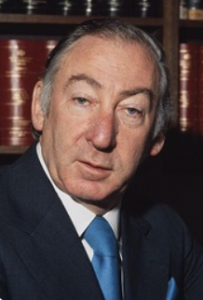
Lionel Murphy (Wikipedia)
Murphy J.
Mrs. Chamberlain was convicted in the Northern Territory Supreme Court of murdering her nine-week-old baby by cutting her throat at Ayers Rock on 17 August 1980 and sentenced to life imprisonment. Her husband Mr. Chamberlain was convicted of being an accessory after the fact and sentenced to eighteen months’ imprisonment, which was suspended on his entering into a good behaviour bond.
Jury System. The jury is a strong antidote to the elitist tendencies of the legal system. It is “the means by which the people participate in the administration of justice” (Jackson v. The Queen [1976] HCA 16). The greatest respect should be given by appeal courts to jury verdicts and any attempt to downgrade the jury to a mere nominal or symbolic role should be restricted. However, inevitably, juries sometimes make mistakes. History demonstrates that in Australia as elsewhere, despite the protection of the jury system and other safeguards, sometimes the innocent are convicted. Because of such miscarriages courts of criminal appeal have been given power to set aside convictions, not only where the judge wrongly admitted or rejected evidence, or misdirected the jury, but also where although there was evidence which could justify the verdict, the appeal court considered it unsafe. The appellate system thus operates as a further safeguard against mistaken conviction of the innocent.
Federal Court’s Appellate Powers. The Federal Court of Australia Act 1976 enables the Federal Court to set aside a verdict if it concludes that it is unsafe and unsatisfactory for any reason, for example, prejudicial pre-trial publicity or misconduct of the trial judge or prosecution. The power is available even if there was enough evidence to convict, if the appeal court thinks that there are features of the case which make the verdict unsafe or unsatisfactory. In this regard I agree with the reasons of the Chief Justice and Mason J. Duff v. The Queen [1979] FCA 83 represents a too narrow view of the Federal Court’s appellate power and should be overruled.
Presumption of Innocence . Our criminal system presumes every person to be innocent. This fundamental assumption is accompanied by the rule that the prosecution must prove guilt beyond any reasonable doubt. An accused person “is entitled to the benefit of every reasonable doubt that is raised in the case” (Reg. v. Phillips (1868) 8 SCR (NSW) 54). Nevertheless, even in the course of this appeal the presumption of innocence often seemed to have been forgotten. Instead, in examining the evidence, there was a tendency to apply a presumption of guilt, as if Mr. and Mrs. Chamberlain were required to prove their innocence.
Proof of Crucial Elements. I agree that requirement of proof beyond reasonable doubt means that any fact should not be accepted for the purpose of inferring guilt unless, in the light of all the evidence, existence of that fact is established beyond reasonable doubt. Every crucial element must be proved beyond reasonable doubt.
Circumstantial Evidence. The case against Mrs. Chamberlain was based on circumstantial evidence. For a conviction to stand, where the evidence of guilt is circumstantial, that evidence must be so cogent and compelling that it convinces the jury that no rational hypothesis other than the accused’s guilt can account for the facts (Reg. v. Onufrejczyk (1955) 1 QB 388; Peacock v. The King [1911] HCA 66. Because of the absence of a body, and of any motive, and of any identified weapon, and of any confession, and because of the good characters of the accused, rigorous proof of guilt was required.
The Crown Case. The Crown charged a murder committed in a most gruesome manner, within an extremely limited time and in difficult circumstances where the chances of discovery were high. During a period of between five and ten minutes Mrs. Chamberlain is alleged to have gone with Azaria and her son Aiden from the barbecue area to their tent some 20-30 metres away; donned tracksuit pants over her dress; taken Azaria from the tent to the family car which was parked alongside; slit Azaria’s throat with a sharp instrument (possibly scissors) while sitting in the front passenger seat of the car; hidden the body (possibly in a camera bag in the car); returned to the tent with blood on her hands and the tracksuit pants; removed the tracksuit pants and washed her hands in an icecream container; and returned, quite composed, to the barbecue area with Aiden.
In view of the Crown’s claim that a great deal of blood was shed in the car during the killing, Mrs. Chamberlain must also have managed to clean up at least the obvious signs of blood in the car during this period. The registered nurse who travelled in the car later in the evening did not notice any blood. Mrs. Chamberlain also found time during these few minutes to put Aiden to bed in his sleeping-bag, hear him complain he was still hungry and to collect a can of baked beans from the car. Aiden, almost seven years old, appears to have been awake throughout this period, apparently remaining in the tent until he returned with Mrs. Chamberlain to the barbecue area. Despite the somewhat bizarre goings-on that he would therefore have been likely to witness (assuming the Crown’s theory to be valid) it is reported that on the night of Azaria’s disappearance he told one witness (Mrs. Lowe) that “the dog had got his baby in its tummy” and when asked by another witness (Mrs. West) if the dingo had taken the baby, he answered that it had.
It is also important to examine the circumstances surrounding the evidence of the baby crying. At the trial, Mrs. Lowe stated that, after Aiden and Mrs. Chamberlain had returned from their tent, she (Mrs. Lowe) had heard the baby cry “but not being my child I didn’t sort of say anything. Aiden (Chamberlain) said: ‘I think that’s bubbie crying’ or something similar. Mike (Chamberlain) said to Lindy (Chamberlain): ‘Yes, that was the baby, you better go and check.’ Lindy went immediately to check”. The Crown has not alleged that Mr. Chamberlain was an accessory before the fact and it is clear that if Mrs. Chamberlain had committed the murder, she would not yet have had a chance to tell him. So three people, none of whom on the Crown’s hypothesis was yet a party to the alleged crime, and one of whom was an entirely independent witness who had only met the Chamberlains that night, heard the baby cry after it is said to have been dead. Mrs. Chamberlain, the alleged murderer, did not. Mrs. Chamberlain did however act as a result of the advice of the others and that was when the baby’s disappearance became known.
If Mrs. Chamberlain had been the one to hear the cry, especially if no one else had heard it, it might have given some colour to the Crown case, since it could be seen to be a preparation for a staged “discovery” of the missing baby. What in fact happened could not have been part of a plan, however, and it would certainly have been risky for a murderer to pursue a course which involved the remote chance that someone else would hear a noise that could be attributed to the murdered baby before the dingo’s involvement could be asserted.
Unsatisfactory Features of the Crown Case. The evidence has been dealt with comprehensively in the judgment of the Chief Justice and Mason J. and there is no need to go over it at any length. However it is essential to a proper understanding to note seven vital elements: 1. the complete absence of any motive for Mrs. Chamberlain to have killed her baby; 2. the fact that Azaria’s body has never been found; 3. the absence of any identified murder weapon; 4. the fact that there have been no admissions of guilt from either applicant; 5. that the murder by a mother of her baby is quite contrary to nature and requires some explanation; it sometimes occurs when a mother’s mind is disturbed or she is suffering post-natal depression but the evidence is that Mrs. Chamberlain was not; 6. the extremely limited opportunity Mrs. Chamberlain had to commit the crime or, if a credible witness is believed, the fact that she had no opportunity to commit the crime; and 7. the undisputed fact that both Mr. and Mrs. Chamberlain are of good character.
Absence of Motive. The Crown is not required to prove a motive but its absence in conjunction with all the other elements, is disquieting in the extreme.
Absence of a Body. There seems no doubt, despite the absence of a body, that Azaria died on the night of her disappearance. However, the body’s absence means that additional caution must be exercised. We are left only with circumstantial evidence concerning the death.
Good Character. Evidence of good character is clearly a powerful factor in rebuttal of evidence of guilt. It has been held to be “relevant to the question of (being) guilty or not guilty: the object of laying it before the jury is to induce them to believe, from the improbability that a person of good character should have conducted himself as alleged, that there is some mistake or misrepresentation in the evidence on the part of the prosecution, and it is strictly evidence in the case” (R. v. Stannard [1837] EngR 476. “The fact that a man has an unblemished reputation leads to the presumption that he is incapable of committing the crime for which he is being tried” (see Reg. v. Rowton [1865] EngR 53; see also Attwood v. The Queen [1960] HCA 15; Reg. v. Stalder(1981) 2 NSWLR 9.
Hypothesis of Innocence. The hypothesis advanced by the defence was that the baby was taken by a dog or dingo and it was conceded by the Crown during this appeal that a dingo could have carried the baby away. This was supported by evidence that dingoes were frequently in the camp area and had attacked children and objects including a pillow and a sleeping bag. A dingo had been seen in the area of the camp earlier in the evening, growling was heard by a number of witnesses just prior to Mrs. Chamberlain raising the alarm and dog or dingo tracks were observed near the camp site later in the evening and the following day were seen at the front of the tent and “right on the edge” of the tent corner where Azaria’s bassinet had been. Several witnesses, including Mr. Roff the Senior Ranger, reported seeing tracks in the nearby area on the night of the disappearance, which indicated that something, resembling the pattern of a crepe bandage according to Mr. Roff and the imprint of a knitted jumper of woven fabric according to another witness, had been carried by a dog. Nothing else was reported to have disappeared from the camp on that night. These drag marks were backtracked to a point directly opposite the Chamberlains’ tent and about 25 yards from it. In view of all the other evidence concerning dog or dingo activity, the fact that the dog or dingo must have started its journey somewhere and the fact that what was being carried must have come from nearby, it is strikingly consistent with the hypothesis of innocence that the dog tracks and drag marks commenced at the Chamberlains’ tent but were no longer visible because they had been obscured by the many searchers who were combing the area in an attempt to find Azaria.
In his directions to the jury, Muirhead A.C.J. of the Supreme Court of the Northern Territory said: “I merely suggest . . . that the evidence merits a finding that on the night of 17 August dingoes did prowl in that area. That they were properly regarded by those, such as Derrick Roff, who had responsibility, as a potential danger, and that they had the strength and capacity to take and carry or drag away, a nine-week-old baby.”
If Mrs. Lowe’s evidence is correct that, while at the barbecue site, she heard the cry of a baby come from the Chamberlains’ tent, after the alleged murder had, on the Crown’s view, occurred, the only correct conclusion is that the Chamberlains are innocent.
The Crown’s “Scientific” Evidence. Failure to preserve the vital evidence of the blood samples from the car prejudiced the defence’s right to have them cross-checked. In the United States it has been held that the “government is flirting with the danger of reversal any time evidence is lost or inadvertently destroyed. When evidence is seized, the government should take every reasonable precaution to preserve it” (United States v. Heiden [1974] USCA9 575). Federal investigatory agencies have been required to “promulgate and rigorously enforce rules designed to preserve all discoverable evidence” (United States v. Bryant [1971] USCADC 273). Breach of the rules will normally result in a violation of due process and suppression of the witnesses’ testimony or setting aside of the verdict (People v. Hitch (1974) 117 Cal Rptr 9). The burden of proof is on the government to prove compliance (United States v. Bryant [1970] USCADC 420; see also “The Right to Independent Testing: A New Hitch in the Preservation of Evidence Doctrine”, Columbia Law Review, vol. 75 (1975); “Criminal Procedure: Government has Duty to Implement Effective Guidelines to Preserve Discoverable Evidence”, (1971) Duke Law Journal p. 644). In 1974 the National Forensic Institute Committee of Enquiry recommended the establishment of a national forensic institute to overcome such problems (National Forensic Institute Report of the Committee of Enquiry (1974) Parliamentary Paper No. 58). In 1983 the National Pathology Accreditation Advisory Council in a paper entitled Retention of Laboratory Records and Diagnostic Material recommended certain minimum standards in relation to the retention of diagnostic material. These did not relate to the specific evidential needs of the legal system although the Council stated: “Much longer retention times may be desired and maintained by individual laboratories and practitioners to meet their particular requirements.”
Destruction of such materials reduces the value of any evidence based on them , because of the inability to test the material and cross-check the results, to such an extent as to render it non-scientific and therefore non-expert. “. . . (A) scientific observation is not taken at face value until several scientists have repeated the observation independently and have reported the same thing. That is also a major reason why one-time, unrepeatable events normally cannot be science” (P.B. Weisz, Elements of Biology (1961).
I agree for the reasons stated by the Chief Justice and Mason J. that a finding could not safely be made that the blood in the car was foetal.
Other Scientific Evidence. Professor James Cameron claimed that he was able to discern the outline of a small adult hand from the pattern of blood-stains on the baby’s jumpsuit. If accepted this was powerful support for the Crown case. Dr. Jones and Dr. Scott, who were the first such experts to view the jumpsuit did not see this print. Dr. Plueckhahn, despite use of a high contrast ultraviolet flourescent photograph, was also unable to discern such a print. This Court viewed the jumpsuit and the photographs. The jury should have been directed that this evidence was not “scientific” but highly imaginative and directed to disregard it.
Professor Cameron also claimed that the blood on the jumpsuit was consistent only with a cut wound to the throat. Later he qualified this absolute view but still maintained that a cut throat would have been the “principal injury”. Dr. Plueckhahn expressly disagreed and said the bleeding could have come from head injuries consistent with a dingo grasping the baby’s skull in its jaws.
Professor Cameron was cross-examined on a recent case in England described as “the Confait Case” where his evidence, devastating against the defendants and resulting in their conviction, was found to be entirely mistaken . He agreed in cross-examination that he had then given evidence without “correct knowledge of all the attendant circumstances”. The accused in that case were, after judicial enquiry, awarded £60,000 in compensation for their wrongful imprisonment. This illustrates that it is dangerous to convict on “expert” evidence which is inconsistent with otherwise credible evidence of what witnesses saw or heard.
Judge’s Directions to the Jury. Muirhead A.C.J.’s summing up to the jury was undoubtedly on the whole favourable to the accused. However the above view that a majority of this Court has formed concerning the blood in the car raises a further central issue concerning the summing up. Muirhead A.C.J. told the jury that it was entirely for them to decide which of the expert opinions they should accept, on the presence of the foetal blood. He directed them that they could act “completely on her (Mrs. Kuhl’s) evidence, if the other evidence leaves you to have no reasonable doubt as to its validity”. In the circumstances of this case that was a misdirection. Eminent experts had raised serious and not satisfactorily answered objections to Mrs. Kuhl’s evidence on foetal blood. The judge’s directions invited the jury to undertake an unsafe and dangerous assessment. The foetal blood was the hinge of the Crown’s theory that the baby was murdered in the family car.
In these circumstances it is not good enough to take the view that this evidence of foetal blood can be set aside, and to look at the rest of the evidence to see if the verdict can be sustained. If that is done the reasoning runs like this. Because of the verdict the jury must have disbelieved not only Mrs. Chamberlain and Mr. Chamberlain but also Mrs. Lowe and the others at the barbecue site, and rejected other evidence which might have raised a reasonable doubt. They therefore rejected the dog or dingo hypothesis leaving murder as the only possibility; therefore the verdict can stand. The error in this approach is that the jury’s view of the exculpatory evidence may well have been taken in the light of their acceptance of the scientific evidence as reliable, an acceptance contributed to by the trial judge’s summing up. Likewise with other adverse conclusions, and the finding of guilt itself. If in accordance with the directions, the jury accepted the evidence that the blood was foetal, it was irresistible that they should then disbelieve Mrs. Chamberlain and the other evidence pointing to her innocence. The problem is analogous to that where a conviction is challenged because powerful inadmissible evidence was admitted. It becomes impossible to know whether the inadmissible evidence was relied on and the extent to which it coloured the jury’s views on other issues. Once it is accepted that it was unsafe to conclude that there was foetal blood in the car then the conviction of Mrs. Chamberlain was unsafe. The Crown contends that the jury were entitled to take a view of the whole of the evidence which would justify a conviction, even if the blood were not accepted as foetal. As I understand it, the Chief Justice and Mason J. accept that contention and as a result would disallow the appeal. In my opinion that is not the correct test.
The real question is whether the jury might have arrived at its verdict against the accused because they accepted the evidence that the blood was foetal, and whether had they been directed otherwise the result may well have been different. Having arrived at the conclusion that it was unsafe for the jury to accept the evidence that the blood was foetal the verdict should be set aside unless the jury would inevitably have reached the same verdict if they had been directed that the evidence that there was foetal blood was unsafe. As there is no proper basis for concluding that the jury would have reached the same verdict, the conviction should be set aside. Not only for that reason, but because I am of the firm view that the rational hypothesis advanced by the defence was not excluded beyond reasonable doubt and that the presumption of innocence was not displaced, Mrs. Chamberlain is entitled to a judgment of acquittal.
Mr. Chamberlain. If Mrs. Chamberlain is acquitted, Mr. Chamberlain must also be. If her conviction stands it does not follow automatically that he is guilty. I have already referred to the presumption of innocence generally. Mr. Chamberlain was entitled to the presumption of innocence, even if he was in the company of a person who is proved to have committed a crime to which he is charged as accessory. It is not enough to brush his case aside on the basis that if she is guilty, he must also be guilty. On the evidence the presumption of his innocence was not displaced. He should have been acquitted (see Andrews v. The Queen [1968] HCA 84; Reid v. The Queen (1980) AC 343.
In each case special leave to appeal should be granted, the appeal allowed, the conviction set aside and judgment of acquittal entered.
With thanks to reader Peter Gill for drawing this to our attention.
Background: Lindy Chamberlain was convicted of murder on October 29, 1982; her appeals to the Federal Court and High Court were both dismissed. In February, 1986, after the discovery of a baby’s matinee jacket (on which her defence relied but which the police believed did not exist) partially buried in an isolated location, she was released. A year later her conviction was quashed. In 1992 the Australian Government paid her $1.3 million in compensation. In 2012, the fourth coronial inquest found that Azaria had died as a result of being attacked and taken by a dingo. Coroner Elizabeth Morris apologised to the Chamberlain family while an amended death certificate was immediately made available to them.
After what I went through myself , I realized that Lindy was yet another victim of police and DPP corruption. Surely it’s corrupt to tamper with evidence when there is no other explanation. Lindy on TV was a much maligned character. A woman I thought to be intelligent once said. “ Lindy looks weird ,, I think she’s guilty!
Now there’s some evidence ?????????? Frightening to think that woman could be on a jury. Heaven help us.
MAY IT BE THAT SOME ATTORNEYS GENERAL DECIDE PETITIONS FOR JUDICIAL REVIEW OF CONVICTIONS FOR SEXUAL ASSAULT BY REFERENCE TO POTENTIAL POLITICAL DAMAGE RATHER THAN BY REFERENCE TO JUDICIAL PRINCIPLES
A legally drafted and compelling petition for judicial review of convictions for sexual assault sat in the then NSW Attorney General’s department for over two years and was then rejected without any reasons being given for that decision.
The Crown Solicitor had been permitted to lodge a response to the petition but the then Attorney General inexplicably refused to provide a copy of that response to the solicitor for the petitioner.
This whole process constituted a denial of natural justice and one is left wondering whether the decision to reject the petition was tainted by political considerations.
Andrew . As the old folk say- you never can tell – here we have Andrew showing due respect for a lefty ! Many non police brain citizens were fully aware that the screen play was a classic Tedeschism. Almost identical to the revolting display used on our Sue Neill-Fraser. Jury fooling blood in the dinghy and car already. The juries didn’t make a mistake- the disappeared flexable forensics- straight from the police prosecutors book of deceptive practice.
What kind of creature would pursue a young mother whose baby was eaten by a dog ? A bloody opportunistic prik ? Flying out from London the well known – to some – flexable forensicer. Do we have forensics for you ? Annoying to read that the juries made a mistake – no they didnt ! If a Jury is fooled by a professional- were was the judge ? How could the police prosecutors be allowed to just lose critical evidence ? The blue cloth with Vass DNA – the samples of baby blood in the Holden.
Are juries ever warned that the police prosecutors are often both scurrilous and mendacious ? Dirty rotten swine…Lionel Murphy was a decent man with an interlect – very scarce in our – do you over system..As is well known – Michael Chamberlain never received a genuine apology – Those police brain mongrels never apologise- even for hanging innocent Ray Bailey – the poor little feller..the mongrels got him- and I dont mean the dingoes..did the reader know that “ordinary” French Police rounded up 3000 French children- loaded them into cattle wagons to the extermination camps..? A hot shot Queensland policeman wrote out a confession for innocent Ray Bailey to be hung by a South Australian judge…Innocent Darryl Beamish was sentenced to death by a West Australian Judge using a confession written by a hot shot WA policemen- let’s see a reader contest a ludicrous traffic ticket – out comes the book of practiced lies
.
I first learned of the Chamberlain case when I was fresh out of high school, and I still remember the notion—shared by my mother and almost everyone around me—that Lindy was guilty. Reading the dissenting perspective all these years later leaves me cold.
What happened went far beyond a tragic accident and a police investigation that suffered from tunnel vision. The prosecution was relentless, the defence was woefully inadequate, and the media’s role was nothing short of disgraceful. From memory, sections of the press were vicious in their portrayal of Lindy, Michael, and their family—peddling cruel, baseless assertions designed to whip the public into a frenzy of hatred. Sensationalism sold papers and filled broadcasts, and an innocent woman’s life was destroyed in the process.
The media never apologised. Not then, and rarely since. They moved on to the next outrage, leaving shattered lives in their wake. Of recent times Louise Milligan comes to mind.
The Chamberlain case remains one of the clearest examples of how the pursuit of clicks and circulation can become an enemy of truth and justice.
After four decades, trust in such reckless reporting has rightly eroded. A sincere correction—and an honest reckoning with the damage done—is long overdue.
People believe the most lurid stuff—-same with the Kathleen Folbigg business. Setting aside whether or not it is true—-I think there should be special leniency for things women are purported to have done around the time of giving birth. Can we also stop a moment to think of Keli Lane, still in gaol because it looked like she may have solved a personal catastrophic situation in a way unacceptable to our patriarchal system. The parole board uses the excuse of the “no body—->no parole” law to keep her inside, although they could ignore this law if they felt inclined. Couldn’t the legal system also allow a “not proven “ verdict?
An excellent reminder of the crown pursuing a scenario which is contrary to reason or commonsense. For Ms Chamberlain to complete the tasks alleged in the few minutes available – and then to allege she arrived back with the others cool, calm and collected after committing such a heinous crime is contrary to any sound psychological and physical analysis. The modern equivalent of ‘burning witches’!